



Hi friends,
Quick update on our upcoming Gel conference (Fri-Sat, Oct 2-3, 2026 in upstate New York): I’m excited to announce that we just confirmed Jess Elefante as a speaker. She was featured in a recent 60 Minutes Australia segment on screen addiction, kids, and digital dementia. If you haven’t signed up for Gel yet, please do so as the hotels are booking up for that busy season in the Catskills.
Now, on to today’s essay. -mark
State Farm is a 104-year-old insurance company known, in part, for its commitment to local, person-to-person service. But like so many other companies, State Farm recently announced a new, company-wide embrace of AI. “Next Gen Good Neighbor” is the name of the AI initiative that has customers chatting with bots while (human) insurance agents face new sales targets.
Over a thousand customers and agents vented their frustration to the Wall Street Journal, which published a summary of their responses (July 8, 2026). Customers, in particular, were not happy:
Chatbots and other automated systems are a pain to deal with, judging by the 900 or so customers who responded to the Journal: “terrible,” “infuriating” and “it sucks” were common descriptions. . . .
“The reason we’ve stuck with State Farm is the great service by the local agent,” said Joe Sonk of Moorestown, N.J. “I don’t have to spend 10 minutes shouting ‘representative’ into the phone.”
Anyone who has dealt with automated customer service can probably attest to the “terrible” and “infuriating” nature of the experience. Whether it’s a chirpy AI voice on a 1-800 phone number, or a chat window on a web page, it’s beyond annoying to have to describe your problem to a disembodied algorithm. My own refrain is “get human, get human, get human” until the AI relents or I get tired and hang up.
I’m not alone. Futurism points out a recent report that found that –
more than half of Americans admitted to actively trying to circumvent a chatbot, with 43.9 percent of those resorting to yelling “human” or “person” when trying to get off the line with an AI agent on the phone. Meanwhile, 17 percent went as far as to “resort to profanity to break free.”
Why, then, would a 104-year-old company known for its customer service intentionally degrade the experience with AI chatbots? The obvious answer is the promise of cost savings, though that only makes sense if customers are still around after the AI policy takes effect. If customers abandon the company, what does it matter if labor costs decreased?
In addition to perceived financial benefits, I suspect there’s also a pressure on senior leadership to “keep up with the times.” It brings to mind this recent comic by Aram J. French at Mandatory Roller Coaster:
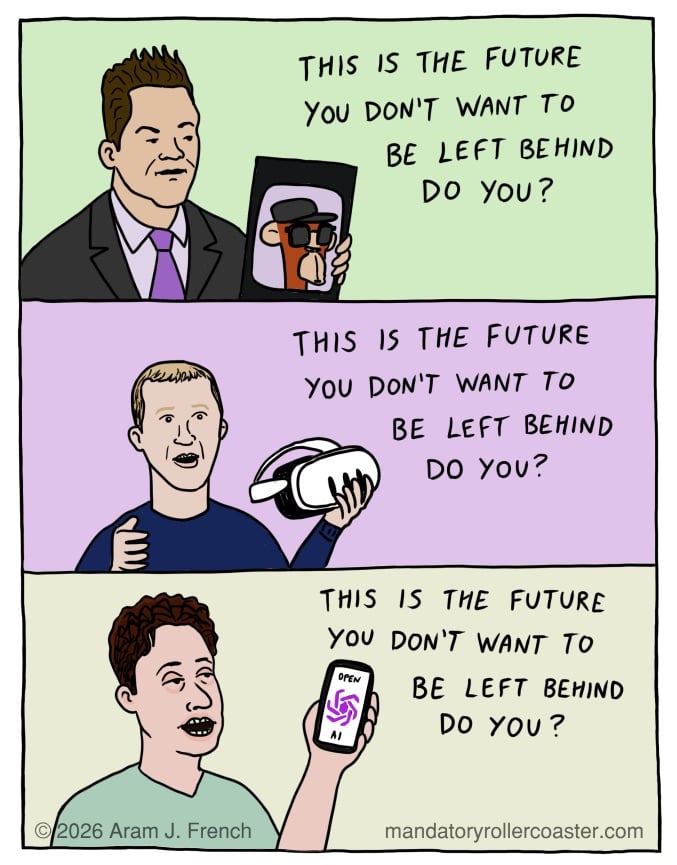
“This is the future – you don’t want to be left behind, do you?” ask three tech bros holding (in sequence) a screen showing a BoredApe NFT, a Facebook metaverse headset, and a phone showing the OpenAI logo.
The comic is reminding us that AI is just the latest overhyped trend from Silicon Valley. Just a few years ago, Web 3.0 – with its blockchain, crypto currencies, and NFTs – was supposed to revolutionize everything. It didn’t. (NFTs were a particularly stupid idea, something I warned about early on, in 2021, in this column.)
Then it was the “metaverse.” Mark Zuckerberg was so sure this was the future that he renamed his company after the idea, all while setting fire to tens of billions of dollars. How many people do you know today who spend time in the metaverse?
Now all we hear, day after day, is that AI is going to revolutionize everything. And anyone who sits this one out is going to regret it. Business executives, like those at State Farm, must see this as an existential crisis: resisting the inexorable advance of AI, even a little bit, could cost your career.
And so companies embrace AI, even when customers say they hate it, even when the company’s own staff members don’t want it. This is the future, and we just can’t be left behind.
I’ll add the necessary caveat that AI is not a dead-on-arrival fad like NFTs and the metaverse. After all, AI – a term that can mean lots of things – has some valuable applications, in the same way that I’d say “computational statistics” can do helpful things. The problem with AI isn’t the concept of linear algebra, it’s the insanely overpromised, overvalued, and overbuilt collection of systems that has inflated a giant bubble, threatened communities and ecosystems, and enriched the worst people in the world.
As I wrote recently:
Silicon Valley today is not oriented toward better outcomes for people like you and me – that is, non-oligarchs. Everything is built for extraction, as Tim Wu says, benefiting the ultra-wealthy and further concentrating their power.
Maybe I shouldn’t be too hard on State Farm, as the company is only following what the tech industry – and thus the rest of the economy – is doing, descending into the AI cult and hoping beyond hope that it will all somehow work out.
But it won’t, not on our present trajectory. Just look at the plague of Big Tech data centers across the country – guzzling water, tapping out the electrical grid, and polluting the air – all to prop up the oligarchs’ sludge empires. The Financial Times reports that “Mark Zuckerberg’s Meta alone is planning to fund 10 gas power plants across Louisiana” for Facebook/Instagram data centers. This is happening in dry, poor, and politically vulnerable areas around the world.
For those of us outside those decisions – the customers, the citizens, the communities – we have an opportunity to resist. Switch to non-Big Tech platforms, protest a local data center, give support to neighbors in need, and don’t believe a single thing the oligarchs say. If this means “being left behind,” let’s live into it.
→ To post a comment, join Creative Good and get access to our members-only Forum.
Fun item: In honor of Bonnie Tyler, who just passed at the age of 75, here is Total Eclipse of the Heart Literal Video Version, which reimagines the song as a literal description of its ridiculous video. (Watch it in the Duck Duck Go browser to strip out Google surveillance.)
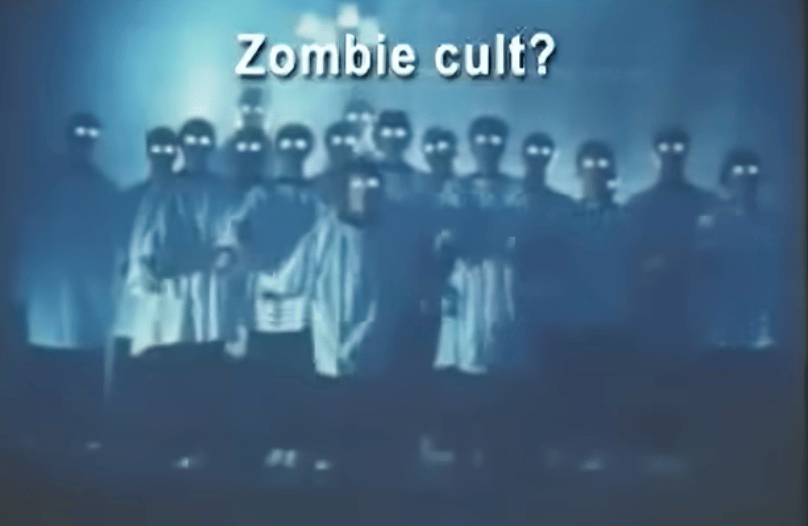
As a special bonus, there’s a shot in the video showing an enrobed group of AI believers. My guess is that they were believers in NFTs and the metaverse, too.
Until next time,
-mark
Mark Hurst, founder, Creative Good
Host, Gel conference
Radio show/podcast: techtonic.fm
Email: mark@creativegood.com
Follow me on Bluesky or Mastodon
此内容由惯性聚合(RSS阅读器)自动聚合整理,仅供阅读参考。 原文来自 — 版权归原作者所有。