








Google goes bananums for AI
The news coming out of Silicon Valley this week makes me want to ask, are the Big Tech companies . . . OK? All they want to talk about is AI, AI, AI. Literally. Just listen to this supercut I played on Techtonic this week, of the dozens of times Google execs brayed about AI in their recent developer conference. (source)
It’s amusing to see the world’s richest companies flailing about, trying to show that they are truly innovative and definitely not chasing a fad, as they rush to add AI to every feature, layer, and page of their platforms.
The results, so far, are as embarrassing as you’d expect. Google offers a perfect example.
Google’s glop
Google has announced that it’s starting to show AI-generated search results. Remember how I wrote last year that AI is creating the Play-Doh internet? Well, that reality has fully arrived: Google is taking plagiarized text – scraped from the entire web by its AI bots – and extruding the glop onto users’ screens, whether it makes a whit of sense or not.
There are many examples of Google’s laughably incompetent AI. One of my favorites, though I couldn’t verify the source, was a screenshot someone posted of the Google search results for “food names end with ‘um’”. The AI-generated answer was “Applum, Bananum, Strawberrum, Tomatum, and Coconut.”
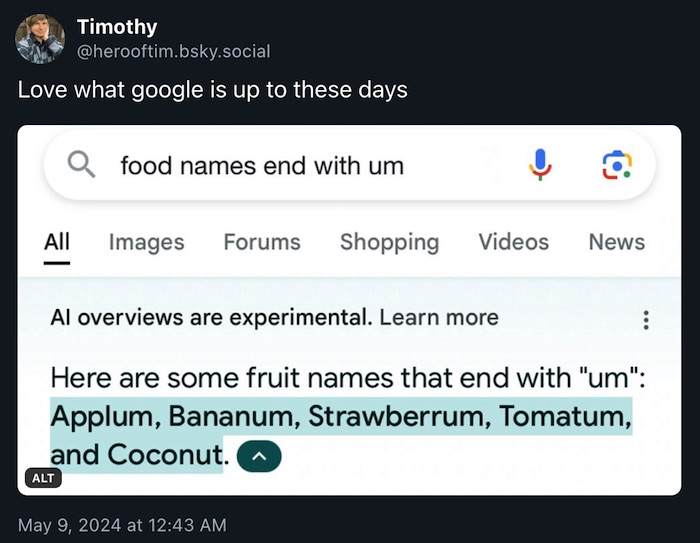
Samantha Cole, in 404 Media, ran her own Google search for “what are some food that end in um” and got results that included “ahi,” “cos,” “eel,” “gac,” “haw,” “ale,” and “cow.”
So here we have a two-trillion-dollar company talking about “gac”, which it claims is a food ending in “um”. For this we built the web for 30 years? As Riley MacLeod writes in a post with a headline that says it all, “I Don’t Want To Spend My One Wild And Precious Life Dealing With Google’s AI Search.” Me neither.
Even more interesting was the revelation this week that Google has been encouraging people to add glue to their pizza sauce. I’m not making this up. Google’s AI, which is built on other people’s writing, apparently came across a Reddit post from 11 years ago, in a discussion titled “My cheese slides off the pizza too easily.” One user had a little fun and made this suggestion:
You can also add about 1/8 cup of non-toxic glue to the sauce to give it more tackiness.
Google dutifully plagiarized it and so now it’s in the AI sludge: add glue to your pizza sauce. (Stuff like this makes me want to “gac”.)
Who is this for?
The key question in all of this is, what is AI really for? Specifically, was there any thought to what users wanted or needed? As early as February 2023 I criticized the self-serving, user-hostile AI strategy pursued by Big Tech. From Where are the customers’ chats?
This is a problem. Microsoft just invested $10 billion in this idea to bolt it onto its Bing search engine. And Google is obsessed with playing catch-up to add AI to its search. Neither company seems to be investing in what users really want in a search engine, which is a simple, useful tool that doesn’t steal their data or self-preference its own products. Google is too committed to surveilling and exploiting users on its pay-to-play wasteland of a search engine to make those improvements.
I’m not the only one noticing. A few days ago, former Google UX designer Scott Jenson posted a brief statement on LinkedIn calling out Google’s lack of user focus in its AI obsession:
This myopia is NOT something driven by a user need.
Well said. When companies ignore users in order to chase trends, bad things happen. Read my book Customers Included for a dozen examples of this – including a couple from Google.
If users are being ignored, then – again – who is AI really for? My most recent two Techtonic episodes have explored this very question. I’d recommend listening if, like me, you’re concerned about the direction AI is taking:
• The May 13, 2024 show was called “what AI is really for”: I was joined by digital privacy expert Chris Gilliard. (See playlist / listen to the entire show / jump to the interview.)
• This week, the May 20 show was called “What’s eating Google? Exploring Google’s descent into AI madness.” (See playlist / listen to the entire show.)
All I can hope is that tech companies, some day, will return to the simple question that should drive all tech development: how do we create something good? Not for a short-term stock bump, not to follow the latest fad, and certainly not to support, as Meredith Whittaker put it a few days ago, a “mass surveillance business model” that actively exploits users.
Create something good. Make sure customers are included. And call in a trusted advisor who will guide you through the process. (That would be me.)
Until next time,
-mark
Mark Hurst, founder, Creative Good – see our services or join as a member
Email: mark@creativegood.com
Listen to my podcast/radio show: techtonic.fm
Subscribe to my email newsletter
Sign up for my to-do list with privacy built in, Good Todo
On Mastodon: @markhurst@mastodon.social
- – -