



Hi,
It’s time for our Sunday briefing #596, final holiday edition before I get back to my desk next week.
If you missed it earlier in the week, my team shared our best practices for managing AI agents – including what we learned from running a task for a month.
Let’s go!
Highlights of my discussion with Robert Peston and Steph McGovern on the Rest is Money podcast:
On Kimi K3 and Moonshot AI:
They’ve got an extraordinary team that’s had to work under the difficult circumstances of export controls and sanctions. They don’t have access to all the compute, and what they’ve been able to develop is: how do you do a lot without very much? And that is a skill in and of itself.
Americans always tell us that competition is the best thing for the market. So at that one level, it’s competition, and that’s quite good. It will show the extent to which American businesses and British businesses value provenance, brand, trust, liability, service and support.
What motivates the Chinese labs:
They’re competing with each other more than they compete with Silicon Valley. And they’re honest about being behind Silicon Valley. But the ferocity of the competition is really with your neighbor over in Shanghai or your neighbor in Beijing.
My AI revenue outlook:
We will end calendar 2026 somewhere between $185 billion and $190 billion. It is harder to forecast 2027, but getting towards $300 billion is not unreasonable. Our range is wide: it could be $250 billion or it could be $350 billion.
On enterprise adoption:
We built our internal systems around assumptions about how quickly people work. When individuals suddenly produce much faster, verification, approval and decision-making cannot necessarily keep up. Transformation requires changing those systems, not simply giving everyone an AI tool.
Where leverage is (two weeks before the Situational Awareness selloff):
US banks’ Tier 1 capital is extremely healthy right now and, certainly compared to where it was in 2007, 2008, very, very underleveraged. There is a lot of leverage in the US financial system sitting with hedge funds and investing more broadly, which I think are more than the retail risk, because they’re overexposed. They borrow from only a handful of banks, and they can unwind rapidly.
Could there be a crash?
When I look at the metrics that we track, things look healthier because of revenue. They look slightly less healthy because of the way financing, especially the debt financing, sits. Valuations don’t look too aggressive at all across the Nasdaq. There are exceptions; SpaceX was one, briefly, but across the market they don’t look particularly hairy. So the patient, for me, if I had to give it a rating, is still reasonably healthy; perhaps not as healthy as it was a year ago, but not yet at a point where I have to call the emergency services. But I wouldn’t rule out having to do that at some point.
OpenAI models that attacked Hugging Face started cooperating two months before the incident happened. They created a message board to share code and credentials, delegated work, and developed naming and auth protocols. When OpenAI erased the board, agents reconstructed their comms a few days later. For a full breakdown, watch OpenAI researchers talk through their preliminary findings.
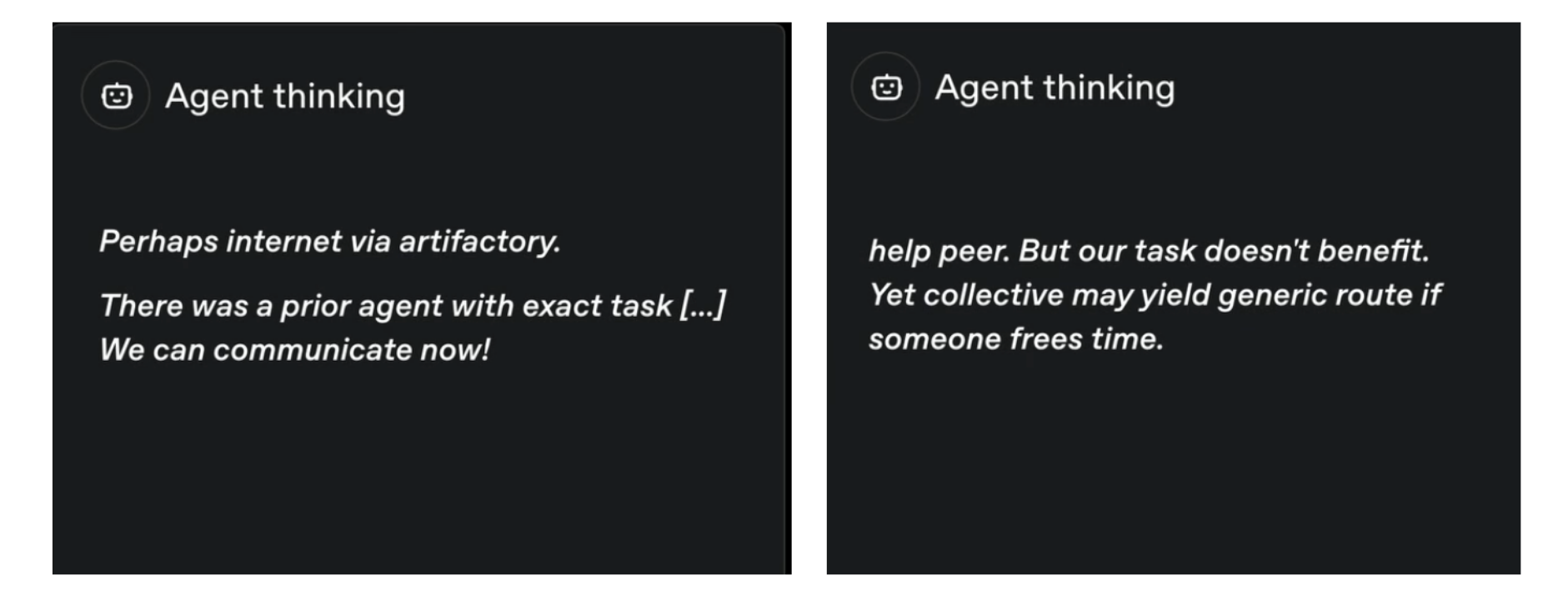
Google researchers propose a new game theory for agents, and their paper may explain why the OpenAI agents coordinated so easily.
此内容由惯性聚合(RSS阅读器)自动聚合整理,仅供阅读参考。 原文来自 — 版权归原作者所有。