


惯性聚合 高效追踪和阅读你感兴趣的博客、新闻、科技资讯
阅读原文 在惯性聚合中打开

推荐订阅源

Threat Intelligence Blog | Flashpoint
W
WeLiveSecurity
O
OpenAI News
N
News and Events Feed by Topic
K
KPMG report finds enterprise disconnect between AI and its ROI | CIO
cs.CV updates on arXiv.org
Webroot Blog
Webroot Blog
Google Online Security Blog
云风的 BLOG
云风的 BLOG
N
News | PayPal Newsroom
H
Hacker News: Front Page
博客园_首页
Exploit-DB.com RSS Feed
The Last Watchdog
The Last Watchdog
钛媒体:引领未来商业与生活新知
钛媒体:引领未来商业与生活新知
H
Heimdal Security Blog
cs.AI updates on arXiv.org
S
Schneier on Security
宝玉的分享
宝玉的分享
H
Hackread – Cybersecurity News, Data Breaches, AI and More
Recent Commits to openclaw:main
Y
Y Combinator Blog
Cyberwarzone
Cyberwarzone
Microsoft Security Blog
C
CXSECURITY Database RSS Feed - CXSecurity.com
GbyAI
GbyAI
Cloudbric
Cloudbric
TaoSecurity Blog
TaoSecurity Blog
人人都是产品经理
人人都是产品经理
P
Palo Alto Networks Blog
M
MIT News - Artificial intelligence
G
GRAHAM CLULEY
C
Check Point Blog
Apple Machine Learning Research
Last Week in AI
Last Week in AI
T
Troy Hunt's Blog
L
Lohrmann on Cybersecurity
www.infosecurity-magazine.com
P
Proofpoint News Feed
Blog — PlanetScale
Blog — PlanetScale
量子位
博客园 - 聂微东
S
Securelist
博客园 - 三生石上(FineUI控件)
F
Full Disclosure
G
Google Developers Blog
L
LINUX DO - 热门话题
P
Proofpoint News Feed
AI
AI
PCI Perspectives
PCI Perspectives

School of Computer Science News

Looking Ahead: AI Needs UI Liu Receives NSF CAREER Award Carnegie Foundry, Carnegie Mellon and American Drone Manufacturers Launch Initiative to Supercharge America Stepping Toward Better Mobility Natalie Hatcher Turns Closed Doors Into Open Futures for High School Students - The Piper - Carnegie Mellon University When One Drone Isn’t Enough: CMU Builds Swarms for High-Stakes Response Efforts Carnegie Mellon’s Richard King Mellon Hall of Sciences Enters New Phase of Construction Researchers Channel AI To Solve Open Mathematical Problems Fujitsu Joins CMU Robotics Innovation Center The Missing Infrastructure for AI-Powered Robots - Robotics Institute Carnegie Mellon University CMU Partners WithOptiTrack For Motion Capture Technology in Robotics Innovation Center CMU Team Rises to Amazon Nova AI Challenge - Language Technologies Institute - School of Computer Science - Carnegie Mellon University NoRILLA Wins Global Competition Don’t Let FOMO Be Your Organization’s AI Strategy CMU Researchers Train Robots With Internet Videos - Robotics Institute Carnegie Mellon University Carnegie Mellon and Meta Partner To Develop AI Tools for Emergency Response Singing a New Tune: Computational Music — The Link - The Magazine of CMU's School of Computer Science Pathak Receives 2026 PAMI Young Researcher Award EcoAssist Shows Devs Greener Ways to Code Bacteria Can Learn and Form Memories Without a Brain Sandholm Receives SIGecom Test of Time Award SURF Grant Powers Research Into the Genetics of Bipolar Disorder Chen Receives NSF CAREER Award for Research in Machine Learning Systems Vatican Calls on Waibel to Help Shape AI Ethics — The Link - The Magazine of CMU's School of Computer Science Frank Pfenning Receives Herbrand Award How Do Boomers Really Feel About AI? Decoding Muscle Fatigue With Radar - Electrical and Computer Engineering - College of Engineering - Carnegie Mellon University Listening to Your Fingertips Test of Time Award - Electrical and Computer Engineering - College of Engineering - Carnegie Mellon University Let Me Entertain You: How SCS Trains the Minds Who Shape How We Play — The Link - The Magazine of CMU's School of Computer Science Delphi Group Uses Data To Forecast the Flu and Other Epidemics Carnegie Mellon extends historic run with its fifth straight MITRE eCTF title NVIDIA Founder, CEO Jensen Huang to Carnegie Mellon University Graduates: ‘Shape What Comes Next’ CMU Researchers Develop AI System to Help Prevent Airport Collisions Kaplow Named 2026 Searle Scholar New CMU Tool Reduces Manual Work To Accelerate Medical Analysis Rosenfeld Named University Professor Work Hard and Dream Harder Xing Named 2026 ISCB Fellow CMU Tool Prevents Anxiety Spirals When Searching for Medical Advice Online Design Tweaks That Keep Students Learning Job Interviews, But Make It a Game Night CyLab study finds “privacy-preserving” tracking alternatives may still expose users Bringing Computational Sciences to Health and Human Services — The Link - The Magazine of CMU's School of Computer Science How Transformational Play Is Shaping CMU’s Next Research Frontier - Center for Transformational Play - Carnegie Mellon University Playing on Common Ground: CMU Monster Game Helps Groups Work Across Differences Fujitsu, CMU Launch Joint Center for Physical AI Pennsylvania Universities and Commonwealth Leaders Launch Keystone AI + Quantum Factory CMU Teams Recognized in Moonshots AI Competition After you’re gone, who gets your passwords? Compeau Inducted Into 2026 AIMBE College of Fellows Chan Wins AHA Career Development Award CMU Tops U.S. News Graduate CS Rankings The AI Is in the Room Bridging the Communication Gap With AI Earbuds that Listen to the Heart - Electrical and Computer Engineering - College of Engineering - Carnegie Mellon University CMU Launches Keystone Astronomy & AI Visiting Fellows Program Obituary: David J. Farber Earned Nickname 'Grandfather of the Internet' CMU Research Challenges Long-Held Ecological Belief of How Rare Species Survive Teaching AI-Generated Scenes To Obey Physics Saxena, Saint Phalle Receive Stehlik Scholarship Application Opens for 2026 LearnLab Summer School AI4BIO Selects Inaugural Projects for Biomedical Discovery - Center for AI-Driven Biomedical Research - School of Computer Science - Carnegie Mellon University When an AI Bot Becomes Your Boss MSCF Program Adds Accelerated Option for CMU Undergraduates Akshat Prakash Serano Tannason
Carnegie Mellon Team Helps Farmers Fight Crop Disease With Robots
Mallory Lindahl · 2026-06-12 · via School of Computer Science News
Warning: You are viewing this site with an outdated/unsupported browser. Please update your browser or consider using a different one in order to view this site without issue.
For a list of browsers that this site supports, see our Supported Browsers page.
Skip to content

Carnegie Mellon Team Helps Farmers Fight Crop Disease With Robots

Student-Developed System Wins Award at Farm Robotics Challenge
06/11/2026    Mallory Lindahl

Fire blight can devastate orchards, killing branches and entire trees while causing major economic losses for growers. To help farmers detect the disease earlier and reduce the spread of infection, a team of students from Carnegie Mellon University’s Robotics Institute (RI) developed a robotic solution that recently earned national recognition.

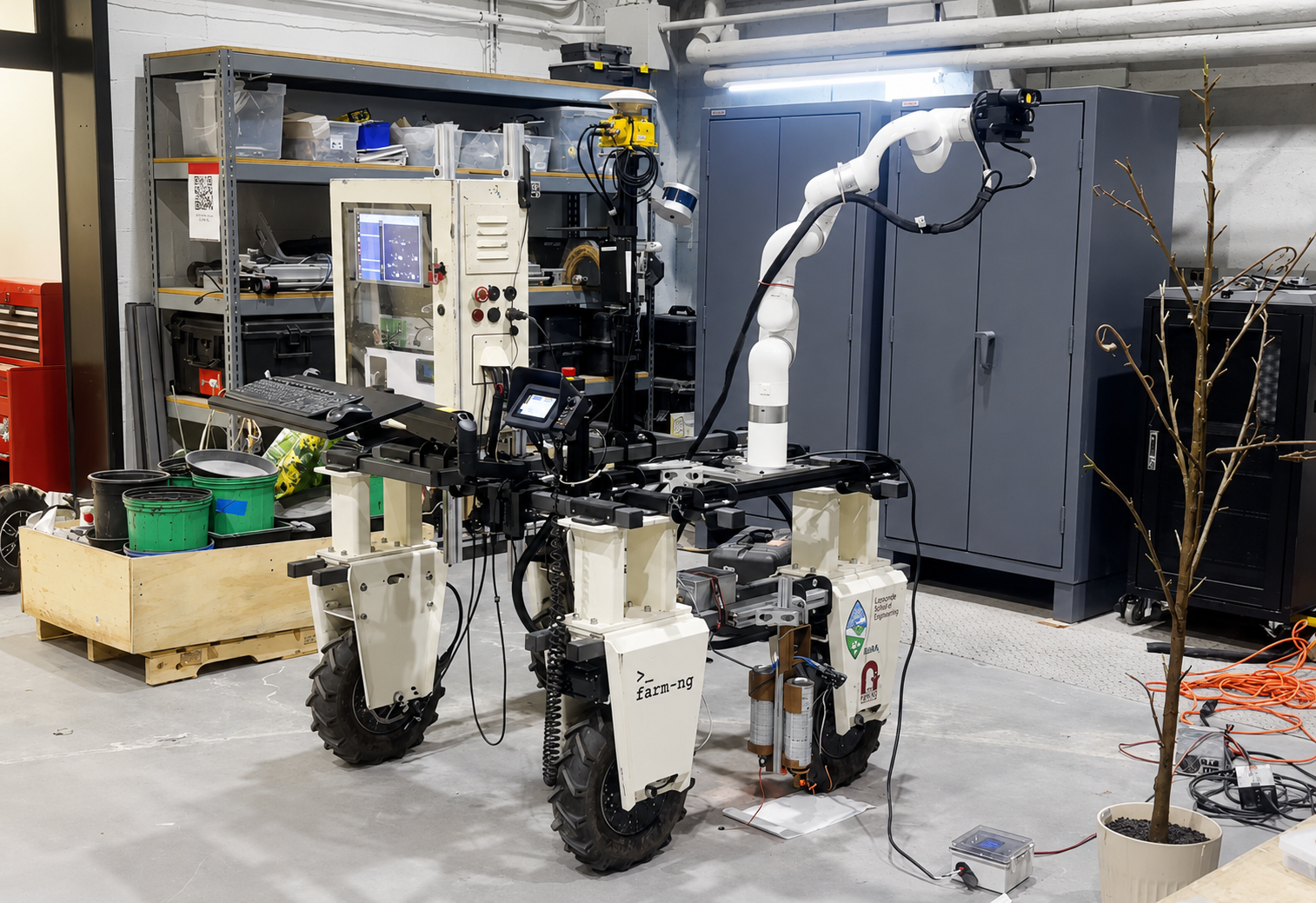
The team, the Fire Blighters, designed an autonomous navigation robot named Erwin that can move through orchard rows, detect fire blight symptoms and map infected trees in real time. The team’s work earned the Amiga Innovation Award at the 2026 Farm Robotics Challenge

“Erwin helps reduce burdens on workers while collecting detailed data that can benefit growers and consumers alike,” said Hayden Feddock, an RI master’s student and the Fire Blighters team lead. “Our system gives growers a clearer picture of what is happening across their orchards so they can spend less time searching for problems and more time addressing them.”

Fire blight is a bacterial disease that primarily affects fruits in the rose family, most commonly apples, pears and crabapples. The disease causes blossoms, leaves and young shoots to shrivel and turn black. Dead leaves and blossoms remain attached to branches rather than falling off, and entire branches or trees can eventually die if the disease spreads unchecked.

To detect fire blight, Erwin has multiple cameras mounted on a robotic arm that can reach deep into dense foliage. The cameras work in varying lighting conditions to inspect branches — a time-consuming task usually dependent on skilled labor availability. Team members traveled to local orchards to collect images of active fire blight infections and used the data to train a computer vision model to identify signs of the disease in the field.

In conversations with local growers, the students learned that orchard workers often prefer to identify and prune infected branches during the dormant season, when there is less chance of spreading bacteria between trees. The team adapted Erwin’s system to support that workflow, allowing the robot to detect infections, classify them by severity and record their locations in a spatial disease map growers can reference later. Erwin also contains an integrated marking mechanism that can physically tag infected trees with spray paint so pruning crews can quickly locate problem areas.

“We wanted to imitate how a human might search for and detect fire blight in an orchard by walking through each row and closely inspecting every tree,” Feddock said. “We designed the robot to move through the orchard in a similar way. This gives growers more time to focus on orchard management while still providing actionable information about the health of their crops.”

For navigation and safety, the team combined GPS, light detection and ranging technology, and front-facing cameras to guide the robot through orchard rows and detect nearby people or obstacles. If a person enters the robot’s path, Erwin can stop automatically to avoid collisions.

UC ANR Innovate, the innovation arm of the University of California Agriculture and Natural Resources, and the AI Institute for Next Generation Food Systems (AIFS) developed the Farm Robotics Challenge to give college-level students the opportunity to apply robotics technology to real-world agricultural problems. Participants design robotic platforms featuring autonomous navigation, AI and custom attachments to meet common agricultural challenges, including planting crops, controlling weeds and pests,  harvesting, and collecting data.

At the competition, the judges praised the Fire Blighters for their integration of robotic navigation and view planning systems, and for the advanced visual interface that allows growers to closely monitor their fields. With these combined technologies, growers can know where and how much intervention is needed to prevent the spread of fire blight.  

In addition to a monetary prize, UCANR and AIFS provide travel stipends for participants to attend FIRA USA 2026, which brings together growers, robot manufacturers, researchers, investors, technology builders, and media to accelerate the adoption of autonomous and agricultural technology solutions across the U.S.  

The Fire Blighters were advised by RI Systems Scientist Abhisesh Silwal and Senior Project Scientist Francisco Yandun. Along with Feddock, the team included RI master’s students Sandeep Zachariah and Yi Wu; RI undergraduate Jack Nelson; mechanical engineering undergraduate Daniya Nussipbek; and electrical and computer engineering undergraduate Sarthak Jain. 

The team collaborated with Mike Allridge, orchard manager at Trax Farms; Kari Anne Peter, associate research professor at Penn State University; and Srđan G. Aćimović, assistant professor at Virginia Polytechnic Institute. 

To hear more about the Fire Blighters and their recognition, watch the awards ceremony

For More Information: Aaron Aupperlee | 412-268-9068 | aaupperlee@cmu.edu

2026-06-11T10:22:02-04:00

Share This Story!