



惯性聚合 高效追踪和阅读你感兴趣的博客、新闻、科技资讯
阅读原文 在惯性聚合中打开

推荐订阅源

Google DeepMind News
freeCodeCamp Programming Tutorials: Python, JavaScript, Git & More
酷 壳 – CoolShell
酷 壳 – CoolShell
WordPress大学
WordPress大学
小众软件
小众软件
博客园 - 司徒正美
OSCHINA 社区最新新闻
OSCHINA 社区最新新闻
Jina AI
Jina AI
Hugging Face - Blog
Hugging Face - Blog
博客园 - Franky
奇客Solidot–传递最新科技情报
奇客Solidot–传递最新科技情报
量子位
钛媒体:引领未来商业与生活新知
钛媒体:引领未来商业与生活新知
雷峰网
雷峰网
云风的 BLOG
云风的 BLOG
M
MIT News - Artificial intelligence
F
Fortinet All Blogs
T
Tailwind CSS Blog
Martin Fowler
Martin Fowler
I
InfoQ
The GitHub Blog
The GitHub Blog
有赞技术团队
有赞技术团队
The Cloudflare Blog
罗磊的独立博客

School of Computer Science News

Robotics Innovation Center Earns LEED Platinum Certification for Sustainable Construction AI4MiddleSchools Expands Nationwide Effort To Prepare Students for an AI-Powered Future Carvalho Earns NSF CAREER Award To Study Motivation and Learning Season Three of 'Does Compute' Now Available Rare Ventures Partners Rings NYSE Opening Bell Bringing Images to Life Through Touch - Robotics Institute Carnegie Mellon University Fried Receives NSF CAREER Award - Language Technologies Institute - School of Computer Science - Carnegie Mellon University PAIR Helps Students Find Their Place in AI Research Navigating the AI Era with a CMU Focus on Critical Thinking Kaess Named to Inaugural Chief of Naval Research Fellows Program Navigating the Moon Koedinger Wins Lifetime Achievement Award Carnegie Mellon Names Damion Shelton Associate VP and Executive Director of the Swartz Center for Entrepreneurship Hong Shen Discusses AI Safety at WEF Annual Meeting Erickson Earns NSF CAREER Award - Robotics Institute Carnegie Mellon University Satya Honored With Test of Time Award From Proof to Program: CMU and the Rise of AI-Driven Mathematics SCS Researchers Named to Inaugural ACM SIGSOFT Software Engineering Academy Healthcare Blind Spots: AI Models Prone To Fabricating Diagnoses - Robotics Institute Carnegie Mellon University You Can't Remove Humans From Software Engineering Designing the Future of Tech Governance AI, Single-Cell Technology Reveal How 3D Genome Differs in People With Alzheimer's Disease Tepper School of Business and School of Computer Science Partner to Launch AI for Business Executive Education Program Carnegie Mellon Researchers Lead Three DOE Genesis Mission Awards to Advance the Future of AI-Enabled Scientific Discovery Snake Robots Support Earthquake Search and Rescue in Venezuela Lindlbauer Receives NSF CAREER Award for Adaptive Extended Reality Interfaces Fredrikson Earns Test of Time Award for AI Security CMU Advances Defense Manufacturing and Military Education at Pennsylvania Defense and Innovation Summit Looking Ahead: AI Needs UI Liu Receives NSF CAREER Award
SURF Grant Powers Research Into the Genetics of Bipolar D...
2026-06-04 · via School of Computer Science News

A research team in Carnegie Mellon University's Ray and Stephanie Lane Computational Biology Department is working to better understand the role that genetic on and off switches play in activating symptoms of bipolar disorder.

By determining the underlying mechanisms driving the disorder's development, Associate Professor Andreas Pfenning and researchers in his Neurogenomics Lab hope to uncover therapies that are more effective and less prone to side effects, revolutionizing how bipolar disorder is addressed.

The work is embedded in the study of epigenetics, or how environmental factors influence the expression of genes. But it's also rooted in decades of student ingenuity supported by CMU's Summer Undergraduate Research Fellowship (SURF) program. Offered through the Office of Undergraduate Research and Scholar Development, SURF provides students with a stipend to conduct eight to ten weeks of full-time study on campus.
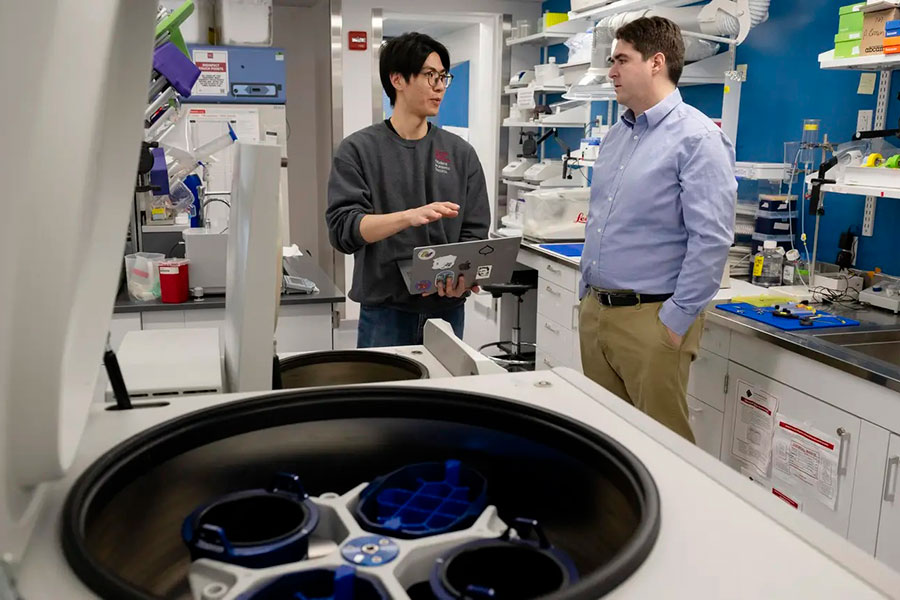
Two men stand in a laboratory, talking.

Computational biology researchers are working to better understand the role that genes play in bipolar disorder — work that's deeply rooted in decades of student ingenuity supported by the Summer Undergraduate Research Fellowship program.

Stephen Wu, who recently graduated from the School of Computer Science with a degree in computational biology, joined the Neurogenomics Lab during the fall semester of his junior year and was assigned to Pfenning's project, which was focused on the expression, or genetically informed activity, of these cells.

Wu collaborated with Sarah Ross of the University of Pittsburgh's Department of Neurobiology to study two sets of data: RNA sequencing data from single cells, and a sequencing dataset used to measure structures inside cells known as chromatin. The ultimate goal of their computational analyses was to determine the specific cell type or group responsible for triggering bipolar disorder.

"If we can figure out these underlying mechanisms, we can design new gene therapies that target these genetic pathways, that will be really effective and have less side effects," Wu said.

Wu follows a long tradition of undergraduate research at CMU, including the work of Pfenning himself, who participated in the SURF and Small Undergraduate Research Grant programs from 2002 to 2006. Today, Pfenning hopes to encourage students to embrace research in a similar way, not only as a potential career, but as a way to explore their skills and interests.

"Just like the mentors that I had when I was an undergrad motivated me for a career in research, I wanted to have the same impact on undergrads like Stephen and myself by mentoring them in research," Pfenning said.

Learn more about Wu's research in the full story on the CMU News website.