








Carnegie Mellon University students are stepping out of the classroom ready to prove that the people who design technology are uniquely qualified to help regulate it.
A spring special topics course, “Design and/of Policy,” taught by Assistant Professor Sarah Fox in the Human-Computer Interaction Institute (HCII), encouraged students to see themselves as not just consumers or builders of technology, but as active participants in shaping its future.
The highly collaborative course approached the subject of policy through the lens of human-computer interaction (HCI) and design practices. Rather than focusing strictly on legal frameworks, this people-first approach pushed students to explore how ideal policies work in practice, who will enforce them, and who might be harmed by them.
What makes an HCI approach to tech policy so vital is its focus on implementation. It moves past the rosy "tech-colored glasses" outlook – a naive assumption that the next clever piece of code can solve every societal problem. While it’s common to think of tech development happening in a straight line, students learned that tech policy is more of a knot – deeply tangled problems with many stakeholders, competing incentives, trade-offs and unintended consequences.
“HCI practitioners and researchers are increasingly being called on to participate in policy conversations around emerging technologies,” said Fox. “I want the students to understand how design and policy together shape social life, and to recognize the responsibility designers and technologists carry in shaping the systems, behaviors and institutions that increasingly mediate our everyday experiences.”
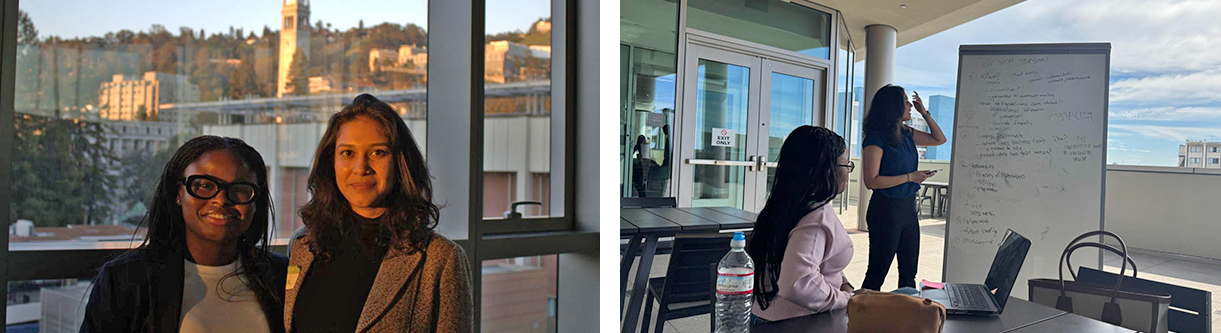
U.S. AI Policy Hackathon photos submitted by Shrivastava and Olusola-Ajayi.
Graduate students Priyal Shrivastava and Simi Olusola-Ajayi (MHCI 2026) enrolled in the Design and/of Policy course wanting the skills to make a difference for others.
Shrivastava, a former applied UX researcher, wants to move closer to where the decisions that shape technology are being made in order to have an impact at a larger scale.
“I've always thought of HCI as sitting in between technology and people,” Shrivastava said. “There's a real need for practitioners who understand both human behavior and technical capability to enter policy spaces.”
The course also stood out to Olusola-Ajayi, an aspiring law student who hopes to practice at the intersection of design, policy and technology.
“I saw it as a rare opportunity to explore how design methods could help make complex policy problems more understandable, usable and responsive to real people,” said Olusola-Ajayi.
In class, students drafted policy briefs and debated timely topics like smart cities, self-driving cars, and the environmental impacts of computing. Fox encouraged students to consider how real people experience technology and the broader societal, political and human context around each problem. The course focused its debates around current AI topics within longer histories of sociotechnical change.
“Rather than treating AI as unprecedented, students explored how today’s concerns connect to broader questions about labor, accountability, participation and power,” added Fox. “The course reflects the HCII’s commitment to combining technical expertise with human-centered and socially engaged approaches to technology.”
This course ended up being one of the most formative parts of Olusola-Ajayi’s spring semester because it changed the way she noticed problems.
“It was not just giving me new concepts. It was actively changing how I worked… and gave me language for things I had sensed before but could not always name,” said Olusola-Ajayi. “I also became more aware of the limits of technical thinking. It is easy, especially in a program like HCI, to believe that better tools, better interfaces, or better systems can solve the problem. But this course pushed me to ask harder questions.”
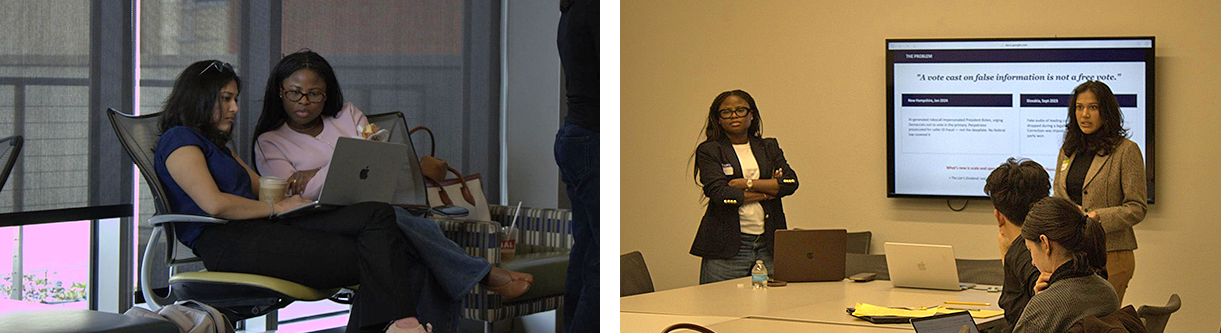
U.S. AI Policy Hackathon photos submitted by Shrivastava and Olusola-Ajayi.
Halfway through the semester, Shrivastava and Olusola-Ajayi put their systems-oriented classroom training to the test in their first-ever hackathon.
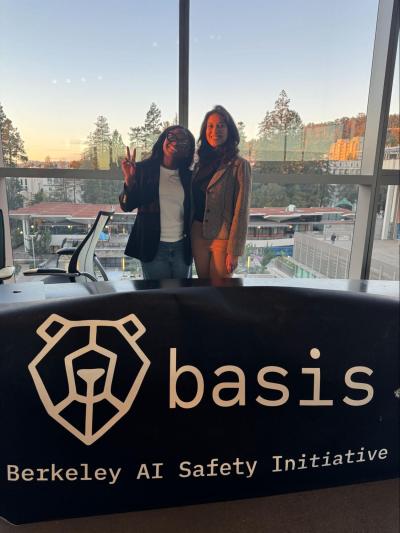
The duo submitted a policy brief to the U.S. AI Policy Hackathon, a nationwide competition hosted by the Berkeley AI Safety Initiative (BASIS) that drew more than 70 submissions.
They chose to focus on a timely and high-stakes topic: deepfakes and election integrity. Deepfakes are highly realistic, AI-generated images, videos or audio clips. These fake media are problematic for a variety of reasons, but in this case, they pose a threat to the fairness, security and trustworthiness of democratic elections.
The topic resonated with Shrivastava, whose prior research was with low digital literacy populations.
"Synthetic media designed to look real is a serious threat," Shrivastava said, thinking of everyday people vulnerable to misinformation. "Convincing fake content travels fast, and skepticism travels slow. Elections felt like the highest stakes version of that problem, which is what made this track feel urgent rather than just interesting (to me)."
While other teams proposed technical fixes or aggressive censorship, Shrivastava and Olusola-Ajayi focused on the human side of the problem and won first place in their track.
They proposed a strategy called algorithmic pausing. Instead of permanently deleting suspicious content, their solution slows down how fast a fake video spreads, giving platforms time to verify it and users time to think.
“Part of what the judges responded to was that we could explain the human experience on both ends of that intervention: what it means for the person encountering synthetic media, and what it means for platforms trying to act responsibly under time pressure,” Shrivastava said, a reflection of how policy functions in the real world.
“In the context of deepfakes and elections, the question is not only how to regulate harmful synthetic media,” said Olusola-Ajayi. “It is also how voters understand what they are seeing, how platforms respond, how civil liberties are protected, and how trust in democratic systems is preserved. HCI helps make policy more human-centered, more practical, and more responsive to real-world complexity. It does not simplify the problem, but it gives us better tools for untangling it.”
Shrivastava said she left the experience with a clearer way of breaking down complex problems, a better understanding of real world constraints, and conviction that people with HCI backgrounds have a role to play in these conversations.
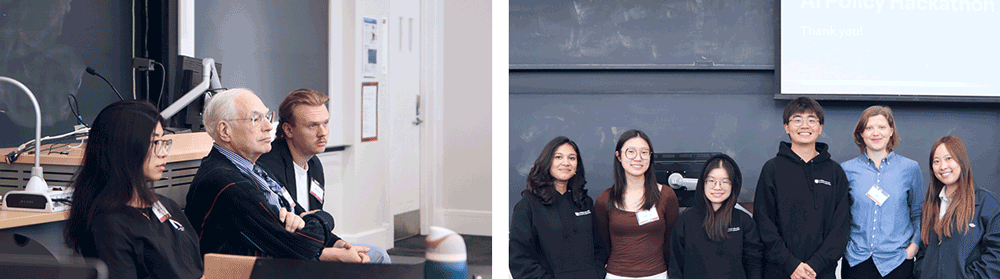
On the left: Pittsburgh AI Policy Hackathon judging panel (L-R): Sarah Cen, Michael Shamos and Mike Zula. On the right, the CASI Board: Priyal Shrivastava, Ningning Ying, Vy Tran, Lawrence Feng, Ida Mattsson and Esther Suh. Photo credit: Esther Suh
This spring, the Carnegie AI Safety Initiative (CASI), a student-run group at CMU dedicated to responsible AI development, organized their inaugural Pittsburgh AI Policy Hackathon. CASI brings together students, researchers and faculty from across disciplines to engage with the technical and societal challenges of AI safety.
Esther Suh, CASI board member and MHCI student enrolled in the Design and/of Policy course, said that the inaugural hackathon came about due to student interest.
“We kept meeting students from CMU and the broader Pittsburgh student community who were already thinking seriously about the gap between AI development and governance,” said Suh. “We wanted to give them a structured place to bring those perspectives together.”
The two-week-long, hybrid competition drew about 150 students from diverse fields like engineering, law, public policy, computer science, and economics, and culminated in an in-person finale for the top teams. CASI’s Pittsburgh AI Policy Hackathon introduced participants to the tech policy space and distributed over $4,500 in prizes across three tracks covering consumer fraud, mass surveillance and creator rights.
Also a member of the CASI board, Shrivastava was encouraged by the response to the hackathon, and said it felt like a direct continuation of what the Design and/of Policy course started.
“AI governance is moving fast and needs more people like technically skilled CMU students who understand the technology from the inside,” said Shrivastava.
“One of the most rewarding aspects of teaching the Design and/of Policy course has been seeing students carry these conversations beyond the classroom,” said Fox. “This semester in particular, many students have become deeply engaged in policy-related work outside the course, participating in advocacy efforts, research initiatives, public-interest technology projects, and broader conversations around AI governance and technology policy.”
The impact of this student-led movement is already echoing beyond Pittsburgh.
Members of the CASI team have advised local congressional staff and national think tanks on AI governance. This fall, backed by CMU’s Government Relations team, the students are heading to Washington, D.C., to present their ideas directly to congressional offices on Capitol Hill.
By teaching students that framing a problem is itself a powerful act of design, CMU is building a vital pipeline of experts and scholars working to ensure that the automated future remains deeply human.
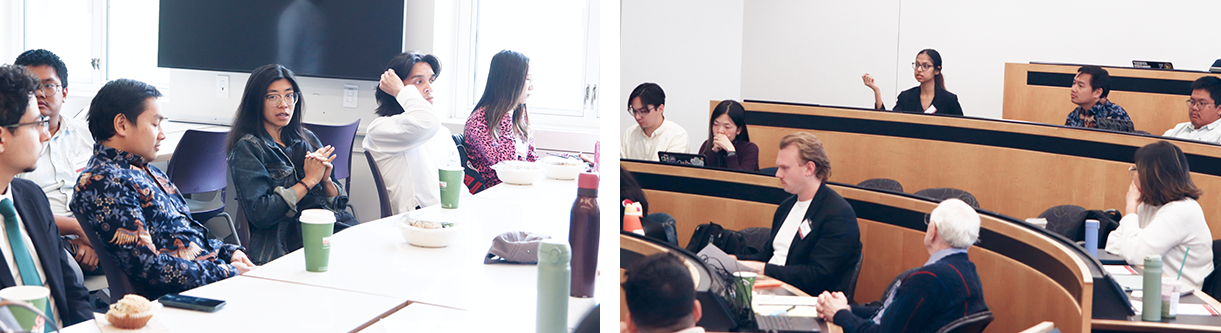
Pittsburgh AI Policy Hackathon photo credit: Esther Suh
Author
Karen Harlan
Research Areas
此内容由惯性聚合(RSS阅读器)自动聚合整理,仅供阅读参考。 原文来自 — 版权归原作者所有。