










KEY TAKEAWAYS
- BloombergNEF’s New Energy Outlook 2026 reveals that recent, successive energy market shocks could be a boon for the energy transition as some countries look to decouple from imported fossil fuels and bolster their energy security.
- Electricity demand is now rising almost everywhere, driven by population growth, rising incomes, data centers, and the electrification of end-use sectors.
- Solar will become the world’s single largest source of electricity in the next six years, due to a major supply glut, technology advances, and falling prices.
London and New York City, May 19, 2026 – The ways in which the world produces, delivers, consumes and ultimately pays for energy is front and center today. So far in this decade, the world has suffered three substantial energy shocks – Covid-19, the war in Ukraine and most recently the Iran war in the Middle East. Each has highlighted the inherent volatility and insecurity of today’s energy system. BloombergNEF’s (BNEF) New Energy Outlook 2026, published today, reveals that if countries continue on their current path of rapidly deploying economically competitive clean technologies, they stand to cut their reliance on imported fossil fuels and ultimately strengthen their energy security.
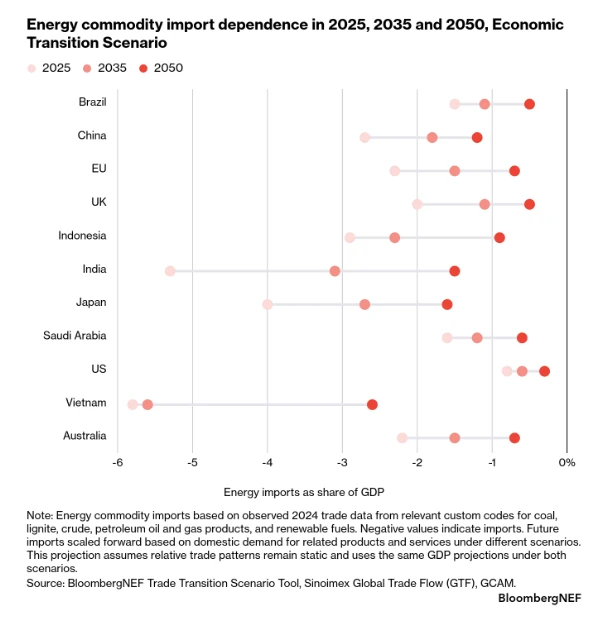
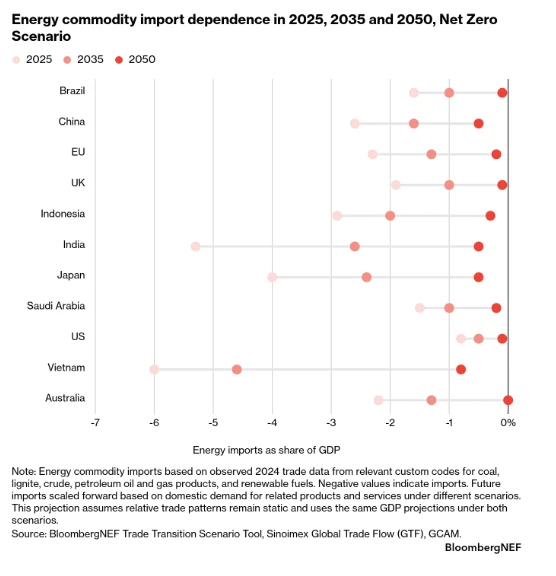
BNEF’s updated Economic Transition Scenario (ETS) maps out how the energy system is most likely to evolve over the next decade and through 2050. Far more so than in previous energy crises, many countries that are dependent on fossil fuels are able to reduce their economic exposure to energy commodity imports by adopting low-carbon technologies. Asian economies with high import liabilities such as Vietnam, Japan, Indonesia and India have the most to gain when looking at energy imports as a share of GDP. Those markets paid between 3% and 6% of their GDP on energy imports in 2025. The EU and China currently spend 2.3% and 2.7% of GDP on energy imports, respectively, but rapidly reduce these liabilities over the next decade in BNEF’s modeling. Meanwhile, net exporters such as the US and Saudi Arabia also modestly reduce import dependence.
While energy security concerns may prompt some coal-rich nations to re-emphasize coal use, according to BNEF’s ETS, fuel cannot compete on cost over the long term, slipping to half of current levels of power generation use by 2050.
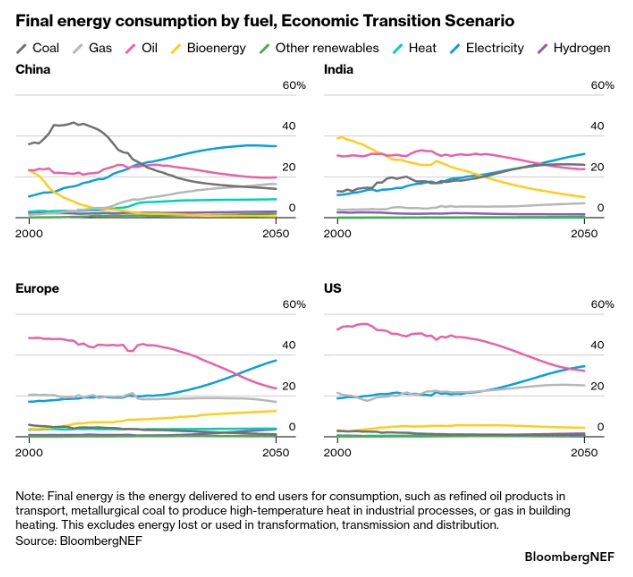
In the long term, the ETS signals the start of an electricity-led era, with electricity meeting two-thirds of new energy demand over the next 24 years, while natural gas supplies another 25%. The demand is largely driven by electric vehicles, data centers and other electrification. Global data centre capacity reached 84GW in 2025, consuming 500 terawatt-hours (TWh) of electricity, or 1.9% of global total demand. This marks a 20% increase year-on-year. Demand from data centers more than doubles to 1,114TWh (3.6% of total demand) by 2050, representing a 10th of electricity consumed worldwide.
Energy transition timelines diverge widely by region. China is rapidly electrifying, with electricity already the dominant final energy carrier by 2023 and coal’s share of power generation falling from about 54% in 2025 to 19% in 2035 and 7% by 2050. In India, electricity overtakes oil and coal by 2041 despite continued coal use in industry. In Europe, electricity becomes the dominant fuel by 2043, while the US transitions more slowly, reaching that point in 2047.
The report also indicates that solar will become the world’s largest generator of electricity by 2032, driven by massive overcapacity and falling prices. Additionally, the outlook for battery deployment has increased, with storage jumping 17-fold from 223GW in 2025 to 3.8TW by 2035.
David Hostert, Chief Economist at BloombergNEF, said: “We’re living in another moment of crisis, but unlike in past decades, today there are real options for countries to react. We now have viable technologies that can be deployed at scale and fast, at an overall lower cost to the system than the fossil fuel technologies that used to be the primary choice. Through clean power and electrification we can strengthen energy security and reduce harmful emissions along the way.”
While EVs reduce crude oil demand, it is the growth of the clean power sector – namely, the shift from coal-fired power generation to renewables or batteries and gas – that makes the single greatest contribution to curbing CO2 emissions under the ETS. This move comes with a rise in gas use, yet oil and gas demand both drop if countries get serious about CO2 emissions, as in the Net Zero Scenario (NZS).
However, a larger, more dynamic power system requires increased flexibility from both supply and demand. By 2035, some 11% of megawatt-hours generated are shifted, up from 3% today.
Global energy transition investment reached a record $2.3 trillion in 2025. Yet investment required to achieve the NZS is $235 trillion by 2050. This means investing 24% more than under the ETS scenario delivers a fundamentally different and cleaner energy system where 84% is directed toward low-carbon technologies.
Matthias Kimmel, Head of Energy Economics, said: “As EVs, data centers, population growth and industrial activity spur electricity demand, the world is in a race to meet rising energy demand with the most efficient, least-cost technologies. NEO shows that solar becomes the world’s largest generator overall by 2032, while storage jumps 17-fold to 3.8 terawatts by 2050, underscoring how clean technologies are increasingly critical to energy security, system flexibility and meeting the world’s growing power needs.”
Other key findings from the report include:
- Global electricity demand has more than doubled since 2000, driven primarily by rising consumption in buildings and industry as populations grow and incomes increase. In the ETS, demand rises a further 29% by 2035 and 69% by 2050. This demand growth reinforces an existing trend in developing economies, where electricity consumption has long been rising. It represents a more fundamental shift in developed markets, many of which previously experienced flat or declining demand. As a result, the ability to deliver capacity in line with new load is becoming increasingly critical, placing growing pressure on grid investment, system expansion and permitting timelines.
- This year’s New Energy Outlook includes a major, reworked update to the NZS, a credible maximum-effort pathway that keeps global warming well below 2C. The updated scenario reflects a slower pace of transition, shifting policy priorities, and limited progress in next-generation clean technologies since our last update, in 2024. Under this pathway, peak warming reaches 1.81C, compared with 1.75C in the 2024 edition.
- BNEF finds that achieving 1.5C is no longer feasible due to persistently high emissions and continued investment in emissions-intensive assets.
- Despite $0.5 trillion in corporate equity and billions in government support over five years for startups and other firms, the next great low-cost energy technology has yet to emerge. Hopes are high for new nuclear, geothermal or storage technologies, but none has been proven sufficiently at scale – yet.
- Asia Pacific dominates nuclear expansion, with China and India accounting for 80% of ETS nuclear capacity additions through 2035 and 44GW of the 75.5GW currently under construction worldwide (38GW in China, 6GW in India).
- China remains the largest contributor to global emissions reductions under the ETS, with emissions projected to decline 17% from their 2023 peak by 2030. By 2050, they fall nearly 50% from their peak, although they remain well above where the US or Europe are today.
BloombergNEF clients can find the full report on bnef.com and the Bloomberg Terminal.
Media Contact
About BloombergNEF
BloombergNEF (BNEF) is a strategic research provider covering global commodity markets and the disruptive technologies driving the transition to a low-carbon economy. Our expert coverage assesses pathways for the power, transport, industry, buildings and agriculture sectors to adapt to the energy transition. We help commodity trading, corporate strategy, finance and policy professionals navigate change and generate opportunities.
About Bloomberg
Bloomberg is a global leader in business and financial information, delivering trusted data, news, and insights that bring transparency, efficiency, and fairness to markets. The company helps connect influential communities across the global financial ecosystem via reliable technology solutions that enable our customers to make more informed decisions and foster better collaboration. For more information, visit Bloomberg.com/company or request a demo.
Related Content
The latest from BloombergNEF delivered to your inbox
Sign up for BNEF’s free newsletter.