








Forward has unveiled Forward Predict, a new capability that allows organizations to evaluate the impact of network changes before deployment. By testing proposed changes against a digital twin of the production network, Forward Predict helps identify potential issues before they reach live environments and supports safer network operations at scale.
“When we founded Forward more than a decade ago, we set our sights on the future of autonomous networking,” said David Erickson, CEO of Forward. “Everything we have built since, including the world’s first network digital twin, was working backwards from that goal. An incredible team, advances in compute, and 12 years of deep collaboration with the world’s largest and most complex networks have made this moment possible. Forward Predict is the next critical step on that journey, and we built it for every organization that cares about their network.”
For decades, the production network has been the only true test environment. Even with weeks of preparation, method-of-procedure (MOP) development, lab testing, and Change Advisory Boards, the outcome was never proven until deployment, turning every change into an exercise in uncertainty, risk, and delay. In every other mission-critical discipline, that standard would be unacceptable. Software engineering teams run rigorous tests in staging long before anything reaches production.
The consequences are significant:
“We built Forward on the conviction that math could do what manual processes never could,” said Nikhil Handigol, Chief AI Officer of Forward. “Network changes have always carried unnecessary risk, because engineers lacked definitive knowledge of the network behavior. Forward Predict changes the paradigm by verifying every change before it happens, which means engineering teams stop operating on instinct and start operating on certainty. This level of certainty is the essential prerequisite for autonomous networking, enabling AI agents to propose, verify, and deploy at machine speed without human intervention.”
Forward Predict is powered by Forward’s Network Digital Twin, a complete, accurate model of behavior, including the state of every device from every vendor, from the network layer to the application layer. This model understands all possible ways the network can handle packets, identifies where policies are in conflict, and answers questions with mathematical certainty.
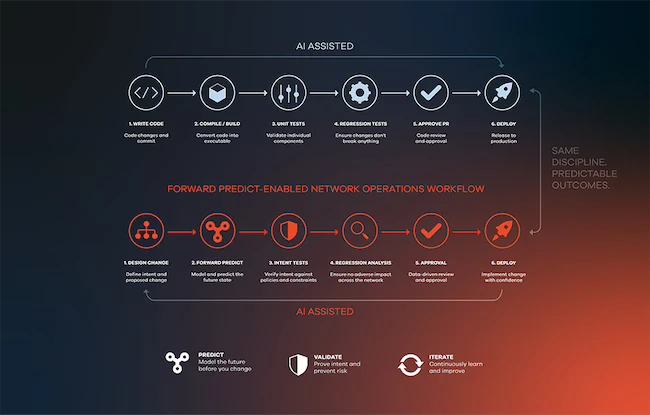
With Forward Predict, these same capabilities extend to future states of the network. Proposed changes are validated against a production equivalent network digital twin spanning every vendor and every cloud. Risks are discovered and resolved before anything touches the live network.
The platform verifies the impact of a change through testing and delivers deterministic evidence of the outcome.
“Once you see the platform and you understand how it works, trusting it is easy,” said Steve Bamford, Senior Network Engineer at IG Group. “I have deliberately tested scenarios that, if pushed live, would have isolated parts of the network and taken the network down. Predict catches them. Being able to test changes across our entire production network before they go live is a game-changer, and it accelerates our autonomous networking journey.”
Forward Predict is already delivering results in beta deployments with select customers, including the ability to:
The ability to predict enables AI agents to safely drive changes. Forward Predict delivers the pre-verification that makes autonomous networking real. Every AI-proposed change is validated against a mathematically accurate digital twin of the entire production network before it executes.
Security, connectivity, and compliance risks are identified in advance, and when a proposed change creates an unintended consequence, the agent receives specific failure feedback and can iterate until a fully verified change is found. This closed-loop verification enables AI to have the same transformative impact on network change that it has had on software development.
“Autonomous networking has long been the goal, but the missing piece has always been trust,” said Zeus Kerravala, principal analyst ZK Research. “Forward Predict changes that by providing a mathematically accurate environment where IT leaders can validate both human and AI-driven changes before they touch production. This creates the safety net required to finally move at machine speed without the fear of manual errors or outages.”
此内容由惯性聚合(RSS阅读器)自动聚合整理,仅供阅读参考。 原文来自 — 版权归原作者所有。