

惯性聚合 高效追踪和阅读你感兴趣的博客、新闻、科技资讯
阅读原文 在惯性聚合中打开

推荐订阅源

博客园 - 叶小钗
Last Week in AI
Last Week in AI
OSCHINA 社区最新新闻
OSCHINA 社区最新新闻
V
V2EX
J
Java Code Geeks
The GitHub Blog
The GitHub Blog
博客园_首页
U
Unit 42
人人都是产品经理
人人都是产品经理
Engineering at Meta
Engineering at Meta
IT之家
IT之家
G
Google Developers Blog
L
LangChain Blog
钛媒体:引领未来商业与生活新知
钛媒体:引领未来商业与生活新知
爱范儿
爱范儿
罗磊的独立博客
博客园 - 三生石上(FineUI控件)
Martin Fowler
Martin Fowler
Jina AI
Jina AI
有赞技术团队
有赞技术团队
Apple Machine Learning Research
Vercel News
Vercel News
小众软件
小众软件
H
Help Net Security

Help Net Security

Your work apps are quietly handing 19 data points to someone ChatGPT advanced account security adds passkeys and hardware keys Week in review: High-severity LPE vulnerability in the Linux kernel, cPanel 0-day exploited for months Automating Pentest Delivery: A Step-by-Step Guide - PlexTrac Open-source privacy proxy masks PII before prompts reach external AI services Shadow AI risks deepen as 31% of users get no employer training Identity is the control plane for distributed infrastructure AI traffic is getting bigger, louder, and less predictable New infosec products of the month: April 2026 cPanel zero-day exploited for months before patch release (CVE-2026-41940) Cisco releases open-source toolkit for verifying AI model lineage Met Police face criticism for using AI to spy on their own officers Nine-year-old Linux kernel flaw enables reliable local privilege escalation (CVE-2026-31431) Hacker with a special interest in breaching sports institutions ends behind bars - Help Net Security Aqua Compass MCP server enables real-time investigation and containment of runtime threats - Help Net Security Google brings instant email verification to Android, no OTP needed - Help Net Security If cyber espionage via HDMI worries you, NCSC built a device to stop it - Help Net Security Apple fixes iPhone bug that let FBI retrieve deleted Signal messages(CVE-2026-28950) - Help Net Security GopherWhisper APT group hides command and control traffic in Slack and Discord - Help Net Security OpenAI tackles a bad habit people have when interacting with AI - Help Net Security A year in, Zoom's CISO reflects on balancing security and business - Help Net Security Scenario: Open-source framework for automated AI app red-teaming - Help Net Security GDPR works, but only where someone enforces it - Help Net Security Ransomware, fraud, and lawsuits drive cyber insurance claims to new peaks - Help Net Security Google’s Workspace Intelligence promises privacy while running on your data - Help Net Security Cyberattack on French government agency triggers phishing alert - Help Net Security Claude Mythos finds 271 Firefox flaws, Mozilla believes zero-days are numbered - Help Net Security Prove Identity Platform connects verification, authentication, and fraud prevention - Help Net Security New Mirai variants target routers and DVRs in parallel campaigns - Help Net Security Acronis GenAI Protection gives MSPs control over AI usage and data risks - Help Net Security
IP Fabric MCP server adds governance and control to enter...
Industry New · 2026-04-23 · via Help Net Security

IP Fabric has launched a new Model Context Protocol (MCP) server that removes key barriers to enterprise AIOps adoption, combining secure in-platform deployment with a built-in prompt library for network operations.
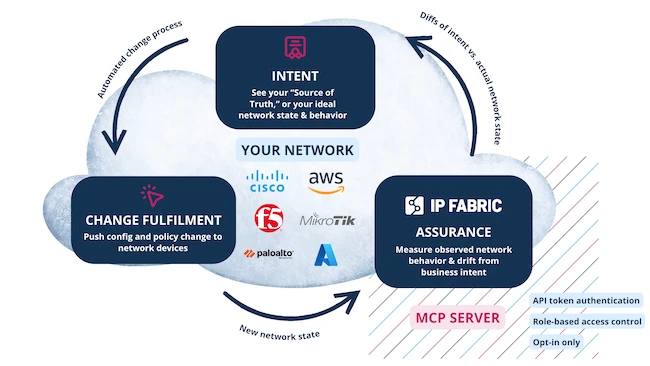
IP Fabric MCP server

While MCP servers and AI integrations are increasingly common, most fall short in enterprise environments where security, control and trusted data are non-negotiable. IP Fabric eliminates these barriers to enterprise AIOps adoption with a purpose-built solution that delivers a practical and governed path to operationalizing AI in network environments.

Enabled directly from the IP Fabric appliance UI, the new MCP server securely delivers the full depth of IP Fabric’s holistic understanding of the entire network and cloud estate, every device, connection and configuration, in a secure, governed manner to AIOps and other automation initiatives. Only IP Fabric’s MCP server is opt-in by default, ensuring full control over data access, which is critical in highly regulated enterprise environments. Its pre-built and expert-tested prompt library provides a clear starting point for common use cases, helping teams apply AI easily and securely to real operational workflows.

“Enterprises are racing toward network automation, only to question if they can trust AI to deliver an outcome that won’t inadvertently damage digital business,” said Pavel Bykov, CEO of IP Fabric. “We built our MCP server to solve that problem at enterprise scale. By combining secure deployment, governed access and a library of proven prompts, we give teams a safe and practical way to securely and successfully bring AI into network operations.”

IP Fabric intelligence and digital twin enable smarter and safer AIOps

IP Fabric’s platform continuously discovers, models and validates network state against business intent. With the MCP server, that intelligence is accessible beyond those who already know where to look. New users and audiences, both technical and nontechnical, can query the network with natural language to generate insights and accelerate decision-making.

With IP Fabric, enterprises can build a verified and vendor-neutral digital twin of the entire network estate in minutes. This can be used to run automated compliance checks, verify autonomous decisions made by AI, and simulate “what-if” scenarios before changes hit production infrastructure.

IP Fabric’s MCP server unlocks new AIOps use cases out of the box, including:

  • Compliance and configuration drift detection that continuously validates the network state against intended design, such as all major security (CIS, NIST, ISO 27001) and regulatory (PCI-DSS, HIPAA, NIS2, DORA) frameworks.
  • Automated troubleshooting and root cause analysis, enabling AI agents to rapidly identify where and why network behavior deviates from intent.
  • Strategic change planning and project acceleration, ranging from SD-WAN migrations and M&A integrations to cloud adoption, grounding high-risk transformation initiatives in verified network intelligence from day one.