



惯性聚合 高效追踪和阅读你感兴趣的博客、新闻、科技资讯
阅读原文 在惯性聚合中打开

推荐订阅源

钛媒体:引领未来商业与生活新知
钛媒体:引领未来商业与生活新知
云风的 BLOG
云风的 BLOG
IT之家
IT之家
C
Check Point Blog
T
The Blog of Author Tim Ferriss
S
SegmentFault 最新的问题
人人都是产品经理
人人都是产品经理
H
Hackread – Cybersecurity News, Data Breaches, AI and More
美团技术团队
M
MIT News - Artificial intelligence
Jina AI
Jina AI
Blog — PlanetScale
Blog — PlanetScale
freeCodeCamp Programming Tutorials: Python, JavaScript, Git & More
Microsoft Security Blog
G
Google Developers Blog
F
Fortinet All Blogs
V
Visual Studio Blog
奇客Solidot–传递最新科技情报
奇客Solidot–传递最新科技情报
T
Tailwind CSS Blog
Hugging Face - Blog
Hugging Face - Blog
MyScale Blog
MyScale Blog
爱范儿
爱范儿
The Cloudflare Blog
博客园 - 三生石上(FineUI控件)

Help Net Security

Your work apps are quietly handing 19 data points to someone ChatGPT advanced account security adds passkeys and hardware keys Week in review: High-severity LPE vulnerability in the Linux kernel, cPanel 0-day exploited for months Automating Pentest Delivery: A Step-by-Step Guide - PlexTrac Shadow AI risks deepen as 31% of users get no employer training Identity is the control plane for distributed infrastructure AI traffic is getting bigger, louder, and less predictable New infosec products of the month: April 2026 cPanel zero-day exploited for months before patch release (CVE-2026-41940) Cisco releases open-source toolkit for verifying AI model lineage Met Police face criticism for using AI to spy on their own officers Nine-year-old Linux kernel flaw enables reliable local privilege escalation (CVE-2026-31431) Hacker with a special interest in breaching sports institutions ends behind bars - Help Net Security IP Fabric MCP server adds governance and control to enterprise AIOps workflows - Help Net Security Aqua Compass MCP server enables real-time investigation and containment of runtime threats - Help Net Security Google brings instant email verification to Android, no OTP needed - Help Net Security If cyber espionage via HDMI worries you, NCSC built a device to stop it - Help Net Security Apple fixes iPhone bug that let FBI retrieve deleted Signal messages(CVE-2026-28950) - Help Net Security GopherWhisper APT group hides command and control traffic in Slack and Discord - Help Net Security OpenAI tackles a bad habit people have when interacting with AI - Help Net Security A year in, Zoom's CISO reflects on balancing security and business - Help Net Security Scenario: Open-source framework for automated AI app red-teaming - Help Net Security GDPR works, but only where someone enforces it - Help Net Security Ransomware, fraud, and lawsuits drive cyber insurance claims to new peaks - Help Net Security Google’s Workspace Intelligence promises privacy while running on your data - Help Net Security Cyberattack on French government agency triggers phishing alert - Help Net Security Claude Mythos finds 271 Firefox flaws, Mozilla believes zero-days are numbered - Help Net Security Prove Identity Platform connects verification, authentication, and fraud prevention - Help Net Security New Mirai variants target routers and DVRs in parallel campaigns - Help Net Security Acronis GenAI Protection gives MSPs control over AI usage and data risks - Help Net Security
Open-source privacy proxy masks PII before prompts reach ...
Sinisa Marko · 2026-05-01 · via Help Net Security

Enterprise developers routinely send prompts to external large language models that contain customer emails, support transcripts, and other identifying information, often without a sanitization layer between the application and the API. Dataiku has released Kiji Privacy Proxy, an open-source local gateway that detects and masks personally identifiable information before requests leave the network.
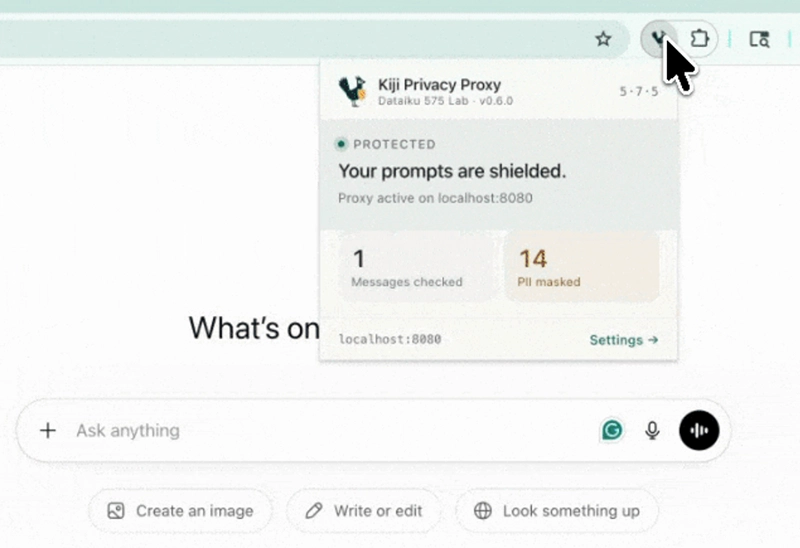
PII privacy proxy

The tool sits between local applications and external AI APIs such as OpenAI and Anthropic. Inbound requests pass through a machine learning model that flags 16 or more categories of PII, including email addresses, phone numbers, Social Security numbers, credit card numbers, and IP addresses. It substitutes detected entries with realistic dummy values, forwards the masked request to the upstream API, and restores the original values in the response so the calling application receives output that matches its input.

Local inference and deployment options

PII detection runs on a quantized DistilBERT model executed through ONNX Runtime on the user’s machine, with no calls to outside services for the detection step itself. Latency stays under 100 milliseconds for most requests, according to the project documentation. The base model achieved a 94 percent F1 score on an industry benchmark dataset.

Distribution covers three form factors. macOS users install a native Electron desktop application that configures Proxy Auto-Config so Safari and Chrome route traffic through Kiji on port 8081 without manual environment variables. Linux users run a standalone server binary and set HTTP_PROXY and HTTPS_PROXY values. A separate Chrome extension routes web requests through the proxy for users who interact with services like ChatGPT through a browser.

Compliance drivers

Sending PII to a third-party API can trigger obligations under GDPR, HIPAA, and CCPA, and many enterprises restrict what data may leave the corporate perimeter. A 2026 Dataiku survey of 600 CIOs found that 85 percent had seen AI projects delayed or blocked because of gaps in traceability or explainability, with privacy concerns a significant factor.

Kiji Privacy Proxy is available for free on GitHub.

Must read:

Subscribe to the Help Net Security ad-free monthly newsletter to stay informed on the essential open-source cybersecurity tools. Subscribe here!