



惯性聚合 高效追踪和阅读你感兴趣的博客、新闻、科技资讯
阅读原文 在惯性聚合中打开

推荐订阅源

小众软件
小众软件
A
About on SuperTechFans
博客园 - Franky
Engineering at Meta
Engineering at Meta
Recent Announcements
云风的 BLOG
云风的 BLOG
B
Blog
Microsoft Security Blog
L
LangChain Blog
OSCHINA 社区最新新闻
OSCHINA 社区最新新闻
U
Unit 42
Martin Fowler
Martin Fowler
Y
Y Combinator Blog
Stack Overflow Blog
Stack Overflow Blog
博客园 - 叶小钗
Vercel News
Vercel News
Apple Machine Learning Research
The Cloudflare Blog
Last Week in AI
Last Week in AI
腾讯CDC
Microsoft Azure Blog
爱范儿
爱范儿
V
V2EX
G
Google Developers Blog

Help Net Security

ChatGPT advanced account security adds passkeys and hardware keys Week in review: High-severity LPE vulnerability in the Linux kernel, cPanel 0-day exploited for months Automating Pentest Delivery: A Step-by-Step Guide - PlexTrac Open-source privacy proxy masks PII before prompts reach external AI services Shadow AI risks deepen as 31% of users get no employer training Identity is the control plane for distributed infrastructure AI traffic is getting bigger, louder, and less predictable New infosec products of the month: April 2026 cPanel zero-day exploited for months before patch release (CVE-2026-41940) Cisco releases open-source toolkit for verifying AI model lineage Met Police face criticism for using AI to spy on their own officers Nine-year-old Linux kernel flaw enables reliable local privilege escalation (CVE-2026-31431) Hacker with a special interest in breaching sports institutions ends behind bars - Help Net Security IP Fabric MCP server adds governance and control to enterprise AIOps workflows - Help Net Security Aqua Compass MCP server enables real-time investigation and containment of runtime threats - Help Net Security Google brings instant email verification to Android, no OTP needed - Help Net Security If cyber espionage via HDMI worries you, NCSC built a device to stop it - Help Net Security Apple fixes iPhone bug that let FBI retrieve deleted Signal messages(CVE-2026-28950) - Help Net Security GopherWhisper APT group hides command and control traffic in Slack and Discord - Help Net Security OpenAI tackles a bad habit people have when interacting with AI - Help Net Security A year in, Zoom's CISO reflects on balancing security and business - Help Net Security Scenario: Open-source framework for automated AI app red-teaming - Help Net Security GDPR works, but only where someone enforces it - Help Net Security Ransomware, fraud, and lawsuits drive cyber insurance claims to new peaks - Help Net Security Google’s Workspace Intelligence promises privacy while running on your data - Help Net Security Cyberattack on French government agency triggers phishing alert - Help Net Security Claude Mythos finds 271 Firefox flaws, Mozilla believes zero-days are numbered - Help Net Security Prove Identity Platform connects verification, authentication, and fraud prevention - Help Net Security New Mirai variants target routers and DVRs in parallel campaigns - Help Net Security Acronis GenAI Protection gives MSPs control over AI usage and data risks - Help Net Security
Mavenir turns NOC knowledge into automation for autonomou...
Industry News · 2026-06-23 · via Help Net Security

Mavenir has announced its Agentic Service Assurance Framework, a TM Forum IG1251/IG1453-aligned, multi-agent system that automates complex network operations across multiple domains without replacing existing systems.

The framework pairs an Intent Orchestrator with a multi-layer agentic ecosystem in which AI helps detect, diagnose, recommend, and resolve network faults, improving operator productivity and accelerating the path to autonomous network operations.
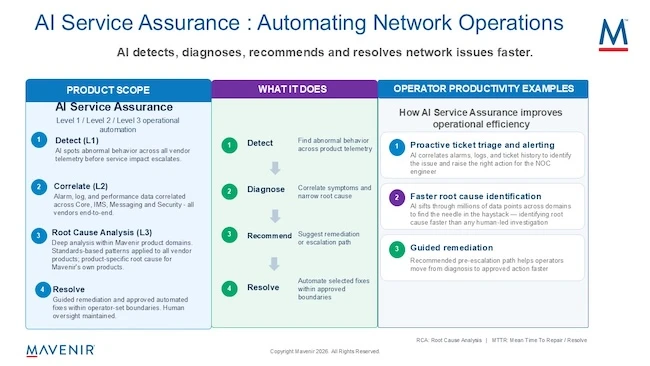
Mavenir Agentic Service Assurance Framework

Network operations across 5G, cloud-native, and IP domains are expensive, fragmented, and increasingly difficult to manage at scale. Assurance systems fire alarms but rarely diagnose root causes. Experienced engineers retire, taking decades of institutional knowledge with them.

Multi-vendor environments generate siloed data that no single tool can correlate. AI tools that reason only over static data models cannot fill that gap. Mavenir’s answer is architectural: a multi-layer, multi-agent framework that learns from how networks are actually operated and automates what skilled engineers do.

At the core of the framework is the Intent Ops engine: a system that observes how NOC teams actually work, learns the patterns behind successful resolution, and converts proven human workflows into repeatable, explainable automation templates with built-in guardrails.

Unlike approaches that reason only over static data models, Intent Ops actively captures institutional expertise from live NOC operations and from third-party vendor teams, publishing vetted automations to a continuously growing orchestration catalog. Every workflow is validated against a human baseline before autonomous execution. The result: the network runs on operators’ best knowledge, not a frozen snapshot of it.

The framework helps deliver cross-domain monitoring, context-aware correlation, and domain-intelligence-driven root-cause analysis across domains, with closed-loop remediation on Mavenir products. Integration with existing OSS AI agents is achieved via the Agent-to-Agent (A2A) protocol defined in IG1453, preserving operators’ existing investments while extending automation reach across the full network stack.

Retaining operational control across geographically distributed, cloud-native networks is one of the most pressing challenges operators face today. Mavenir’s framework helps address this directly with AI-driven workflows spanning deployment topology, application health, interface health, and service status, each backed by trusted, auditable remediation actions.

The framework’s priorities map directly to operator demand. Recent industry research ranks AI-driven trace and log analysis, cross-domain fault correlation, and automated diagnosis of complex interconnect issues as the top operational priorities. These are precisely the capabilities Mavenir’s Agentic Service Assurance Framework delivers.

Framework highlights

  • Standards-native architecture (IG1251/IG1453): Multi-agent architecture and A2A communication built natively to TM Forum IG1251 and IG1453, which is the industry’s definitive specifications for autonomous networks and agent interoperability.
  • Intent Orchestration: Operators express desired outcomes as natural-language or voice intent. The platform interprets, plans, executes, and validates end-to-end, continuously refining automation as network conditions evolve.
  • Intent Ops Knowledge Capture: Actively learns from live NOC team workflows and third-party vendor operations, converting proven human expertise into a continuously growing, vendor-neutral automation catalog.
  • Multi-vendor, multi-domain: Spans L1 monitoring to L3 remediation across heterogeneous networks without replacing incumbent systems.
  • Closed-loop validation: Every automated workflow is validated using pre-validated workflows before autonomous execution, ensuring consistency, accuracy, and a full audit trail. Mavenir closes the loop; it does not just recommend.

“Every operator I talk to is wrestling with the same paradox: their networks are becoming more complex while the operational expertise to run them is retiring. Intent Ops solves that paradox directly. It captures what your best engineers know, validates it, and makes it available to the entire operations organization, autonomously and at scale. This is how you build a network that genuinely runs itself,” said Bejoy Pankajakshan, EVP, Chief Technology & Strategy Officer, Mavenir.

“Operators need practical routes to autonomous networks that work across complex, multi-vendor environments. Intent-based operations and knowledge capture aligned to TM Forum’s frameworks can help turn proven NOC expertise into scalable automation. Mavenir’s approach shows the direction the industry needs: open, standards-based autonomy operators can trust,” added Andy Tiller, EVP Member Products, TM Forum.