




惯性聚合 高效追踪和阅读你感兴趣的博客、新闻、科技资讯
阅读原文 在惯性聚合中打开

推荐订阅源

Jina AI
Jina AI
大猫的无限游戏
大猫的无限游戏
T
Tailwind CSS Blog
酷 壳 – CoolShell
酷 壳 – CoolShell
WordPress大学
WordPress大学
Last Week in AI
Last Week in AI
Hugging Face - Blog
Hugging Face - Blog
阮一峰的网络日志
阮一峰的网络日志
让小产品的独立变现更简单 - ezindie.com
人人都是产品经理
人人都是产品经理
V
V2EX
博客园 - 叶小钗
雷峰网
雷峰网
小众软件
小众软件
量子位
V
Visual Studio Blog
H
Hackread – Cybersecurity News, Data Breaches, AI and More
The GitHub Blog
The GitHub Blog
Martin Fowler
Martin Fowler
G
Google Developers Blog
博客园_首页
博客园 - Franky
有赞技术团队
有赞技术团队
宝玉的分享
宝玉的分享

Futurism

China Deploys Rare Type of Space Junk That Pollutes Orbit for Hundreds of Years Researchers Alarmed as GPS Readings Suddenly Veer Off by 33 Feet, Enough to Crash Self-Driving Cars NASA's Powerful New Space Telescope, Just Cleared for Launch, Was Developed by an Intelligence Agency to "Spy on America's Adversaries" NASA Set Up a Major Test of Its New Strategy Under Trump by Hiring a Startup to Launch a Daring Mission to Rescue a Dying Space Telescope in Orbit. The Unfortunate Result Will Have Long-Ranging Repercussions. Scientists Warn That New Satellites Could Cause Eye Damage for People on the Ground Scientist Reveals Plan to Save Earth From Destruction by the Sun NASA Rescue Mission Spirals Into Crisis Incredible Video Shows Chinese Rocket Get Hit by Lightning Mid-Launch SpaceX Plunges to All-Time Low After Competitor Makes Major Leap China Is Catching Up With SpaceX Fast, Landing First Reusable Rocket Booster on Offshore Platform Scientists Test New Spacecraft Thruster That Uses No Fuel, Just Earth's Magnetic Field, in Orbit Experts Say Mysterious Metallic Orbs Appear to Have Fallen From the Sky Anybody Who Thinks Orbital Data Centers are a Good Idea Is Suffering from AI Psychosis, Experts Argue NASA Prepping to Launch Extremely Risky Rescue Mission Boeing's Starliner Is Such a Disaster That We Don't Even Have Words NASA Has a Major Problem Threatening Its Entire Moon Plans NASA Rover Finds "Complex Organic Matter" on Mars SpaceX Launches Secretive New Spacecraft Shaped Like Flying Saucer Saturn's Icy Moon Is the Perfect Place to Settle, NASA Scientist Argues Scientists Building World's Most Powerful Radio Telescope Deep in the Nevada Desert NASA Loads Moon Rocket onto Giant Trump-Branded Train NASA’s Next Moon Mission Is a Rube Goldberg Machine of Corporate Failure Points Scientists Release Results After Scanning 3I/ATLAS for Alien Signals NASA’s James Webb Discovers That 3I/ATLAS Let One Rip as It Passed Through Solar System Scientists Find Chunk of Lost Planet in Desert ISS Astronauts Ordered to Enter Evacuation Mode Paper Claims the “Asteroid” Japan’s Probe Is Approaching Is Actually a Derelict Spacecraft Scientists Say They’ve Found Fungi That Turn Dead Martian Soil Into Fertile Cropland Jeff Bezos’ Rocket Explodes Into Mushroom Cloud, Dealing Massive Blow to NASA’s Moon Plans NASA Releases Sweeping Plans for Moon Base
Scientists Baffled by Bizarre "Anomaly" Deep Beneath the ...
Victor Tangermann · 2026-08-29 · via Futurism

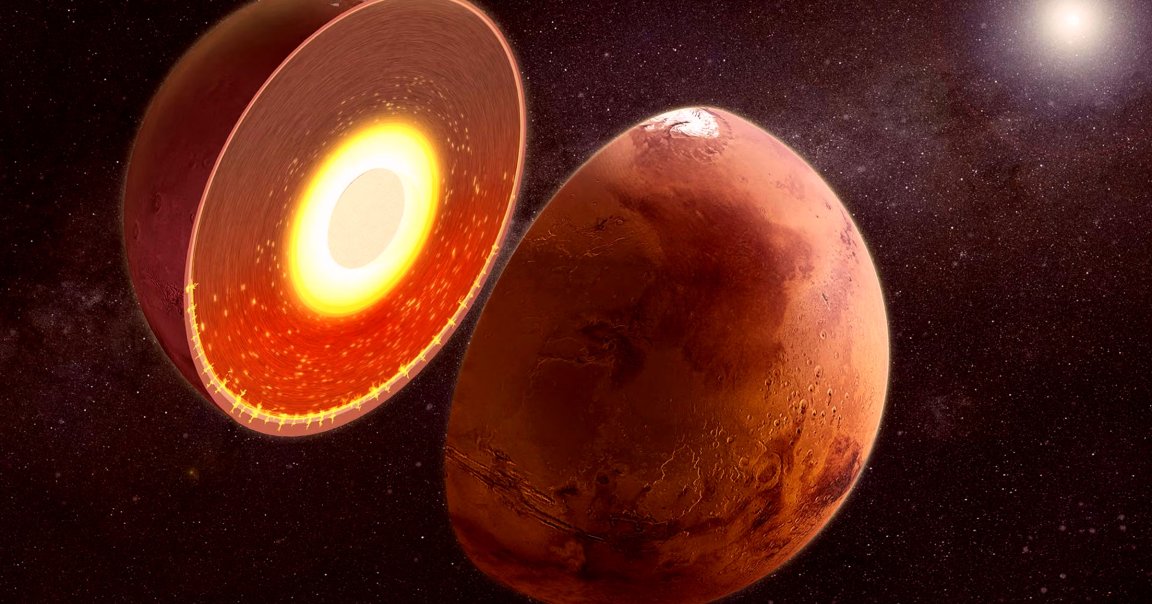
Artist concept of Mars's warm southern interior.

NASA / Theophilus Britt Griswold

Sign up to see the future, today

Can’t-miss innovations from the bleeding edge of science and tech

Scientists have detected an unusual “thermal asymmetry” buried deep beneath the surface of Mars’ southern hemisphere — and they’re only beginning to postulate potential explanations for its existence.

As detailed in a new paper published in the journal Nature, the team found that the interior of the Red Planet’s southern half is roughly 400 to 750 degrees Fahrenheit warmer than its northern half. The unexpected discrepancy could give scientists important clues about the period during which the planet was warm enough to host life billions of years ago.

The surfaces of the planet’s two halves are dramatically different. The south is densely cratered and stands several miles higher, while the northern half is relatively smooth and dotted with plains.

“Scientists usually assume that the interiors of planetary bodies are generally spherically symmetric, but this is not necessarily true,” said lead author and University of Arizona planetary scientist Alexander Berne in a statement. “As we get more gravity data, we can determine the three-dimensional intricacies of a planet’s interior structure.”

“These inferences in turn give us a blueprint for designing future missions and scientific exploration of these worlds,” he added. “Understanding the interior structure of planetary bodies helps us unravel the processes that shaped their formation and evolution.”

The considerable “thermal anomaly” could indicate that the planet’s southern mantle was once covered in a magnetic field strong enough to trigger changes particular to Mars’ southern hemisphere.

It may have also “influenced the hydrology of Mars, including the formation of basins that may have held water,” as coauthor and Caltech postdoctoral scholar Amirhossein Bagheri explained in the statement.

The scientists are only starting to unravel possible explanations. One hypothesis suggests a giant impact forced the heat to escape the northern hemisphere, random convection currents in the past, and the southern hemisphere’s massive mountains trapping excess heat.

“This temperature variation could reflect regional mantle convection or insulation by the thick southern highlands crust of Mars that has persisted over several billion years,” the scientists conluded int heir paper.

It’s part of a much larger puzzle that will require many years to unpack.

“There are still questions to be answered,” Washington University in St. Louis planetary scientist Paul Byrne told Scientific American. For one, he questioned why the planet’s largest volcanic province sits ont he margins between the north and south, not the south, where the mantle is far hotter.

The origin is “still an ongoing question in Mars science, and a pretty fundamental one,” as coauthor and Brown University planetary scientist Nick Wagner told 404 Media. “This study doesn’t provide an answer to it, but adds another line of evidence to figure out what is actually going on underneath Mars.”

More on Mars: NASA Fires Up Futuristic Plasma Thruster Designed to Take Us to Mars