


惯性聚合 高效追踪和阅读你感兴趣的博客、新闻、科技资讯
阅读原文 在惯性聚合中打开

推荐订阅源

V
Visual Studio Blog
I
InfoQ
freeCodeCamp Programming Tutorials: Python, JavaScript, Git & More
博客园 - 【当耐特】
小众软件
小众软件
B
Blog RSS Feed
大猫的无限游戏
大猫的无限游戏
博客园 - 三生石上(FineUI控件)
Engineering at Meta
Engineering at Meta
人人都是产品经理
人人都是产品经理
Microsoft Security Blog
Last Week in AI
Last Week in AI
H
Help Net Security
爱范儿
爱范儿
云风的 BLOG
云风的 BLOG
博客园 - 司徒正美
Y
Y Combinator Blog
H
Hackread – Cybersecurity News, Data Breaches, AI and More
Microsoft Azure Blog
L
LangChain Blog
WordPress大学
WordPress大学
GbyAI
GbyAI
Google DeepMind News
腾讯CDC

Futurism

China Deploys Rare Type of Space Junk That Pollutes Orbit for Hundreds of Years Scientists Baffled by Bizarre "Anomaly" Deep Beneath the Surface of Mars NASA's Powerful New Space Telescope, Just Cleared for Launch, Was Developed by an Intelligence Agency to "Spy on America's Adversaries" NASA Set Up a Major Test of Its New Strategy Under Trump by Hiring a Startup to Launch a Daring Mission to Rescue a Dying Space Telescope in Orbit. The Unfortunate Result Will Have Long-Ranging Repercussions. Scientists Warn That New Satellites Could Cause Eye Damage for People on the Ground Scientist Reveals Plan to Save Earth From Destruction by the Sun NASA Rescue Mission Spirals Into Crisis Incredible Video Shows Chinese Rocket Get Hit by Lightning Mid-Launch SpaceX Plunges to All-Time Low After Competitor Makes Major Leap China Is Catching Up With SpaceX Fast, Landing First Reusable Rocket Booster on Offshore Platform Scientists Test New Spacecraft Thruster That Uses No Fuel, Just Earth's Magnetic Field, in Orbit Experts Say Mysterious Metallic Orbs Appear to Have Fallen From the Sky Anybody Who Thinks Orbital Data Centers are a Good Idea Is Suffering from AI Psychosis, Experts Argue NASA Prepping to Launch Extremely Risky Rescue Mission Boeing's Starliner Is Such a Disaster That We Don't Even Have Words NASA Has a Major Problem Threatening Its Entire Moon Plans NASA Rover Finds "Complex Organic Matter" on Mars SpaceX Launches Secretive New Spacecraft Shaped Like Flying Saucer Saturn's Icy Moon Is the Perfect Place to Settle, NASA Scientist Argues Scientists Building World's Most Powerful Radio Telescope Deep in the Nevada Desert NASA Loads Moon Rocket onto Giant Trump-Branded Train NASA’s Next Moon Mission Is a Rube Goldberg Machine of Corporate Failure Points Scientists Release Results After Scanning 3I/ATLAS for Alien Signals NASA’s James Webb Discovers That 3I/ATLAS Let One Rip as It Passed Through Solar System Scientists Find Chunk of Lost Planet in Desert ISS Astronauts Ordered to Enter Evacuation Mode Paper Claims the “Asteroid” Japan’s Probe Is Approaching Is Actually a Derelict Spacecraft Scientists Say They’ve Found Fungi That Turn Dead Martian Soil Into Fertile Cropland Jeff Bezos’ Rocket Explodes Into Mushroom Cloud, Dealing Massive Blow to NASA’s Moon Plans NASA Releases Sweeping Plans for Moon Base
Researchers Alarmed as GPS Readings Suddenly Veer Off by ...
Victor Tangermann · 2026-09-02 · via Futurism

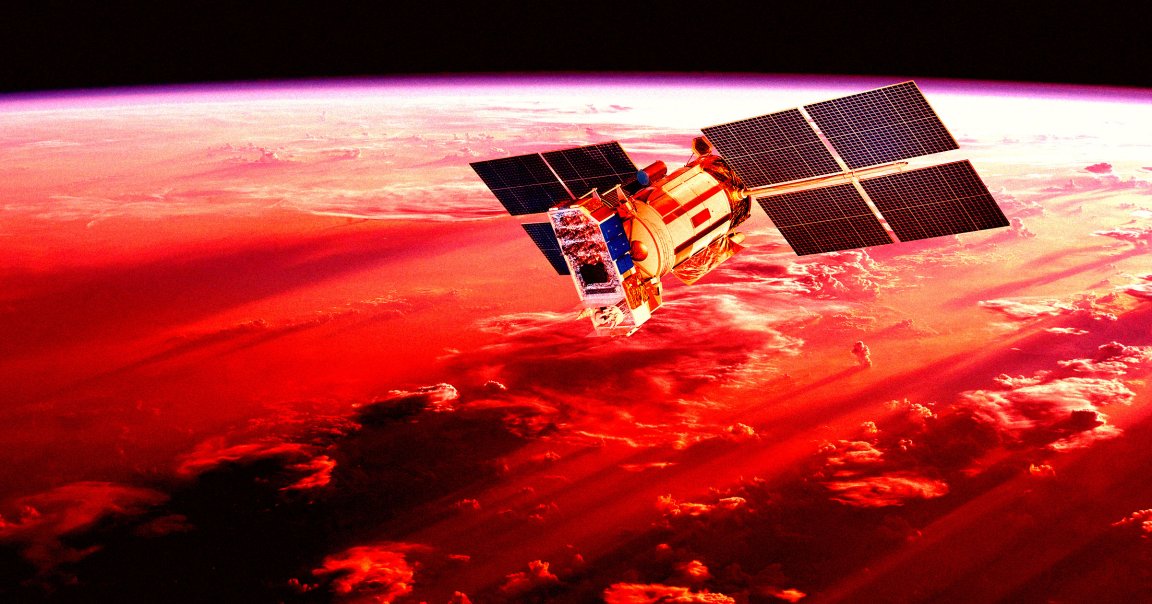
A color-treated photo of a satellite.

Shutterstock / Futurism

In November of last year, scientists warned of a “severe” solar storm, the strongest in over two decades, colliding with the Earth.

Solar storms are the result of a surge in solar activity, with the Sun unleashing a barrage of charged particles that can trigger spectacular auroras — and wreak havoc with communications satellites and radio signals — when they reach the Earth’s magnetosphere.

Beyond being ferocious enough to delay the launch of a Mars-bound NASA spacecraft, the storm wreaked absolute havoc with GPS systems back on the ground for hours at a time. As detailed in a new paper published in the journal Geophysical Research Letters, a team of scientists found that global navigation satellite systems experienced “significant positioning errors” of over 33 feet during the superstorm, “large enough to disrupt precision agriculture and autonomous transportation industries” across the continental United States.

That’s enough risk to warrant a careful study on these types of events can impact human activity on Earth.

“The results underscore the importance of accurate understanding of various space weather phenomena to enhance our predictive capabilities through coordinated observations and physics‐based modeling and ultimately reducing disruptions to RF applications during space weather events,” the paper reads.

The researchers analyzed observations from several scientific instruments spread out across the US to watch the chaos unfold last November. The Aurora Oval, a ring-shaped area of pronounced activity around the Earth’s geomagnetic north pole where auroras conventionally occur, was pushed south toward the equator. This triggered a “horizontally extended band of intense density gradients” in the upper atmosphere, causing fluctuations in how long signals take to travel through it.

The result: “significant positioning errors at mid-latitudes,” the researchers noted.

The researchers also found that as the auroras became brighter, the observed irregularities became more intense, deteriorating GPS accuracy accordingly.

Fortunately, while farming equipment like GPS-equipped tractors would’ve likely been affected, the November storm occurred long after the farming season concluded.

However, that wasn’t the case for the May 2024 superstorm, which scientists estimate cost farmers half a billion dollars in damages.

“Had the November superstorm occurred during the farming season in the American sector, it could have caused significant economic losses for the American farming industry, in addition to affecting the autonomous transportation industry,” the paper reads.

More on the solar storm: Scientists Say the Largest Solar Storm in Two Decades Is About to Blast Earth