







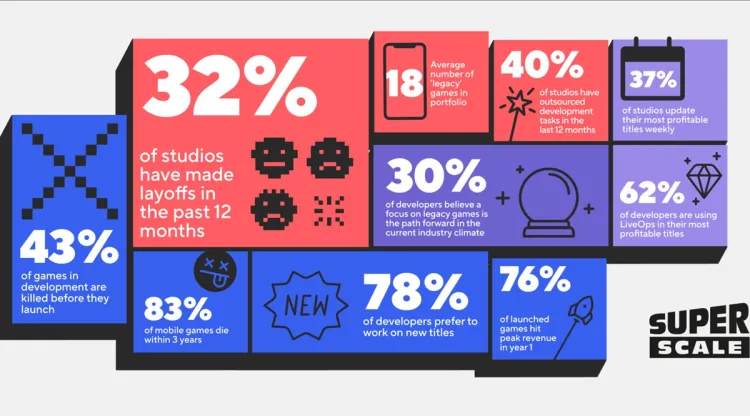
SuperScale, a company based in London that helps mobile games grow, recently published a report based on interviews with 500 game developers in the UK and US. It found that 43% of mobile gaming apps do not make it past the development stage. Let’s take a look.
The fact that 43% of mobile games don’t make it past the development stage highlights the high level of risk and uncertainty in game development. It might also raise concern over a high portion of resources invested in game creation going to waste.
The report also found that among the games that do get released, a whopping 83% stop getting updates and services within three years.
- Advertisement -

The gap between a 65% and 90%+ privacy opt-in rate can mean $525,000 in lost revenue annually for a 100K DAU app — and most teams have no idea where they stand.
This guide breaks down the true cost of consent debt, why the average app sits at just 80% opt-in, and the exact tactics top performers use to consistently hit 90%+: prompt timing, banner design, vendor list optimization, and more.
The short lifecycle of games is a serious challenge for developers who are already struggling to maintain relevance and profitability in the highly competitive mobile gaming market.
This is a tough situation for game developers. Many of them prefer working on new games rather than improving existing ones. However, 62% of their most profitable games rely on constant updates and engagement with players.
So, even though developers want to create new games, it might not be as financially rewarding, especially when so many games fail even before they’re launched.
The report also cites economic difficulties and job layoffs in the gaming industry this year. In fact, 32% of the developers who were interviewed had to let go of employees, and 40% had to hire external help for tasks, especially in hypercasual and collectable card game studios.
Nearly 25% of developers came close to shutting down completely in 2023.
Ivan Trancik, the founder and CEO of SuperScale, acknowledged that these are tough times for the gaming industry. He mentioned challenges like competition, economic conditions, and changes like the ATT (App Tracking Transparency) policy. However, he also sees an opportunity for the industry to revisit and revitalize existing gaming content.
SuperScale’s report also provides insights into current trends, how developers measure their game’s success, and the ways they make money from their games.
此内容由惯性聚合(RSS阅读器)自动聚合整理,仅供阅读参考。 原文来自 — 版权归原作者所有。