











NOTE: If you are short on time, watch the video and complete this See, Think, Wonder activity: What did you notice? What did the story make you think? What would you want to learn more about?
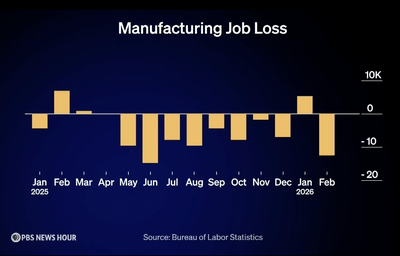
The U.S. job market has been cooling, and it’s only getting harder for Americans to find a job. One sector that has proved tougher than most is manufacturing. President Trump has promised a manufacturing boom in both of his terms. While he has been able to get pledges for more factory investment, the real job numbers tell a different story so far. Economics correspondent Paul Solman reports.
View the transcript of the story.
News alternative: Check out recent segments from the NewsHour, and choose the story you’re most interested in watching. You can make a Google doc copy of discussion questions that work for any of the stories here.
Key Terms
tariff — a tax on imported or exported goods
Media literacy: Why do you think this segment focused on manufacturing jobs in the state of Ohio? What is significant about that state that might make it a good focus for this story?
The News Hour included two infographics in this segment. One shows manufacturing job losses since President Trump took office in January 2025. The other states how many manufacturing jobs were lost over a more than 20 year period. Examine the infographics and then discuss the questions below —

The News: Then & Now section of the Daily News Lessons allows students to see connections between current and past news events. The activity provides historical context using primary sources from the Library of Congress.
See PBS News Hour Classroom's Journalism in Action website for interactive examples of how journalists covered key events in U.S. history while honing your primary source, civics and digital news literacy skills.
The Industrial Revolution of the 19th century brought major changes to American society, moving it from a largely agrarian (farming) economy to a manufacturing one.
Examine the political cartoon (1883) by Bernhard Gillam created during the Gilded Age (1870s to 1890s). The cartoon shows so-called captains of industry (also known as Robber Barrons) Cyrus Field, Jay Gould, Cornelius Vanderbilt, and Russell Sage, seated on bags of millions of dollars on top of a large raft being carried by workers of various professions.
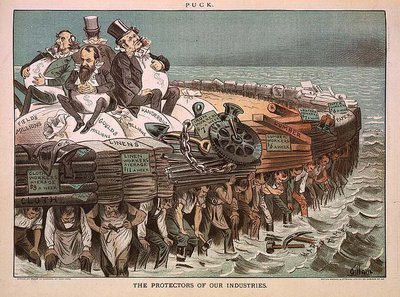
"The protectors of our industries." Puck, v. 12, no. 309, (1883 February 7), Library of Congress. Washington, D.C. https://www.loc.gov/pictures/resource/ds.16881/
Now take a look at the 1907 photograph of women sewing in a shirt factory in Troy, N.Y. You can explore more of the Progressive Era and the treatment of workers in Journalism in Action's case study here.
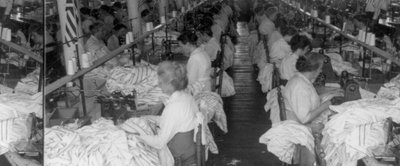
Keystone View Company. Sewing room, shirt factory, Troy, N.Y. New York Troy, ca. 1907. Meadville, Pa.: Keystone View Company. Photograph. https://www.loc.gov/item/89706288/.
As the closing graphic in the News Hour story states, the U.S. has lost 5 million manufacturing jobs between 1998 and 2020. The manufacturing sector, which peaked in 1979, has been hard hit due to global competition, exchange rates and automation. President Trump promised a manufacturing boom in both of his terms, which has not yet come to fruition (= has not occurred).
Discussion questions:
Sign up to receive our weekly newsletter with Daily News Lessons and community events.
To provide feedback on News Hour Classroom's resources, including this lesson, click here.
此内容由惯性聚合(RSS阅读器)自动聚合整理,仅供阅读参考。 原文来自 — 版权归原作者所有。