
惯性聚合 高效追踪和阅读你感兴趣的博客、新闻、科技资讯
阅读原文 在惯性聚合中打开

推荐订阅源

cs.AI updates on arXiv.org
V
Vulnerabilities – Threatpost
Security Latest
Security Latest
T
Threatpost
L
Lohrmann on Cybersecurity
Know Your Adversary
Know Your Adversary
Cyberwarzone
Cyberwarzone
S
Securelist
A
Arctic Wolf
W
WeLiveSecurity
Help Net Security
Help Net Security
Last Week in AI
Last Week in AI
H
Hacker News: Front Page
freeCodeCamp Programming Tutorials: Python, JavaScript, Git & More
大猫的无限游戏
大猫的无限游戏
博客园 - 聂微东
博客园_首页
NISL@THU
NISL@THU
N
News and Events Feed by Topic
博客园 - 【当耐特】
S
Schneier on Security
阮一峰的网络日志
阮一峰的网络日志
Cloudbric
Cloudbric
P
Privacy International News Feed
小众软件
小众软件
OSCHINA 社区最新新闻
OSCHINA 社区最新新闻
K
KPMG report finds enterprise disconnect between AI and its ROI | CIO
宝玉的分享
宝玉的分享
Latest news
Latest news
美团技术团队
T
The Exploit Database - CXSecurity.com
S
Security Affairs
月光博客
月光博客
M
MIT News - Artificial intelligence
GbyAI
GbyAI
D
Docker
IT之家
IT之家
PCI Perspectives
PCI Perspectives
Application and Cybersecurity Blog
K
Kaspersky official blog
WordPress大学
WordPress大学
V2EX - 技术
V2EX - 技术
L
LINUX DO - 最新话题
P
Proofpoint News Feed
Google Online Security Blog
C
CERT Recently Published Vulnerability Notes
奇客Solidot–传递最新科技情报
奇客Solidot–传递最新科技情报
C
Cyber Attacks, Cyber Crime and Cyber Security
J
Java Code Geeks
I
InfoQ

JPost.com - Archaeology Around the World

Second century CE Roman military fort found north of Hadrian's Wall in Scotland | The Jerusalem Post Ancient mosaic with Greek inscription discovered in Turkey | The Jerusalem Post Collection of pre-revolution coins found under house in Russia | The Jerusalem Post Handgun fragments found in Germany may be oldest in Europe | The Jerusalem Post Archaeologists find evidence to legendary African king in Sudan | The Jerusalem Post Archaeologists find gold, ceramic in pre-Hispanic tomb in Panama | The Jerusalem Post Ancient Egyptians used 'Wite-Out' to fix mistakes in sacred texts | The Jerusalem Post Cambridge students find 9th century burial pit on dig | The Jerusalem Post Mexico discovers Zapotec tomb from 600 CE | The Jerusalem Post Medieval tunnel system discovered in Germany | The Jerusalem Post Roman carriage ornament found in Essex deemed 'Treasure' | The Jerusalem Post Humans, not glaciers, brought stones to Stonehenge | The Jerusalem Post Indonesia human hand outline may be world's oldest rock art | The Jerusalem Post New human species found, challenges story of 'Lucy' fossil | The Jerusalem Post Ancient Scottish burial site reveals Bronze Age devastation | The Jerusalem Post Louvre shuts fragile wing with Greek masterpieces | The Jerusalem Post Israeli team finds 12,000-year myths in clay figurine | The Jerusalem Post 800-year-old gilded Christ found near lost church | The Jerusalem Post Archaeologists uncover long-lost Temple of Zeus at Limyra | The Jerusalem Post Study shows dogs diversified before modern breeding | The Jerusalem Post Medieval Muslim sunken city discovered in Kyrgyzstan | The Jerusalem Post Archaeologists uncover finds at birthplace of Menander | The Jerusalem Post ‘This is from Moses’: Newly imaged Sinai inscriptions revive Exodus-era | The Jerusalem Post Ancient inscriptions reveal identity of Great Pyramid builders | The Jerusalem Post Atlantis ruins near Cadiz found, archaeologist blames giant tsunami | The Jerusalem Post 5,000-year-old manuscript with eerie message found in Saqqara tomb | The Jerusalem Post Study: Leprosy existed in the Americas long before Europeans arrived | The Jerusalem Post Original architecture of ancient Roman fountain revealed in Perre Ancien | The Jerusalem Post Museum: Artifact shows playful, serious sides of 19th-century sexuality | The Jerusalem Post
Ancient tools uncovered in China shed new light on early human diet | The Jerusalem Post
JERUSALEM POST STAFF · 2025-07-07 · via JPost.com - Archaeology Around the World

The tools include digging sticks made of pine and hardwood, hooks for cutting roots, and small, pointed implements for extracting edible plants from the ground.
Follow us on Google
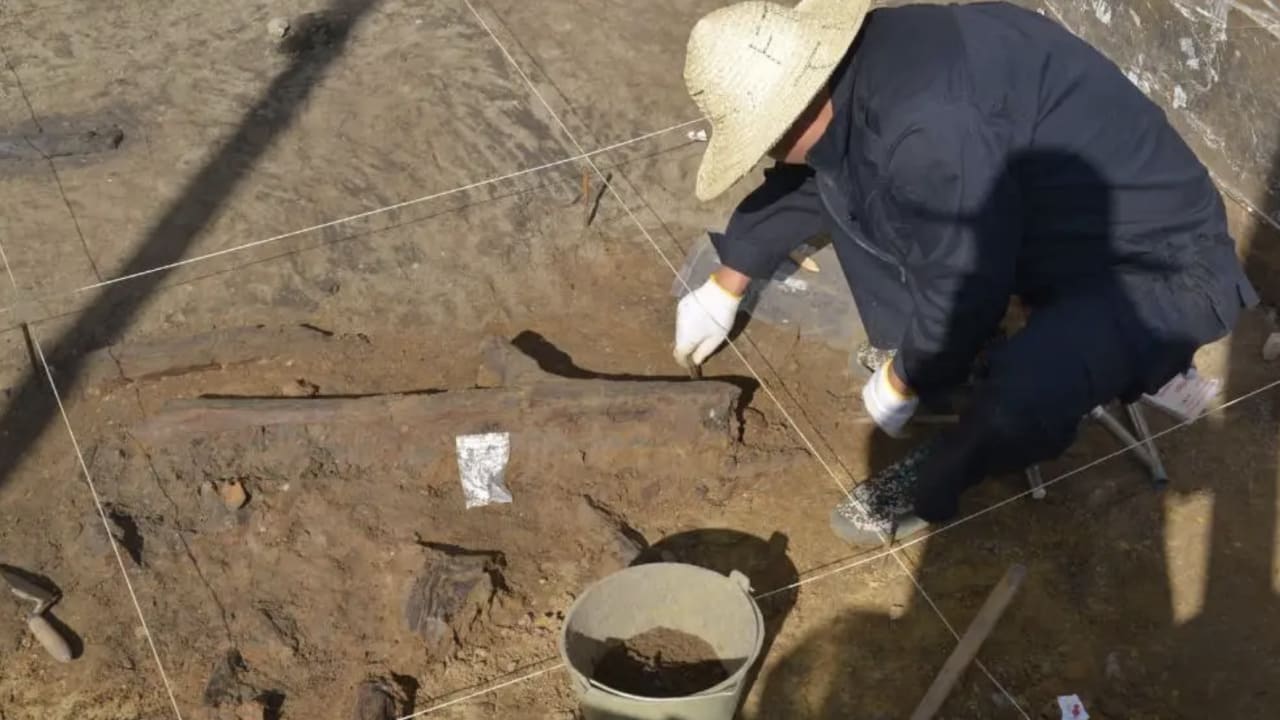
 Ancient wooden tools uncovered in China shed new light on early human diet, cognitive abilities.
Ancient wooden tools uncovered in China shed new light on early human diet, cognitive abilities.
(photo credit: BO LI, University of Woolongong)
ByJERUSALEM POST STAFF

A groundbreaking discovery in China has revealed 35 wooden tools dating back to the Old Stone Age, approximately 300,000 years ago. These tools, discovered in the Gantangqing archaeological site in southwestern China's Yunnan province, provide valuable insights into the lives of early humans and their dietary habits.

According to a study published in the journal Science, the tools include digging sticks made of pine and hardwood, hooks for cutting roots, and small, pointed implements for extracting edible plants from the ground. The tools were crafted with impressive craftsmanship and demonstrate advanced cognitive skills.

"This discovery is exceptional because it preserves a moment in time when early humans were using sophisticated wooden tools to harvest underground food resources," said study lead author Bo Li, a professor at the University of Wollongong, Australia.

The tools were found buried in oxygen-poor clay sediments on the shores of an ancient lake, which helped preserve the wooden artifacts. The sediments showed deliberate polishing and scraping marks on the tools, as well as plant and soil remains on some of the edges, giving researchers clues about the tools' function.

The discovery suggests that early humans in East Asia were crafting and using tools for specific purposes, demonstrating considerable foresight and intention. The artifacts also indicate that these early humans had a good understanding of which plants and parts of plants were edible.

Ancient wooden tools uncovered in China shed new light on early human diet, cognitive abilities.
Ancient wooden tools uncovered in China shed new light on early human diet, cognitive abilities. (credit: BO LI, University of Woolongong)

"The tools show a level of planning and craftsmanship that challenges the notion that East Asian hominins were technologically conservative," Li said.

Study challenges previous thoughts on early human adaptation

The study's findings challenge previous assumptions about early human adaptation and highlight the importance of plant-based food sources in the ancient diet. While contemporary European sites focused on hunting large mammals, the Gantangqing site reveals a unique plant-based survival strategy.

The researchers dated the tools using a technique developed by Li that uses infrared luminescence and another method called electron spin resonance. Both produced estimates indicating that the wooden tools were between 250,000 and 361,000 years old.

The plant remains on the tools have not been identified due to advanced decomposition, but other plant remains at Gantangqing indicate that early humans there ate berries, pine nuts, hazelnuts, kiwi fruit, and aquatic tubers.

This remarkable discovery provides a fascinating glimpse into the lives of early humans and their resourcefulness in exploiting plant-based food sources. As Li noted, "The discovery challenges previous assumptions about early human adaptation."

Follow us on Google

