
惯性聚合 高效追踪和阅读你感兴趣的博客、新闻、科技资讯
阅读原文 在惯性聚合中打开

推荐订阅源

GbyAI
GbyAI
N
News and Events Feed by Topic
D
DataBreaches.Net
MongoDB | Blog
MongoDB | Blog
CTFtime.org: upcoming CTF events
freeCodeCamp Programming Tutorials: Python, JavaScript, Git & More
Engineering at Meta
Engineering at Meta
T
Tailwind CSS Blog
博客园_首页
Microsoft Azure Blog
Y
Y Combinator Blog
博客园 - Franky
Hugging Face - Blog
Hugging Face - Blog
月光博客
月光博客
A
About on SuperTechFans
I
InfoQ
S
Securelist
Last Week in AI
Last Week in AI
S
Schneier on Security
C
CXSECURITY Database RSS Feed - CXSecurity.com
Hacker News: Ask HN
Hacker News: Ask HN
Schneier on Security
Know Your Adversary
Know Your Adversary
腾讯CDC
大猫的无限游戏
大猫的无限游戏
S
Security @ Cisco Blogs
博客园 - 三生石上(FineUI控件)
Simon Willison's Weblog
D
Darknet – Hacking Tools, Hacker News & Cyber Security
T
Tor Project blog
美团技术团队
aimingoo的专栏
aimingoo的专栏
G
Google Developers Blog
罗磊的独立博客
Vercel News
Vercel News
Cyber Security Advisories - MS-ISAC
Threat Intelligence Blog | Flashpoint
The Cloudflare Blog
S
Secure Thoughts
www.infosecurity-magazine.com
Latest news
Latest news
Recent Announcements
Exploit-DB.com RSS Feed
cs.CV updates on arXiv.org
奇客Solidot–传递最新科技情报
奇客Solidot–传递最新科技情报
L
LINUX DO - 热门话题
Security Latest
Security Latest
TaoSecurity Blog
TaoSecurity Blog
Cyberwarzone
Cyberwarzone
有赞技术团队
有赞技术团队

JPost.com - Archaeology Around the World

Second century CE Roman military fort found north of Hadrian's Wall in Scotland | The Jerusalem Post Ancient mosaic with Greek inscription discovered in Turkey | The Jerusalem Post Handgun fragments found in Germany may be oldest in Europe | The Jerusalem Post Archaeologists find evidence to legendary African king in Sudan | The Jerusalem Post Archaeologists find gold, ceramic in pre-Hispanic tomb in Panama | The Jerusalem Post Ancient Egyptians used 'Wite-Out' to fix mistakes in sacred texts | The Jerusalem Post Cambridge students find 9th century burial pit on dig | The Jerusalem Post Mexico discovers Zapotec tomb from 600 CE | The Jerusalem Post Medieval tunnel system discovered in Germany | The Jerusalem Post Roman carriage ornament found in Essex deemed 'Treasure' | The Jerusalem Post Humans, not glaciers, brought stones to Stonehenge | The Jerusalem Post Indonesia human hand outline may be world's oldest rock art | The Jerusalem Post New human species found, challenges story of 'Lucy' fossil | The Jerusalem Post Ancient Scottish burial site reveals Bronze Age devastation | The Jerusalem Post Louvre shuts fragile wing with Greek masterpieces | The Jerusalem Post Israeli team finds 12,000-year myths in clay figurine | The Jerusalem Post 800-year-old gilded Christ found near lost church | The Jerusalem Post Archaeologists uncover long-lost Temple of Zeus at Limyra | The Jerusalem Post Study shows dogs diversified before modern breeding | The Jerusalem Post Medieval Muslim sunken city discovered in Kyrgyzstan | The Jerusalem Post Archaeologists uncover finds at birthplace of Menander | The Jerusalem Post Ancient tools uncovered in China shed new light on early human diet | The Jerusalem Post ‘This is from Moses’: Newly imaged Sinai inscriptions revive Exodus-era | The Jerusalem Post Ancient inscriptions reveal identity of Great Pyramid builders | The Jerusalem Post Atlantis ruins near Cadiz found, archaeologist blames giant tsunami | The Jerusalem Post 5,000-year-old manuscript with eerie message found in Saqqara tomb | The Jerusalem Post Study: Leprosy existed in the Americas long before Europeans arrived | The Jerusalem Post Original architecture of ancient Roman fountain revealed in Perre Ancien | The Jerusalem Post Museum: Artifact shows playful, serious sides of 19th-century sexuality | The Jerusalem Post
Collection of pre-revolution coins found under house in Russia | The Jerusalem Post
MIRIAM SELA-EITAM · 2026-03-27 · via JPost.com - Archaeology Around the World

Based on the melt value of one pre-revolution 10 ruble coin, which is about 90% gold, the entire hoard may be valued at an estimated half a million dollars.
Follow us on Google
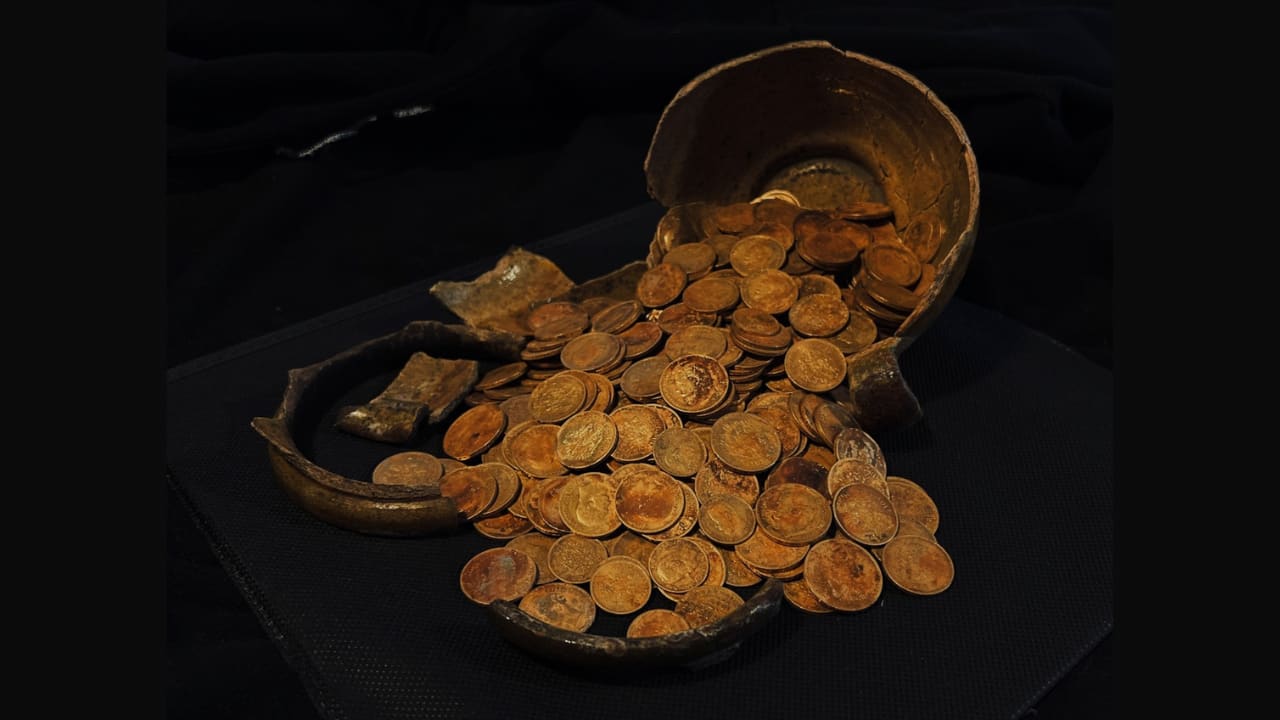
Hoard of gold rubles found under a house in western Russia, March 25, 2026.
(photo credit: The Institute of Archaeology of the Russian Academy of Sciences)
ByMIRIAM SELA-EITAM

A hoard of 409 gold ruble coins dated to over a century ago was discovered underneath a home in Torzhok, Russia, the Institute of Archaeology of the Russian Academy of Sciences shared in early March. 

Discovered during a joint expedition between the Institute and the All-Russian Historical and Ethnographic Museum in 2025, the hoard is one of the largest hoards of late Imperial Russian gold coins ever to be recovered.

Part of the property under excavation contained the foundations of a house believed to have been destroyed during World War II. After the war, the home’s new owners rebuilt the wooden house on the surviving stone foundations.

Found hidden within a broken kandyushka (glazed clay vessel) in a pit under the house’s foundation, the hoard consisted of 387 gold 10-ruble coins, 10 five ruble coins, 10 coins worth 15 rubles, and two seven-and-a-half ruble coins were found. 

Together, the coins add up to about 4,070 rubles, according to the Institute’s statement. Based on the melt value of one pre-revolution 10 ruble coin, which is about 90% gold, the entire hoard may be valued at an estimated half a million dollars.

Hoard of gold coins found in the foundations of a house in western Russia, March 25, 2026.
Hoard of gold coins found in the foundations of a house in western Russia, March 25, 2026. (credit: The Institute of Archaeology of the Russian Academy of Sciences)

The earliest coin, a five ruble piece from the reign of Nicholas I, was minted in 1848, and a second five-ruble coin bears dates back to the reign of Alexander III.

The remaining coins are from the reign of Nicholas II, the last tsar of Russia and father of the famed Anastasia, between 1894 and 1911.

One of the most intriguing finds, however, are the 15 and seven-and-a-half ruble denomination, as they were special-issue coins minted only in 1897, as part of the monetary reform introduced by then finance minister Sergei Witte that put Russia on the gold standard.

Coins belong to a ‘return hoard’

According to the Institute, the discovery has been classified as a “return hoard,” meaning that it had deliberately been concealed by an individual with the intention of recovery at a later date.

Even though the most recent coin found is dated to 1911, archaeologists believe the circumstances of the hoard’s concealment point strongly to the Russian Revolution, when private wealth was nationalized and holding gold became dangerous.

Historical records show that pre-1917, the street housed 24 different properties, including priests from the nearby Church of St. Demetrius, two merchants, a treasurer, a bookkeeper, an overseer, a tailor, a metalworker, a shoemaker, a court official, a secretary, and an unskilled labourer.

These records, however, do not correspond to modern addresses, leaving the precise property, and therefore the precise owner of the hoard, difficult to identify.

While researchers attempt to locate the owner of the coins, the hoard will be transferred to the All-Russian Historical and Ethnographic Museum in Torzhok, where it will eventually go on public display.

Follow us on Google