


惯性聚合 高效追踪和阅读你感兴趣的博客、新闻、科技资讯
阅读原文 在惯性聚合中打开

推荐订阅源

人人都是产品经理
人人都是产品经理
D
Docker
GbyAI
GbyAI
B
Blog RSS Feed
博客园 - 司徒正美
博客园 - Franky
美团技术团队
Cyber Security Advisories - MS-ISAC
aimingoo的专栏
aimingoo的专栏
C
Check Point Blog
IT之家
IT之家
让小产品的独立变现更简单 - ezindie.com
www.infosecurity-magazine.com
AI
AI
O
OpenAI News
Attack and Defense Labs
cs.CV updates on arXiv.org
T
Tailwind CSS Blog
酷 壳 – CoolShell
酷 壳 – CoolShell
S
Secure Thoughts
博客园 - 聂微东
L
LINUX DO - 最新话题
U
Unit 42
SecWiki News
SecWiki News
A
Arctic Wolf
Schneier on Security
Threat Intelligence Blog | Flashpoint
V
Visual Studio Blog
量子位
The Cloudflare Blog
cs.AI updates on arXiv.org
大猫的无限游戏
大猫的无限游戏
Google DeepMind News
G
Google Developers Blog
T
Threat Research - Cisco Blogs
TaoSecurity Blog
TaoSecurity Blog
Recent Commits to openclaw:main
B
Blog
博客园 - 【当耐特】
C
CERT Recently Published Vulnerability Notes
Scott Helme
Scott Helme
Last Week in AI
Last Week in AI
D
Darknet – Hacking Tools, Hacker News & Cyber Security
Microsoft Security Blog
Apple Machine Learning Research
F
Full Disclosure
Hacker News: Ask HN
Hacker News: Ask HN
A
About on SuperTechFans
博客园 - 三生石上(FineUI控件)
Latest news
Latest news

Microsoft Edge Blog

New in Edge for developers – Style layout gaps, improve keyboard accessibility and migrate your PWA to a new origin Faster updates, enterprise-friendly schedule: the new Microsoft Edge release cycle Expanding on‑device AI in Microsoft Edge: New models and APIs for the web New in Edge for Business: AI for work, safe from day one New updates to Edge across desktop and mobile Engineering secure passkey sync in Microsoft Password Manager Protect your enterprise from shadow AI and more: Announcements at RSAC 2026 Monitor and improve your web app’s load performance Making keyboard navigation effortless
Microsoft Edge and Interop 2026
Microsoft Edge Blog · 2026-02-13 · via Microsoft Edge Blog

Written By published February 12, 2026

Microsoft Edge is commited to a more powerful, predictable, and reliable web platform. One way we pursue those goals is via our ongoing participation in the Interop project.

This year marks the sixth edition of the project, and once again, we’re collaborating closely with Mozilla, Igalia, Google, and Apple to push for a more interoperable web.

We’ve received a lot of proposals for inclusion in Interop 2026, and we’re very grateful to everyone who provided input. These proposals highlight areas where inconsistent behavior breaks sites, slows developers down, or discourages adoption of new features. We know from feedback that these interoperability issues are extremely important to web developers, and we pushed for as many of them to be included in the Interop project as possible.

Although not all worthy proposals make it through the selection process, the Interop project is still a very helpful way to make progress towards a more cohesive web that enables developers to ship with greater confidence.

Launching Interop 2026

Today, we’re happy to unveil the focus areas that the Interop members have agreed to for 2026. By aligning on these shared priorities, we focus our engineering efforts where they’ll have the greatest impact:

  • attr(), to expand the CSS attr() function so any property can read HTML attributes of any type and unit.
  • contrast-color(), to improve color tooling across the web.
  • Container style queries, to enable styling elements based on the styling of container elements.
  • Custom highlights, to allow styling arbitrary text ranges without modifying the DOM.
  • Dialogs and popovers, to improve the interoperability of the <dialog> element and the popover API.
  • Fetch, to enhance the fetch() API with support for streaming request bodies and more.
  • IndexedDB, to improve the performance of reading large datasets with the getAllRecords() method.
  • JSPI for Wasm, to integrate Wasm with JavaScript promises.
  • Media pseudo-classes, to implement pseudo-classes such as :playing, :paused, :buffering, and others for audio/video element states across browsers.
  • Navigation API, to continue improving interoperability, including adding support for navigation pre-commit handlers.
  • Scoped custom element registry, to allow multiple custom element registries to coexist safely.
  • Scroll-driven animations, to create advanced animations that are based on the user’s scroll position.
  • Scroll snap, to improve the consistency of the CSS scroll snapping behavior.
  • shape(), to add interoperable support for the shape() CSS function to define complex shapes around elements.
  • View Transitions, to improve same-document behavior and implement cross-page transitions.
  • Web compat, to address real-world compatibility issues.
  • WebRTC, to continue improving WebRTC interoperability and resolve remaining issues.
  • WebTransport, to advance support for the WebTransport API for low-latency, bidirectional communication over HTTP/3.

In addition to these focus areas, the Interop project members have also committed to making progress on the following investigation efforts:

  • Accessibility testing: to make it easier to test the accessibility of web features.
  • JPEG XL: to create a comprehensive test suite, eventually creating the possibility for JPEG XL to be part of a future Interop project iteration as a focus area.
  • Mobile testing: to continue improving the infrastructure that makes it possible to test mobile-specific features.
  • WebVTT: to continue improving the specification and test suite for this feature, opening the possibility for WebVTT to be part of a future Interop project iteration.

To learn more about these focus areas and investigation efforts, see the full descriptions on the Interop GitHub repository. If you want to follow along as the work lands throughout the year, the Interop 2026 dashboard is the best place to track progress.

Advocating for more

On the Microsoft Edge team, we’re always listening, and we know that there are more long-lived interoperability issues which remain. To track progress on the highest-impact, long-running issues, we launched a supplementary Top Developer Needs dashboard. In past years, items like Custom Highlights, field-sizing, scroll-driven animations, and Trusted Types benefited from this focus and helped shape Interop priorities. We’ll be refreshing the dashboard in the coming weeks.

Editor’s note, March 6, 2026: The 2026 Top Developer Needs dashboard is now live.

We will also continue to push the boundaries of what’s possible on the web by shipping new features, which can then become input to future Interop project iterations.

And finally, we’ll continue advocating within the Interop group for increased transparency and fewer behind-closed-doors blockers. Developers have told us that the focus area selection process can feel opaque from the outside, and we agree that better visibility into how priorities are set matters.

Closing Interop 2025

Last year, the Interop 2025 project made strong progress across a broad set of areas, many of which had first appeared in Chromium, then became standards, before eventually getting implemented across browsers. This includes:

  • CSS anchor positioning, unlocking reliable cross-browser positioning for tooltips and other anchored UI patterns.
  • View Transitions, enabling smoother app-like transitions on the web, including across pages.
  • Navigation API, making stateful, single-page-app experiences easier to implement.
  • Core Web Vitals, aligning browsers on key performance metrics that directly reflect user experience quality.
  • JSON module scripts, simplifying data loading in modern JavaScript.
  • <details> element, creating accessible disclosure widgets.

For more, check out the Interop 2025 dashboard.

All participating browsers are closing the Interop 2025 project with a strong score of at least 98%:
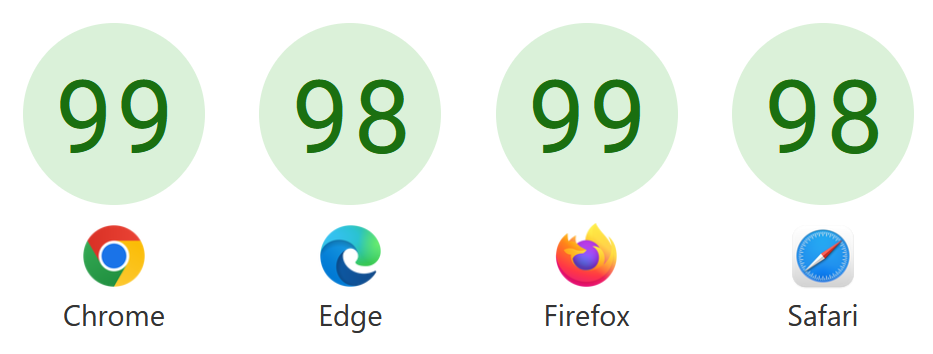
The closing scores for Interop 2025, as seen on the Interop 2025 dashboard: Chrome 99%, Edge 98%, Firefox 99%, Safari 98%.

We’re excited about the improvements Interop 2026 will bring, and we’re grateful for the proposals and feedback the community continues to share. Those proposals, along with surveys and other developer signals, help us understand what’s most important to you and where the web needs to do better.