

惯性聚合 高效追踪和阅读你感兴趣的博客、新闻、科技资讯
阅读原文 在惯性聚合中打开

推荐订阅源

V
V2EX
C
Check Point Blog
博客园_首页
B
Blog
D
Docker
U
Unit 42
量子位
I
InfoQ
有赞技术团队
有赞技术团队
Martin Fowler
Martin Fowler
GbyAI
GbyAI
L
LangChain Blog
云风的 BLOG
云风的 BLOG
博客园 - Franky
美团技术团队
T
The Blog of Author Tim Ferriss
阮一峰的网络日志
阮一峰的网络日志
月光博客
月光博客
Vercel News
Vercel News
Recent Announcements
雷峰网
雷峰网
大猫的无限游戏
大猫的无限游戏
小众软件
小众软件
Google DeepMind News

John D. Cook

What is the quality of software that AI writes? Junk solutions Ultraspherical Numerical (in)stability of recurrece relations Three-term recurrences von Mises probability distribution | von Mises-Fisher What exactly is modified about a modified Bessel function? Why special function terminology is arcane The difference orbit inclination makes Coming soon How would you know whether an ancient culture had zero? AI-generated ASCII diagrams Big little hexagon The imbalance theorem Mean distance to the sun Proportion of 1s in a Hadamard matrix Probability of correcting errors Compressing a Hadamard matrix Hadamard Codes and Sphere Packing How NASA’s Mariner 9 probe encoded images Constructing Hadamard matrices Cryptic but consistent Dogs and fat tails Manually unbreakable cryptography Learning from historical mistakes Inverse differential equations DNA and Bessel functions Simple range reduction algorithm by Cody and Waite Corrupted apostrophes How not to calculate cosine
Second solutions
John · 2026-08-27 · via John D. Cook

This post provides a couple examples to go along with two earlier posts.

The pattern we’re illustrating is families of polynomials pn(x) that each satisfy a differential equation and a three-term recurrence. The differential equations have a second solution qn(x) that is the larger solution with respect to x but the smaller solution with respect to n.

In both the examples below pn(x) is a polynomial, and so bounded on the interval [−1, 1], and qn(x) is not a polynomial, with singularities at ±1. This is analogous to the previous examples with Bessel functions Jn(x) and Qn(x) that satisfy the same differential equation but have contrasting behavior with respect to x versus n.

Legendre polynomials

The differential equation

(1-x^2)\,y^{\prime\prime} - 2x\,y^\prime + n(n+1)\,y = 0

has two solutions for each n, Pn(x) and Qn(x).
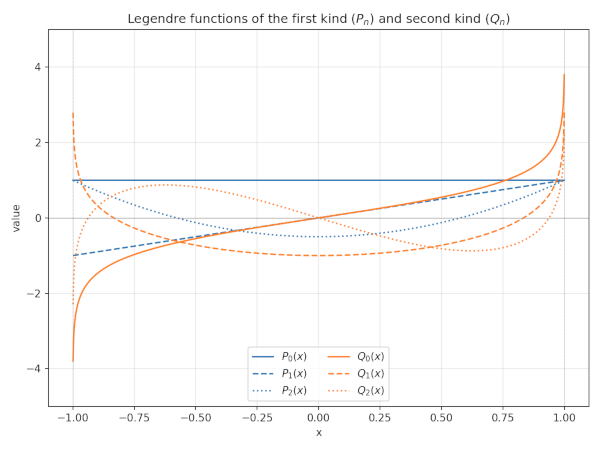
The solutions Pn(x) are the Legendre polynomials. The solutions Qn(x) are not polynomials but involve a term log((1 + x)/(1 − x)) that blows up at 1 and −1. But for fixed x and increasing n, Pn(x) grows exponentially and Qn(x) decays exponentially.

Chebyshev polynomials

The differential equation

(1-x^2)\,y^{\prime\prime} - x\,y^\prime + n^2\,y = 0

has two solutions for each n, Tn(x) and Vn(x).
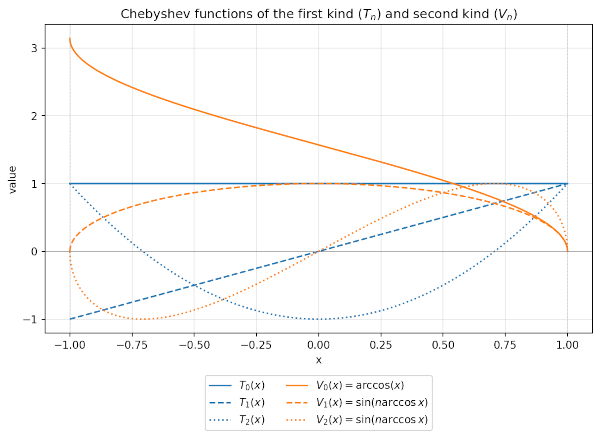
The solutions Tn(x) are the Chebyshev polynomials. The solutions Vn(x) are not polynomials but involve a term √(1 — x²) that become vertical up at 1 and −1. But for fixed x and increasing n, Tn(x) grows exponentially and Vn(x) decays exponentially.