
惯性聚合 高效追踪和阅读你感兴趣的博客、新闻、科技资讯
阅读原文 在惯性聚合中打开

推荐订阅源

钛媒体:引领未来商业与生活新知
钛媒体:引领未来商业与生活新知
博客园_首页
Vercel News
Vercel News
Last Week in AI
Last Week in AI
罗磊的独立博客
Cyber Security Advisories - MS-ISAC
IT之家
IT之家
美团技术团队
U
Unit 42
Google DeepMind News
P
Proofpoint News Feed
J
Java Code Geeks
V
V2EX
量子位
腾讯CDC
S
SegmentFault 最新的问题
The GitHub Blog
The GitHub Blog
G
Google Developers Blog
D
DataBreaches.Net
雷峰网
雷峰网
让小产品的独立变现更简单 - ezindie.com
博客园 - 聂微东
L
LangChain Blog
C
Check Point Blog

John D. Cook

Second solutions What is the quality of software that AI writes? Junk solutions Ultraspherical Numerical (in)stability of recurrece relations Three-term recurrences von Mises probability distribution | von Mises-Fisher What exactly is modified about a modified Bessel function? Why special function terminology is arcane Coming soon How would you know whether an ancient culture had zero? AI-generated ASCII diagrams Big little hexagon The imbalance theorem Mean distance to the sun Proportion of 1s in a Hadamard matrix Probability of correcting errors Compressing a Hadamard matrix Hadamard Codes and Sphere Packing How NASA’s Mariner 9 probe encoded images Constructing Hadamard matrices Cryptic but consistent Dogs and fat tails Manually unbreakable cryptography Learning from historical mistakes Inverse differential equations DNA and Bessel functions Simple range reduction algorithm by Cody and Waite Corrupted apostrophes How not to calculate cosine
The difference orbit inclination makes
John · 2026-08-23 · via John D. Cook

Suppose you wanted to find the distance between Earth and Mars over time. To first approximation, both planets orbit the sun in elliptic orbits in the same plane.

If you wanted to be more accurate, you’d need to take into account the fact that the orbit of Mars is tilted about 1.85° relative to the Earth’s orbit. How much difference does that make?

To simplify things, let’s assume the Earth orbits the sun in a circle of radius 1 and Mars orbits the sun in a circle of radius 1.5. The distance between Earth and Mars over time would be basically sinusoidal.
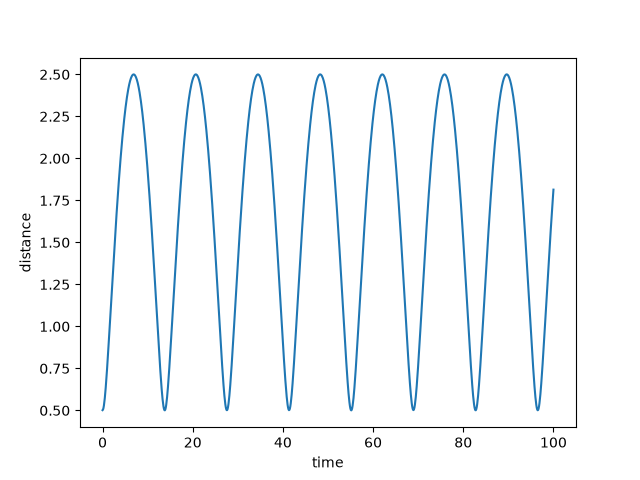
How much does inclination contribute to this distance? In other words, what is the difference between the distance accounting for the inclination of Mars’ orbit and the distance if we assume the two orbits are in the same plane?

This plot gives the answer.
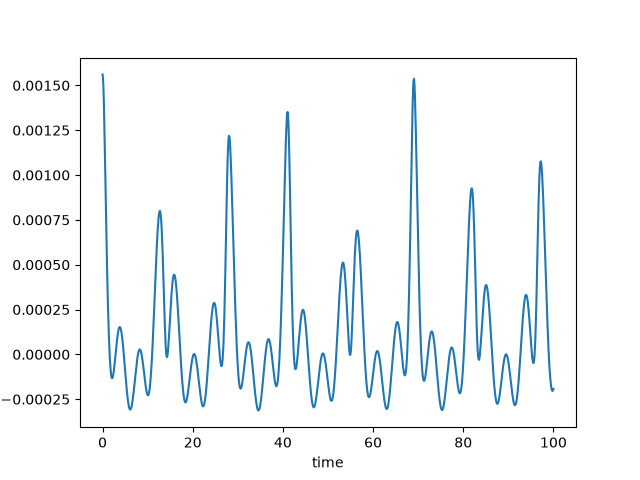
The effect is not large, about three orders of magnitude smaller than the main effect, but it’s interesting how erratic it is.

The plots were made with the following code.

from numpy import *

R = 1.5
T = R**1.5 # Kepler's third law

def f(t, theta):
    return sqrt(
        (cos(t) - R*cos(t/T)*cos(theta))**2 +
        (sin(t) - R*sin(t/T))**2 +
        (R*sin(theta)*cos(t/T))**2
    )

The first plot graphs f(t, θ) and the second graphs f(t, θ) − f(t, 0).