



惯性聚合 高效追踪和阅读你感兴趣的博客、新闻、科技资讯
阅读原文 在惯性聚合中打开

推荐订阅源

J
Java Code Geeks
月光博客
月光博客
aimingoo的专栏
aimingoo的专栏
Google DeepMind News
Recent Announcements
MyScale Blog
MyScale Blog
钛媒体:引领未来商业与生活新知
钛媒体:引领未来商业与生活新知
S
SegmentFault 最新的问题
Hugging Face - Blog
Hugging Face - Blog
Martin Fowler
Martin Fowler
WordPress大学
WordPress大学
F
Fortinet All Blogs
小众软件
小众软件
D
Docker
U
Unit 42
博客园 - 聂微东
freeCodeCamp Programming Tutorials: Python, JavaScript, Git & More
爱范儿
爱范儿
OSCHINA 社区最新新闻
OSCHINA 社区最新新闻
IT之家
IT之家
云风的 BLOG
云风的 BLOG
博客园 - 司徒正美
有赞技术团队
有赞技术团队
腾讯CDC

John D. Cook

Second solutions What is the quality of software that AI writes? Junk solutions Ultraspherical Numerical (in)stability of recurrece relations von Mises probability distribution | von Mises-Fisher What exactly is modified about a modified Bessel function? Why special function terminology is arcane The difference orbit inclination makes Coming soon How would you know whether an ancient culture had zero? AI-generated ASCII diagrams Big little hexagon The imbalance theorem Mean distance to the sun Proportion of 1s in a Hadamard matrix Probability of correcting errors Compressing a Hadamard matrix Hadamard Codes and Sphere Packing How NASA’s Mariner 9 probe encoded images Constructing Hadamard matrices Cryptic but consistent Dogs and fat tails Manually unbreakable cryptography Learning from historical mistakes Inverse differential equations DNA and Bessel functions Simple range reduction algorithm by Cody and Waite Corrupted apostrophes How not to calculate cosine
Three-term recurrences
John · 2026-08-24 · via John D. Cook

There many examples of families of functions where each function can be computed as a linear combination of the two previous terms

f_{n+1}(x) = a(x) f_n(x) + b(x) f_{n-1}(x)

where a and b are functions of x but not on n. This is called a three-term recurrence formula.

It’s amazing how often you can run into three-term recurrence formulas. There are theorems that give conditions for such recurrences to hold, but I haven’t reached the bottom of that rabbit hole [1].

For this post I just want to give examples.

Bessel functions of the first and second kind:
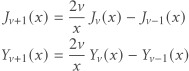
\begin{align*} J_{\nu+1}(x) &= \frac{2\nu}{x}\,J_\nu(x) - J_{\nu-1}(x) \\ Y_{\nu+1}(x) &= \frac{2\nu}{x}\,Y_\nu(x) - Y_{\nu-1}(x) \end{align*}

Modified Bessel functions of the first and second kind:
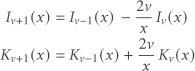
\begin{align*} I_{\nu+1}(x) &= I_{\nu-1}(x) - \frac{2\nu}{x}\,I_\nu(x) \\ K_{\nu+1}(x) &= K_{\nu-1}(x) + \frac{2\nu}{x}\,K_\nu(x) \end{align*}

Chebyshev polynomials of the first and second kind:

\begin{align*} T_{n+1}(x) &= 2x\,T_n(x) - T_{n-1}(x) \\ U_{n+1}(x) &= 2x\,U_n(x) - U_{n-1}(x) \end{align*}

Hermite polynomials (physicists’ convention):

H_{n+1}(x) = 2x\,H_n(x) - 2n\,H_{n-1}(x)

Legendre polynomials:

P_{n+1}(x) = \frac{2n+1}{n+1}\,x\,P_n(x) - \frac{n}{n+1}\,P_{n-1}(x)

[1] See Bochner’s theorem for orthogonal polynomials, the Nikiforov–Uvarov method, and Infeld-Hull factorization.
