





Adopting a cloud-based, distributed architecture may help your organization scale quickly, but it can also add complexity. Correlating telemetry, security signals, and alerts across services often proves difficult, resulting in slower issue remediation. Additionally, when something goes wrong, figuring out who to contact—for example, the on-call responder or the service owner— may become needlessly time-consuming. To navigate these challenges, you need a unified service management approach that brings together monitoring, DevOps, IT operations, and app development tools for effective communication and fast issue resolution.
Datadog’s Service Management offerings help you quickly detect issues within your system and take action on them without leaving the platform. By drawing on service data from throughout the Datadog platform, features such as Incident, Case, and Event Management enable you to seamlessly pivot from viewing observability data that details issues within your services to contacting service owners and responders for troubleshooting. As a result, you can improve reliability while preventing tool sprawl and streamlining engineering processes.
In this post, we’ll explore how Datadog Service Management can help you:
Quickly detect and remediate issues from a centralized hub
Triage and track issues, tasks, and to-do items
Easily correlate service events and reduce alert fatigue
Incident response often involves repeatedly pivoting between a variety of tools, taking precious minutes away from time-sensitive incident remediation. Responding to an issue may involve being paged in one platform, opening the ticket in another, pivoting to a monitoring platform to view troubleshooting data, and then accessing yet another tool to track down relevant service owners. This piecemeal process makes it challenging to detect and triage issues with multi-service impact, especially if they require you to coordinate response activities across teams.
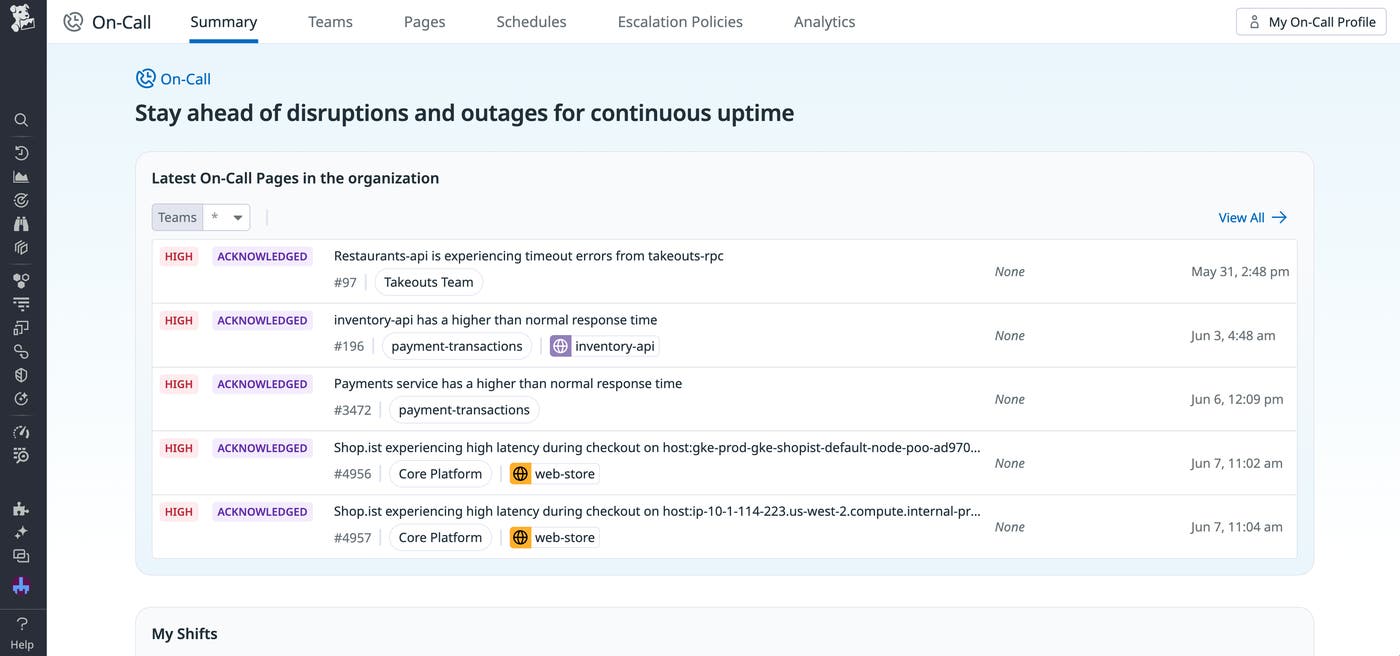
By contrast, Datadog Service Management gives you a centralized hub for responding to problems within your services, with alerting, paging, response planning, and automation functionality all in the same platform. When an issue is detected, Datadog On-Call quickly notifies relevant teams of the problem and provides essential context by drawing on observability data. Responders receive detailed alerts with real-time service data, and can easily create incidents directly from these alerts. Datadog Incident Management then immediately helps you kick off the response process with built-in automated actions, including customizable updates to stakeholders sent via the communication platform of your choice. Incident Management also helps you keep track of response actions by capturing your to-do items, Zoom calls, Slack conversations, and graphs.
Additionally, you can use Bits AI with Incident Management to simplify your response process. You can stay up-to-date on ongoing issues without leaving your collaboration tools—including Slack and Teams—by using auto-generated summaries, natural language prompts, and ticket management features within incident channels. Once the incident is resolved, Datadog Incident Management can generate comprehensive postmortems that can help you remediate—and even prevent—similar issues in the future.
After an incident has been closed, there are still follow-up items to complete, other issues to investigate, and day-to-day maintenance tasks to work on. Proactively handling these activities helps you prevent future incidents as well as track improvements on specific services.
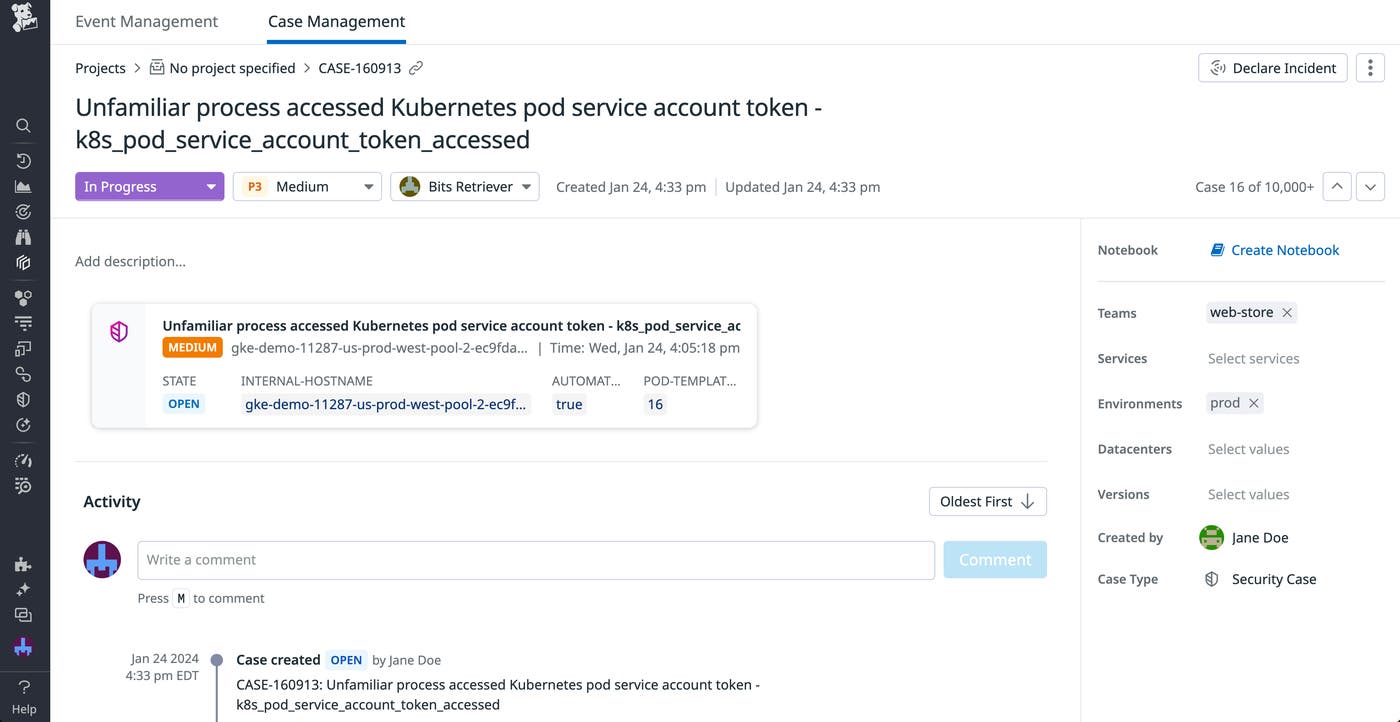
With Case Management, Datadog gives you a centralized location for organizing your tasks, to-do items, investigations, and follow-ups. Within each case, you can track which team members have been assigned to an issue as well as any remediation actions they’ve taken. You can easily automate case creation from tickets in other platforms via our bidirectional Jira and ServiceNow integrations, helping you sync your data. Additionally, Case Management integrates with the rest of the Datadog platform, enabling teams to enrich cases with graphs, logs, alerts, and notebooks.
Datadog not only integrates built-in automation into your incidents and cases to help you troubleshoot faster but also provides customizable tools that enable you to automate critical actions elsewhere in your system. Datadog Workflow Automation provides easy-to-create templates you can use to implement new workflows without coding, as well as granular logical, conditional, and branching options for more complex processes.
Workflow Automation can handle both simple operational activities and more complex response processes. One example of the latter is when your system suffers from larger, recurring issues with simple temporary patches, such as complicated memory leaks that can be kept at bay with Kubernetes pod restarts. While you work to pinpoint and remediate the root cause—which could take weeks—you can create a workflow that automatically restarts the affected pods when they run out of memory and crash. In addition to giving you more time to focus on fixing the problem, this can reduce the number of late-night pages for quick tasks, helping cut down on burnout. Alternatively, for less straightforward issues, you can even configure your workflows to message the relevant responders and create incidents or cases, with Datadog or elsewhere.
Keeping modern cloud systems highly available and performant requires teams to track a wealth of service activity, including system errors, routine updates, and suspicious user behavior. With so many signals coming from different parts of your stack, it can be challenging to identify legitimate incidents among the noise. This can lead to both alert fatigue among your responders and delayed incident response efforts.
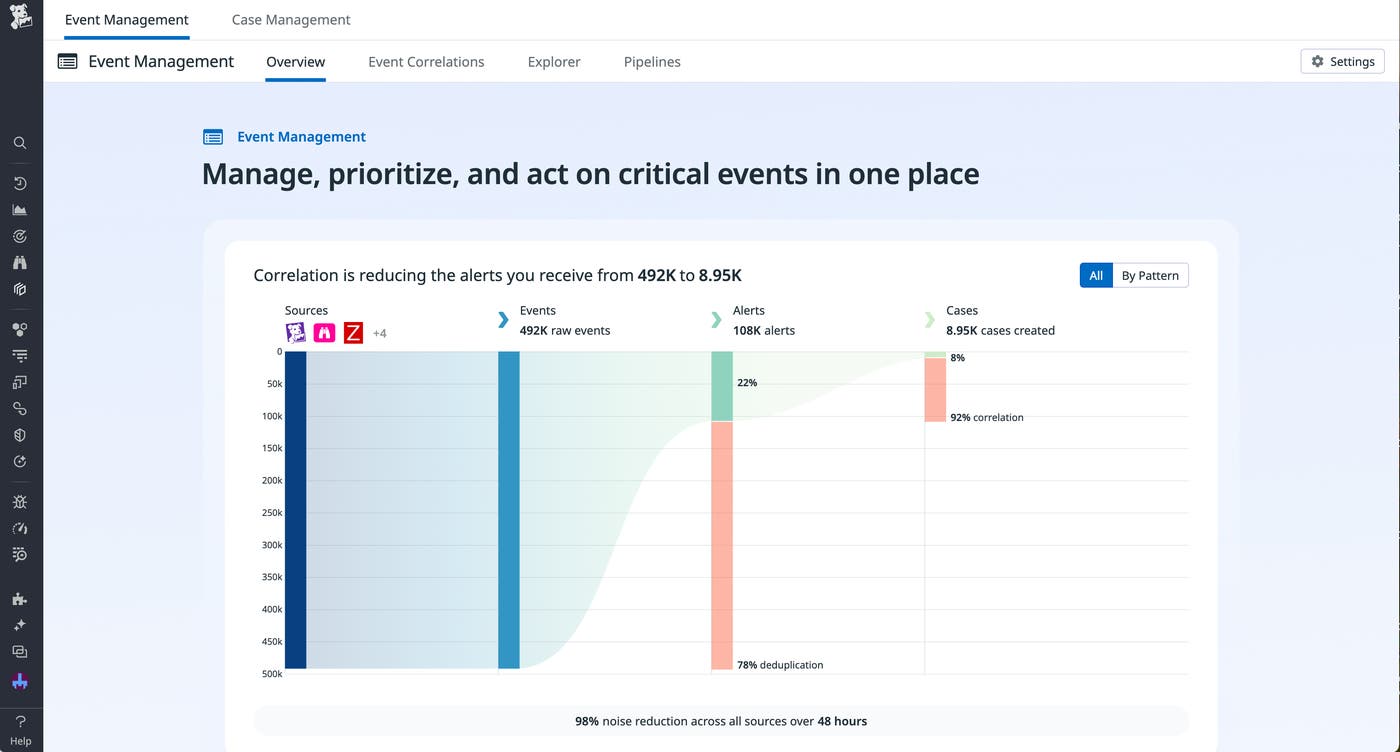
To help you address these challenges, Datadog Event Management enables you to centralize and consolidate alerts and events from your entire stack—including ones from third-party sources. Strengthened by machine learning, Datadog automatically correlates related alerts based on tag commonality, service topology, alert entropy, and other heuristics so you can understand an issue’s full breadth of impact and expedite time to assign. You can add critical, business-specific data—such as ownership or location details—to these alerts using Enrichment processors and include changes that occurred around the time of your correlated alerts to simplify root cause analysis. When you do decide to take action on an alert, Event Management helps you automate triage and remediation by sending notifications to responders and stakeholders, executing remediation workflows, and escalating cases within Case Management to Incident Management.
With a centralized platform that helps you manage everything from on-call responders to case creation, Datadog helps you close the circle with your service management strategy. You can easily triage alerts, manage tickets, and access events for your services, with critical observability data available every step of the way.
Check out our documentation to learn more about Incident Management, Case Management, Event Management, and other Datadog Service Management features. Or, if you’re new to Datadog, you can sign up for a 14-day free trial.
此内容由惯性聚合(RSS阅读器)自动聚合整理,仅供阅读参考。 原文来自 — 版权归原作者所有。