




惯性聚合 高效追踪和阅读你感兴趣的博客、新闻、科技资讯
阅读原文 在惯性聚合中打开

推荐订阅源

L
Lohrmann on Cybersecurity
K
Kaspersky official blog
C
Cyber Attacks, Cyber Crime and Cyber Security
Threat Intelligence Blog | Flashpoint
P
Palo Alto Networks Blog
Scott Helme
Scott Helme
P
Proofpoint News Feed
量子位
S
Schneier on Security
AWS News Blog
AWS News Blog
N
Netflix TechBlog - Medium
T
Threat Research - Cisco Blogs
T
Threatpost
Cisco Talos Blog
Cisco Talos Blog
L
LINUX DO - 热门话题
T
The Exploit Database - CXSecurity.com
A
Arctic Wolf
S
Securelist
T
Tailwind CSS Blog
T
Tor Project blog
Last Week in AI
Last Week in AI
Martin Fowler
Martin Fowler
I
InfoQ
Cyber Security Advisories - MS-ISAC
C
CXSECURITY Database RSS Feed - CXSecurity.com
C
Cisco Blogs
D
DataBreaches.Net
OSCHINA 社区最新新闻
OSCHINA 社区最新新闻
T
Tenable Blog
The GitHub Blog
The GitHub Blog
V
Vulnerabilities – Threatpost
V
Visual Studio Blog
博客园 - 叶小钗
F
Full Disclosure
Know Your Adversary
Know Your Adversary
N
News and Events Feed by Topic
Engineering at Meta
Engineering at Meta
S
SegmentFault 最新的问题
The Last Watchdog
The Last Watchdog
H
Hacker News: Front Page
阮一峰的网络日志
阮一峰的网络日志
D
Docker
Spread Privacy
Spread Privacy
T
The Blog of Author Tim Ferriss
S
Security @ Cisco Blogs
Attack and Defense Labs
MyScale Blog
MyScale Blog
腾讯CDC
Recent Announcements
Stack Overflow Blog
Stack Overflow Blog

Datadog | The Monitor blog

Instrument and monitor Boomi integration flows with OpenTelemetry and Datadog Not all index scans are equal: How we cut query latency by over 99% Platform engineering metrics: What to measure and what to ignore Integrate Recorded Future threat intelligence with Datadog Cloud SIEM CI/CD security: threat modeling using a MITRE-style threat matrix CI/CD security: How to secure your GitHub ecosystem Ingress NGINX is EOL: A practical guide for migrating to Kubernetes Gateway API Operating agentic AI with Amazon Bedrock AgentCore and Datadog LLM Observability: Lessons from NTT DATA Introducing the Datadog Code Security MCP Capture and analyze custom heatmaps in Session Replay Understand session replays faster with AI summaries and smart chapters Monitor ClickHouse query performance with Datadog Database Monitoring How we designed empathetic alert sounds for on-call engineers Search and act across Datadog to resolve issues faster with Bits Assistant Measure the business impact of every product change with Datadog Experiments Analyzing round trip query latency Configuring JavaScript caches for better performance Introducing Bits AI Dev Agent for Code Security Datadog achieves ISO 42001 certification for responsible AI Monitor Nutanix clusters, hosts, and VMs with Datadog Monitor Juniper Mist in Datadog A new Host Map for modern infrastructure Annotate traces to improve LLM quality with Datadog LLM Observability What’s new in Cloud SIEM: AI-powered investigations, enhanced threat intelligence, and scalable security operations Explore Kubernetes with native OpenTelemetry data Monitor Oracle Fusion Cloud Applications with Datadog Announcing the Datadog Terraform provider v4.0.0 Scaling Kubernetes workloads on custom metrics How to design cloud environments for AI-powered threat analysis Monitor Aruba Central in Datadog How we centralize and remediate risks with Datadog Case Management Accelerate incident response with Datadog and ServiceNow Monitor your application and network load balancer logs Understanding Karpenter architecture for Kubernetes autoscaling Tools for collecting metrics and logs from Karpenter Monitor Karpenter with Datadog What your product data is actually saying Key metrics for monitoring Karpenter Securing Datadog’s platform in the AI age: The role of observability data Four ways engineering teams use the Datadog MCP Server to power AI agents Approaching your observability migration with the right mindset Meet the new Bits AI SRE: Deeper reasoning, twice as fast Key learnings from the 2026 State of DevSecOps study Use plain English to query your multi-cloud infrastructure in Resource Catalog Simplifying troubleshooting across the user journey with Datadog Synthetic Monitoring Protect your OCI resources with Datadog Cloud Security This Month in Datadog - February 2026 Amazon EC2 security: How misconfigured and public AMIs expand your cloud attack surface Enable end-to-end visibility into your Java apps with a single command Measure and improve mobile app startup performance with Datadog RUM Evaluating our AI Guard application to improve quality and control cost Identify untested code across every level of your codebase Make use of guardrail metrics and stop babysitting your releases Monitor Versa Networks SD-WAN performance in Datadog Improve performance and reliability with APM Recommendations Remediate transitive vulnerabilities faster with Datadog Software Composition Analysis Generate audit-ready vulnerability and compliance reports with Datadog Sheets Monitor Fortinet FortiManager performance in Datadog Improve test coverage across codebases with Datadog Code Coverage Move fast, don’t break things: Consistent testing standards at scale Enrich logs with ServiceNow CMDB context before routing to any SIEM or logging tool Monitor Lustre with Datadog Make faster, better product decisions with Datadog Product Analytics Surface and remediate runtime posture issues with Workload Protection Findings Protect agentic AI applications with Datadog AI Guard How to optimize JavaScript code with CSS Trace Google Pub/Sub workloads in Cloud Run with Datadog Detect human names in logs with ML in Sensitive Data Scanner How we cut our NLQ agent debugging time from hours to minutes with LLM Observability Debug PostgreSQL query latency faster with EXPLAIN ANALYZE in Datadog Database Monitoring Datadog acquires Propolis Unify and correlate frontend and backend data with retention filters Scale compliance across global frameworks with Datadog Cloud Security Monitor Arista VeloCloud SD-WAN performance with Datadog Building reliable dashboard agents with Datadog LLM Observability Simplify log collection and aggregation for MSSPs with Datadog Observability Pipelines Mitigation for Node.js denial-of-service vulnerability affecting Datadog APM Automate flaky test fixes with the Bits AI Dev Agent and Test Optimization How we built an AI SRE agent that investigates like a team of engineers Datadog integrations 2025 recap: Observability for AI, security, and hybrid cloud Design effective executive dashboards with Datadog Implement dbt data quality checks with dbt-expectations Bring faster visibility into AWS Lambda functions with remote instrumentation Troubleshoot faster with the GitLab Source Code integration in Datadog How Cambia Health Solutions saved $30,000 monthly with Cloud Cost Management and the Datadog Resource Catalog Normalize any logs for Cloud SIEM with Datadog's OCSF processor Optimizing Datadog at scale: Cost-efficient observability at Zendesk Detect, diagnose, and resolve network issues easily with CNM Network Health Securing customer logins with breach intelligence Connect engineering errors to user impact in early-stage products Cilium configuration for Kubernetes operations at scale Designing feedback loops for progressive delivery Ship features faster and safer with Datadog Feature Flags Choosing the right OpenTelemetry Collector distribution Route your monitor alerts with Datadog monitor notification rules Automate Cloud SIEM investigations with Bits AI Security Analyst Cloud threat detection: How to identify risky activity across control and data planes Collecting Kafka performance metrics Monitoring Kafka with Datadog Monitoring Kafka performance metrics
Introducing our open source AI-native SAST
Julien Delange, Bahar Shah · 2026-04-10 · via Datadog | The Monitor blog

Static application security testing (SAST) tools help developers quickly catch potential vulnerabilities as they code. However, these tools rely on inflexible rules that often generate a high number of false positives, reducing trust in their accuracy and slowing adoption.

To help developers access context-aware vulnerability detection, we’ve released an open source AI-native SAST solution. This tool scans code changes incrementally and surfaces security issues in real time. Our project is able to deliver more accurate vulnerability detection than traditional solutions, outperforming the latter on OWASP benchmarks.

What is AI-native SAST?

Traditional SAST tools analyze source code using static rules and pattern matching to detect potential vulnerabilities. Each rule targets a specific type of vulnerability, such as SQL injection, cross-site scripting (XSS), or command injection. A 2018 study from Google found that false positives and the lack of actionable recommendations are the primary barriers to SAST adoption.

AI-native SAST solutions analyze code using large language models (LLMs) to enhance traditional SAST functionality with more flexible, intelligent vulnerability detection. They can reason about code semantics or execution context, such as call stack details or which services the code is associated with, to more reliably assess whether a potential vulnerability is present. This reasoning enables these tools to better contextualize code, decreasing the rate of false positives compared to traditional approaches.

While AI-native solutions are more accurate, they’re also more expensive to run. Each analysis requires multiple LLM calls, incurring significant token and inference costs. At scale, AI-native scanning becomes prohibitively expensive without the right architecture. Our project helps minimize these costs through incremental analysis, which reduces the number of full-repository scans that need to be performed.

How does Datadog’s AI-native SAST feature work?

Our project relies on four steps:

  • Identification: Candidate files are filtered based on heuristics) that help us pinpoint code likely to contain risks. For example, when evaluating code that could be vulnerable to SQL injection, the tool looks for database libraries that may be in use, SQL-like strings, and user-controlled input in queries.

  • Context retrieval: The tool gathers any additional files or functions invoked by the target code to build the full context for analysis.

  • Analysis: The file and its context are sent to the LLM. The LLM processes the file and analyzes it for potential sources of vulnerabilities, such as improperly validated input. It then contextualizes these findings to verify whether a vulnerability is present. For example, if the input is treated as data instead of as an executable command, injection attacks are less likely.

  • Post-processing: Results are categorized using two approaches. First, a set of heuristic functions looks for specific words or patterns in the results to identify the vulnerability type. For example, a function may search for language relating to SQL injection. Next, the tool applies LLM-based false positive filtering to determine whether the findings represent genuine issues.

Once this process is finished, you’ll have a list of vulnerabilities and the corresponding code snippets they were found in. If you use Datadog Code Security, your SAST vulnerability findings will automatically be enhanced with the finalized AI assessments. For each vulnerability, you’ll see a clear explanation of how the code could be exploited along with a suggested fix.
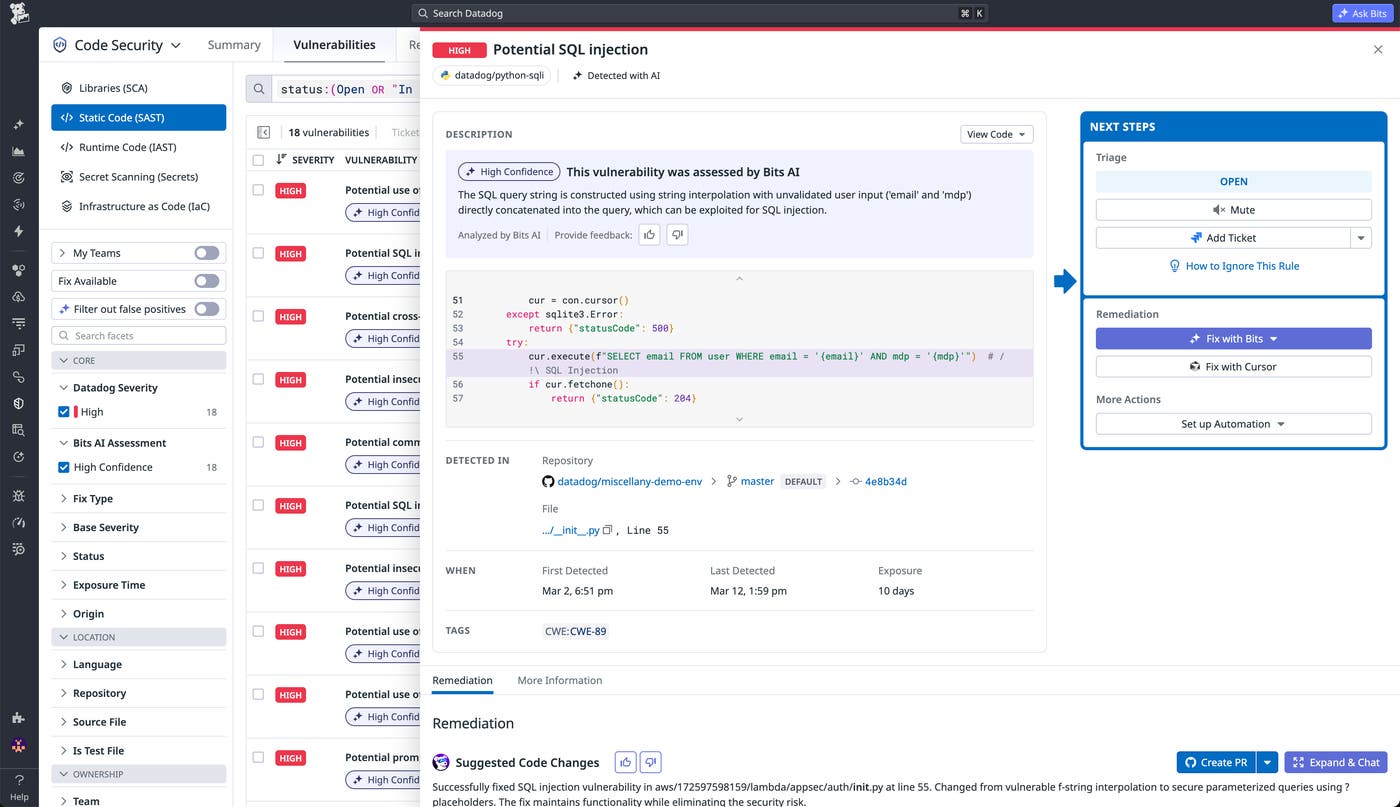
The vulnerability page for a potential SQL injection weakpoint that was detected with AI. The relevant lines of code suggested and fixes are displayed.

Fine-tuned performance

Because the analysis process is repeated on each file in a repository—and each run requires multiple LLM calls—a full scan can be both slow and costly. Costs can increase further when using more advanced models with higher latency, such as Claude Opus.

To overcome this limitation, we run a complete repository scan at onboarding. Once this initial scan is done, Datadog only performs incremental analysis when a file’s content or context changes. Subsequent scans are faster and more cost effective as a result. To balance accuracy and cost, our AI-native SAST solution can provide better detection for high-impact and high-prevalence vulnerabilities rather than the broader rule set covered by traditional SAST tools.

Additionally, we use Datadog LLM Observability to monitor both performance and cost for our AI-native SAST solution. Here, we’re able to track latency, token usage, LLM calls, and estimated cost. This data helps us ensure that our project continues to perform optimally throughout any refinements.
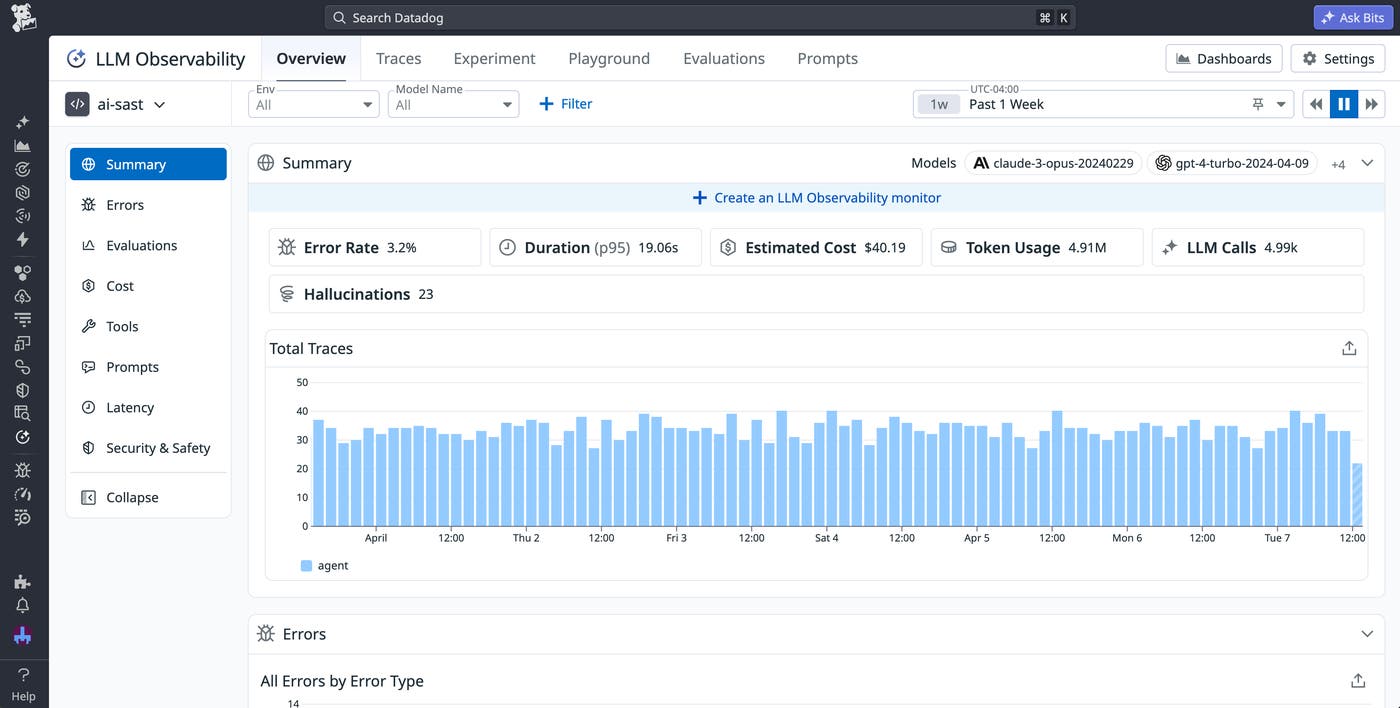
The data shown above is for demo purposes and is not reflective of real metrics for the AI-native SAST project.
The overview page for an app in LLM Observability, with key metrics and a graph showing trace activity displayed.
The data shown above is for demo purposes and is not reflective of real metrics for the AI-native SAST project.

Evaluating accuracy against the OWASP Benchmark

To determine whether our AI-native project surfaces more accurate results, we used the OWASP Benchmark framework to compare its true positive rate against our traditional SAST solution (enhanced with LLM false-positive filtering).

The table below shows the true positive rate (recall) for each OWASP Benchmark vulnerability category.

VulnerabilityTraditional SAST + LLM FilteringAI-native SAST
Command Injection59%90%
Cross-Site Scripting (XSS)65%93%
Insecure Cookie87%100%
LDAP Injection70%85%
Path Traversal64%90%
SQL Injection63%86%
Trust Boundary46%81%
Weak Encryption Algorithm100%100%
Weak Hashing Algorithm69%54%
Weak Randomness100%99%
XPath Injection68%95%

In almost every category, our AI-native solution outperforms our traditional SAST tool, even when the latter has been augmented with LLM-based filtering.

The results suggest that the AI-native solution provides more accurate detection for context-dependent vulnerabilities. For vulnerabilities like command injection or SQL injection—where data flow across files must be analyzed to accurately detect a vulnerability—the true positive rates from our AI-native solution are at least three times higher than our traditional SAST tool. For context-independent vulnerabilities such as weak randomness or weak encryption algorithms, we see a similar level of accuracy across tools. Because our AI-native project surfaces findings alongside traditional SAST results, both approaches can be used together to identify true vulnerabilities more completely.

Why open source it?

Since the early 2000s, many SAST tools, including Datadog SAST, have been released under an open source license. This helps the security community contribute toward building better tools and improve security posture across the industry.

We believe that LLMs open up new opportunities for creating more robust, efficient application security tools and we want to be a leader of this change. By open sourcing our solution, we aim to increase transparency for our customers and invite collaboration from the security community.

The future of AI-enhanced SAST at Datadog

This first iteration of our AI-native SAST solution provides better accuracy than traditional tools. Its integration within Datadog allows it to run at scale for every code change. The current architecture relies on structured prompting rather than a full agentic approach, giving tighter control over resource usage and predictable execution costs.

In the coming months, we plan to explore more agentic scanning techniques to improve contextual reasoning and vulnerability discovery depth. You can view the latest version of the Datadog AI-native SAST project on GitHub.

Note that while the codebase is open source, incremental analysis is only available for Datadog customers. Our AI-enhanced incremental analysis feature is currently in Preview. To learn more about Datadog’s in-platform SAST feature, see the AI-enhanced Static Code Analysis documentation.

To explore Datadog’s security tooling, you can sign up for a 14-day free trial.