












Infrastructure as code (IaC) has become the default way to manage cloud infrastructure.
At the same time, AI-assisted coding generates more infrastructure code than teams have ever had to review, and agents are starting to open pull requests and make infrastructure decisions on their own. The tooling keeps moving as well, and a setup that looked solid five years ago can hold a team back today, even if nothing about it is technically broken.
In this blog, we will look at what IaC modernization means in practice, provide a practical roadmap, and discuss how to future-proof your IaC setup without breaking production.
What we’ll cover:
IaC modernization involves bringing your infrastructure code, delivery workflows, and tooling up to current standards. The exact details of this journey depend on your organization’s maturity, and most teams fall somewhere on a spectrum.
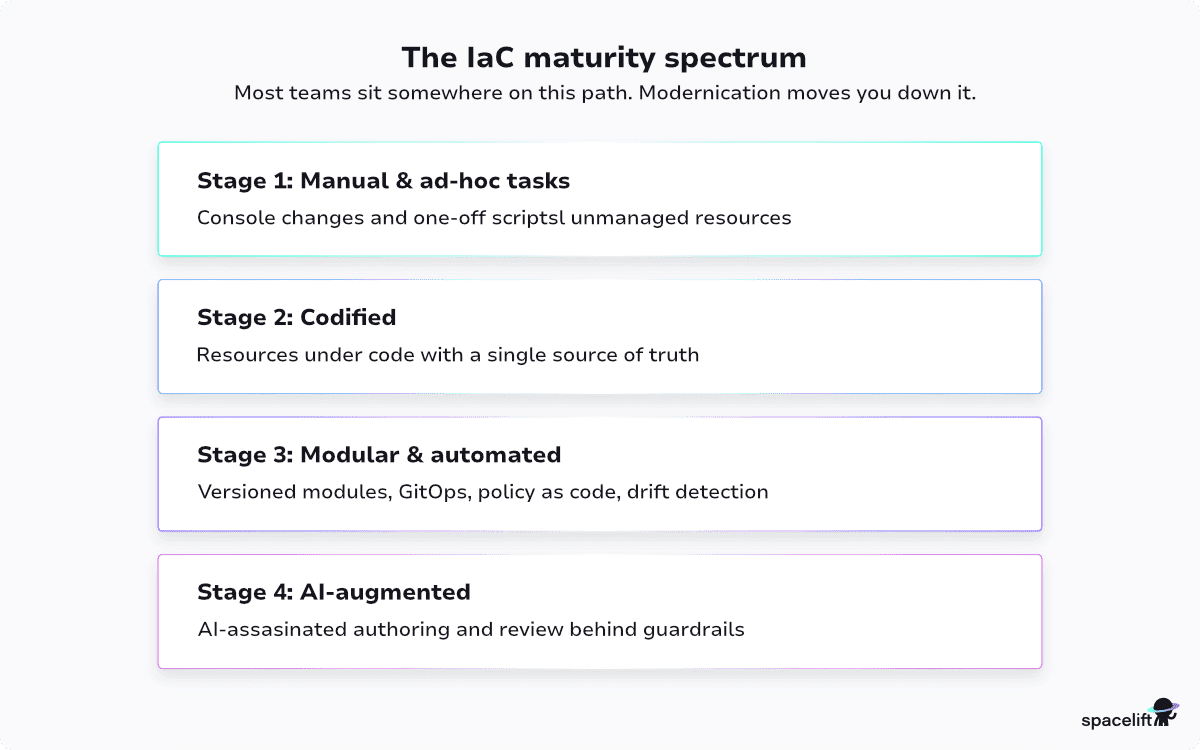
For some, the starting point is IaC adoption itself. Teams that have built on top of console changes and one-off scripts need to shift their mindset and start preparing their IaC strategy. With a strategy in place, IaC adoption also requires teams to bring unmanaged resources under code and establish a single source of truth.
Teams that adopted IaC early face a different problem. A codebase that worked fine initially might struggle to scale effectively, with plans taking a long time to complete, and version upgrades feeling risky. Uncontrolled IaC and module development often lead to duplication, unmaintained modules, and messy code structure. Modernization here means restructuring legacy code so that changes become small and safe again.
For others, it might mean standardizing and improving their custom-built and difficult to maintain CI pipelines with an optimized delivery workflow with pull request-driven changes, automated checks, and an audit trail.
Finally, AI-driven workflows and optimizations are on every team’s radar these days. Teams now use AI to generate infrastructure code, review pull requests, explain drift, and assist with operations. Integrating these capabilities safely, and without sacrificing quality, is top of mind for many orgs, raising governance questions that older setups were never designed to answer.
A core principle applies across the whole spectrum: modernization is continuous. Cloud providers release new services, tools evolve, new AI models appear every quarter, and organizations grow. Treat it as an ongoing practice rather than a one-time project.
Outdated infrastructure as code slows teams down and adds risk. Plans take longer to run, version upgrades feel unsafe, and drift builds up as manual changes go untracked. These problems only compound as your cloud footprint and team grow.
Modernizing IaC keeps changes small and safe, speeds up delivery, and gives developers a governed path to move fast while platform teams stay in control.
Mature IaC setups differ in their tools and conventions, but they share a few common traits:
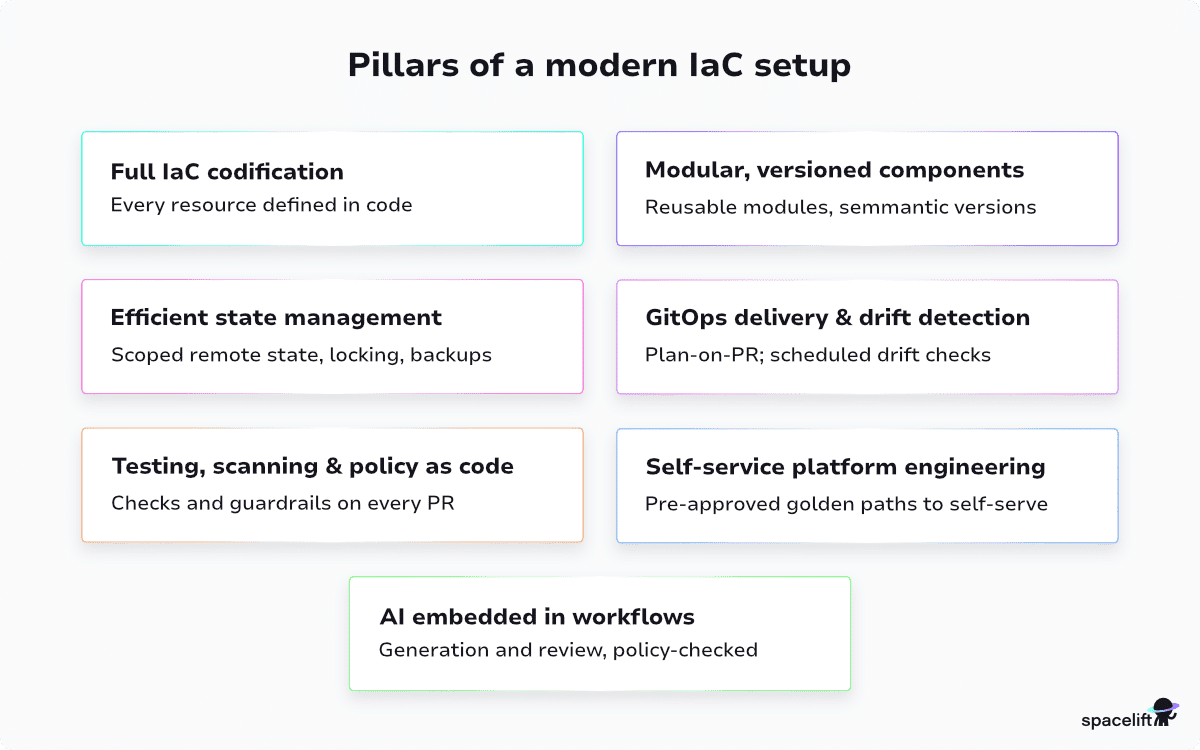
Every infrastructure resource, whether for production or lower-level environments, is defined in code. Full IaC codification provides auditability, governance, process-driven automation, and the confidence needed to operate efficient setups at scale.
Hand in hand with full IaC codification are version control and well-structured, modular code. This allows following common practices such as KISS (keep it simple, stupid) and DRY (don’t repeat yourself). Shared modules encode your standards once, and every team consumes them instead of rebuilding the same patterns.
Publishing modules to a registry with semantic versions makes reusability and upgrades easier. Teams can then test the next module versions in a non-production environment and upgrade when they feel confident.
State should reside in remote backends with locking, encryption, and versioned backups. Locking prevents two concurrent runs from corrupting each other, and encryption matters because state files might contain sensitive values.
Instead of a single giant state file containing all your infrastructure, split it into multiple scoped states. Smaller states produce faster plans, and a mistake in one part of the system, wont affect the rest.
With AI-generated code pushing the limits of software and infrastructure delivery, robust platform engineering practices, such as well-defined GitOps workflows, are essential. Every change needs to go through a pull request. Applies should happen from a controlled environment after review and merge.
Without proper guardrails in place, environments can drift away from the source of truth in code repositories due to incident break-glass scenarios, automation tools with write access, and old console habits. This means the next deploy can have unintended consequences. Drift detection and guided remediation are necessary parts of a complete IaC strategy.
Policy as code provides safety, codifies security, and brings confidence. Rules written using frameworks like Open Policy Agent can automatically evaluate every change. Required tags, encryption settings, allowed regions, and approval requirements are checked on every run.
Even more, linting, validation, security scanning, and cost checks run on every pull request. Tools such as tflint, Checkov, and Trivy catch misconfigurations before provisioning, and cost estimation tools like Infracost show the price impact of changes.
In modern setups, developers are empowered to provision approved infrastructure patterns on their own through golden paths. Platform teams define the patterns and the guardrails.
Developers leverage these to get the infrastructure needed to support their applications without deadlocks and dependencies between teams.
AI generates code, summarizes plans, explains drift, and helps triage failed runs. It can also help troubleshoot and remediate issues, and sift through large logs. Mature setups start treating AI output like any other change: planned, policy-checked, and reviewed before it reaches production.
The capability to leverage the speed and potential AI offers is truly valuable, but only on top of the guardrails the other pillars provide.
The steps below form a practical sequence for modernizing your existing setup, with each step building on the previous one.
Think about defining and tracking progress before you start on this task. IaC coverage, the share of resources managed by code, is a good metric to start with. Time to provision a standard environment, drift findings, and the percentage of changes that go through self-service are other examples of metrics you could use.
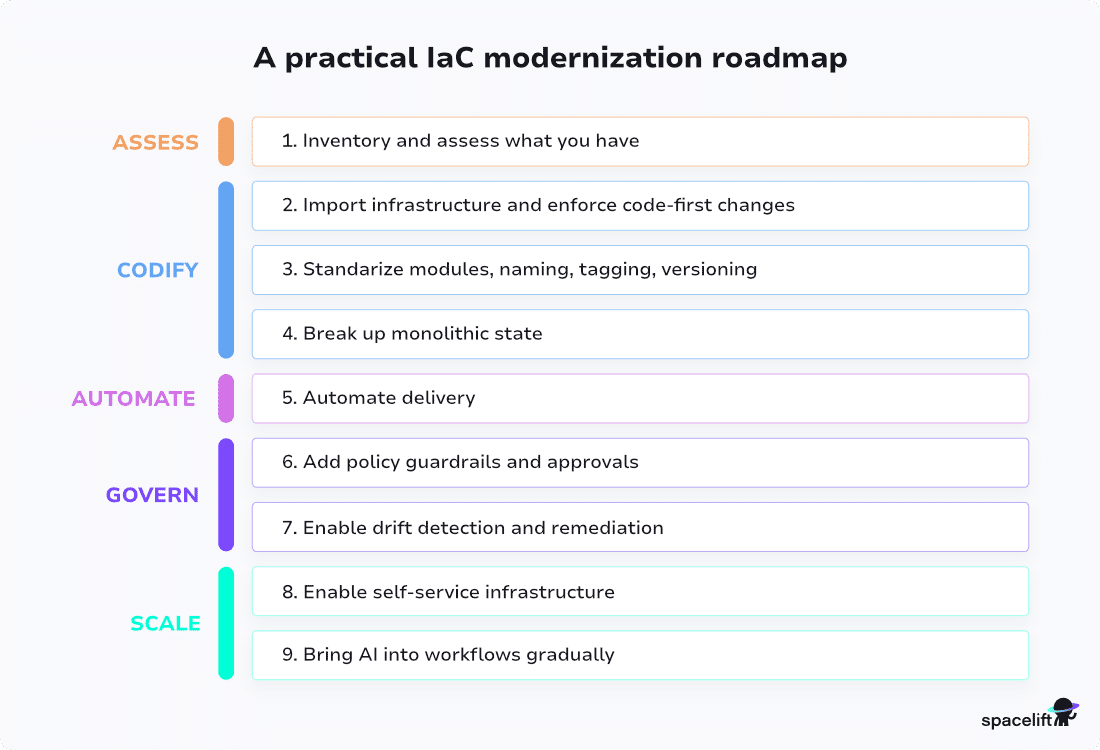
Start by making an inventory and classifying every resource in your cloud accounts. Understand what is already codified and in good shape, what is unmanaged, and if there are drifted resources, or resources that exist in state, but no longer exist in the live environment.
Cloud-native inventory tools (such as using the AWS Config to automatically inventory AWS resources across multiple accounts and regions) and IaC management platforms can help with this. Scope the effort by account or environment instead of taking on everything at once.
The output of this step is a map of your inventory and a priority list. Focus first on resources that change often or carry a security risk.
Bring unmanaged resources under code without recreating them. Terraform and OpenTofu support config-driven imports through import blocks, which are reviewable and repeatable:
import {
  to = aws_s3_bucket.assets
  id = "company-assets-bucket"
}
Running a plan with the -generate-config-out flag produces a starter configuration for the imported resources.
Import well-understood resources first, and schedule careful reviews for critical production systems. Use plans against imported resources and verify you see no changes. Work in batches as you go: import a group of related resources, refactor, get the plan clean, merge, and then move on. Avoid big-bang imports that nobody can meaningfully review.
For a complete guide, check out Importing Existing Infrastructure Into Terraform – Step by Step.
Importing resources will be a never ending task if new ones keep appearing outside the code. Make consoles read-only for day-to-day work, and create a break-glass process for emergencies: elevated access is granted temporarily, logged, and followed by a task to codify whatever changed. These restrictions should be paired with self-service capabilities to avoid blocking workflows and enable users to move fast by following the proper path.
Define conventions early on before scaling. How resources are named, which tags are mandatory, how modules are structured, and how they are versioned. Build a library of modules for your most common patterns and publish them with semantic version numbers.
A tagging strategy with required details for all resources, such as owner, environment, and cost center, is crucial for effective scaling, cost reporting, and incident response. Standards only work when they are enforced, so you have to bake them into the pipelines and policies.
For inspiration, check out our Terraform Best Practices Guide.
Large, shared states slow plans down and create large areas where things could go wrong with every change. Split them by lifecycle and ownership. A common split is one stack per environment per logical component, such as networking, data, and application layers. Stacks that change rarely, such as networking, should be separated from application infrastructure that changes more often.
Take a look at refactoring state guidance for best practice on how to perform this cleanly.
The end goal is a set of small stacks that any engineer can plan without fear, with short plan times. Check out our Managing Terraform State – Best Practices & Examples guide for more details.
A consistent infrastructure delivery workflow is non-negotiable for IaC modernization and preparing for scaling to the GenAI and agentic eras. Pipelines also offer deterministic workflows that align with platform engineering best practices we can rely on.
Especially for effectively integrating IaC coming from AI coding assistants, create pipelines that let you output and review plans in pull requests. In terms of workflow, review AI-generated code, apply only after review, and allow deployment only through pre-approved workflows. This also allows you to properly manage deployment credentials with short-lived, dynamically issued environment credentials.
A generic CI system can do this with significant custom work, and many teams spend months building and maintaining CI systems for this purpose. Purpose-built orchestration platforms handle it natively.
Spacelift, for example, maps repositories to stacks, uses stack dependencies to order multi-layer deployments, provides governance on every change, and allows you to deploy with confidence through git-driven policy-enforced workflows.
With delivery configured and automated, next, you need to look into the policies and guardrails that keep your environments safe and compliant with your needs. Policy as code has become the de facto standard to manage this.
Policy as code evaluates each run: blocking non-compliant resources and configurations, enforcing best practices, and restricting resource types.
One of the most popular policy management tools is Open Policy Agent (OPA). OPA implements policies as code using the Rego language. For example, here’s a policy in Rego scanning a Terraform plan and rejecting the run if any S3 bucket is about to be created or updated with a public-read access control list (ACL):
deny[msg] {
  resource := input.resource_changes[_]
  resource.type == "aws_s3_bucket"
  resource.change.after.acl == "public-read"
  msg := "S3 buckets must not be public"
}
You can find more details on Rego syntax here.
Policies can be configured as needed, for example, to warn on minor issues and hard-fail on serious ones. Add approval rules for sensitive cases, such as any change to production or any plan that deletes resources.
In Spacelift, OPA-based policies attach at multiple points of the run lifecycle, offering quality guarantees based on allowed resources and configurations.
Infrastructure drift can lead to costly production incidents, especially in environments without detection or remediation processes. Schedule drift checks and decide in advance what to do when they find something. Notification fits most environments. Automatic remediation has to be examined on a case by case basis, depending on the environment.
Spacelift runs scheduled drift detection for each stack and can trigger remediation runs to restore the declared state.
Restrictions without alternatives just move the bottleneck to the platform team and force users to bypass platforms. Invest in giving developers pre-approved self-service infrastructure paths instead. Define templates for the environments people request most often, expose them with input fields, and let teams provision on demand within the pre-built guardrails.
Spacelift Blueprints work this way: a platform engineer defines a parameterized stack template, and developers create infrastructure from it through a form, with every policy still applying.
When you need those guardrails to hold long after provisioning, Spacelift Templates keep every deployment version-pinned and centrally governed, so the same inputs produce identical infrastructure every time and platform teams retain control over its whole lifecycle.
AI adoption in infrastructure is catching up with software development. Many teams have adopted or are experimenting with AI for infrastructure automation in production or pilots. A sane mental model to get started: Start with low-impact assistance such as code suggestions, plan summaries, drift explanations, and first-pass reviews of module changes.
Let the guardrails from steps 6 and 7 prove themselves against AI-generated changes. Then expand toward higher-impact automation, keeping a human approval in the loop for anything that touches production.
Here’s how to future-proof your infrastructure against whatever comes next.
HashiCorp moved Terraform to the Business Source License in August 2023. OpenTofu, the community fork under the Linux Foundation, reached general availability in January 2024 and is increasingly getting adopted. The two remain largely compatible, but they are diverging.
Open, community-governed building blocks can give you freedom and protect your strategy for a single vendor’s decisions.
Examples of well-established projects on the wider IaC space include:
In real settings and complex enterprise environments, we find that no single tool covers all the infrastructure needs in terms of provisioning, configuration management, automation, deployment, and workload orchestration. In other cases, acquisitions regularly bring a second toolchain into the organization.
This is what multi-IaC orchestration platforms like Spacelift solve, with one workflow across Terraform, OpenTofu, Terragrunt, Pulumi, CloudFormation, Ansible, and Kubernetes.
Platform engineering has proved its value at scale over the past few years. Golden paths, the pre-approved routes for common infrastructure needs, reduce the decisions every team has to make and keep the landscape consistent according to best practices and security requirements. They also shorten onboarding, with new engineers following well-known patterns and pathways.
Golden paths help you also manage changes at scale: when a standard needs to evolve, you update one template that propagates to many environments.
AI assistance in IaC is already practical for code authoring, module documentation, plan summaries, and explaining failures. Generating IaC based on well-established templates and modules, previous examples, and coding conventions can be extremely practical.
Documentation benefits as well: generated module docs and change summaries stay current with no practical effort. The teams getting value from AI treat its output as a proposal that goes through the same pipeline as human-written changes.
Spacelift Intelligence follows this model, assisting with infrastructure work inside the platform’s existing policies and approvals rather than around them.
The step beyond assistance is agents that act: opening pull requests, remediating drift, provisioning environments on request. Standard interfaces like the Model Context Protocol (MCP) make it easier to connect agents to infrastructure tooling, which lowers the barrier to adoption.
Running agents against infrastructure safely requires the foundation this article describes, plus a few specific controls. Give agents least-privilege credentials scoped to their tasks, and separate the systems that propose changes from those that approve them. Keep a human in the loop for production, and run experimental work in sandboxed accounts where mistakes stay contained.
Agentic systems are here to stay, so we need to figure out how to embed them into infrastructure workloads in a controlled, safe way.
Spacelift is an infrastructure orchestration platform built for the kind of modernization this article describes. This is how the capabilities mentioned above fit together:
If you want to see what this looks like on your own stacks, start a free trial or book a demo with our engineers.
IaC modernization is the ongoing effort to keep infrastructure code, workflows, and tooling up to date. Where it starts depends on your maturity: importing unmanaged resources, restructuring a legacy codebase, upgrading delivery workflows, or safely adding AI capabilities.
The roadmap is incremental. Inventory first; import and standardize next; then automate delivery; add policies and drift detection; and open up self-service. Future-proofing comes down to portability, open standards, a workflow that spans multiple tools, and guardrails strong enough to let AI adoption grow safely.
It keeps infrastructure code viable as change volume, multi-cloud sprawl, and AI-generated Terraform outpace legacy patterns. Modernized IaC adds modularity, policy-as-code, and drift control, so teams can scale safely instead of drowning in brittle monolithic files.
Adoption is the first move from manual provisioning to managing infrastructure through code. Modernization is what follows: refactoring existing IaC into modular, testable, policy-governed components with GitOps and drift detection.
AI generates Terraform or OpenTofu from prompts, codifies existing cloud resources into modules, reviews pull requests, and flags drift. Autonomous production changes are still rare, usually gated behind approval workflows and policy-as-code guardrails.
此内容由惯性聚合(RSS阅读器)自动聚合整理,仅供阅读参考。 原文来自 — 版权归原作者所有。