






Multicloud compliance is the practice of meeting your regulatory, security, and governance requirements consistently across two or more cloud providers, and producing the evidence to prove it. It applies whenever workloads covered by a framework such as SOC 2, ISO/IEC 27001, GDPR, HIPAA, PCI DSS, or DORA run in more than one cloud.
The frameworks themselves are provider-agnostic. They ask for encryption at rest, least-privilege access, logged privileged actions, and retained audit trails. The evidence is not.
AWS, Azure, and Google Cloud each implement those controls through a different identity model, a different policy engine, a different audit log format, and a different shared-responsibility boundary. The same rule can be enforced in one cloud, missing in another, and reported differently by both, which is how a control that looks compliant on paper fails an audit.
This article covers which regulations and standards apply to multicloud environments, why compliance is harder across providers than in a single cloud, the mistakes that cause compliance failures, how to build a compliance strategy that scales, how to produce audit evidence an auditor will accept, and which tools handle each layer.
What we’ll cover:
Multicloud compliance is the process of configuring multicloud environments so that they meet all your regulatory, security, and internal governance requirements. It’s how you layer aspects, including data protection, encryption, access controls, and auditability, to ensure your infrastructure is safe to use.
Building a multicloud compliance strategy isn’t as simple as just duplicating rules across providers. As each platform has its own policy systems and default configurations, it’s easy for conflicts and dangerous oversights to occur.
Multicloud compliance depends on implementing dependable systems that abstract provider-specific functionality and enable you to manage cloud-wide policies and audits in one place.
Why is multicloud compliance harder than single-cloud compliance? Most multicloud compliance challenges stem from the increased operational complexity that the architecture creates. Compared with conventional single-cloud solutions, multicloud has an inherently larger threat surface that exposes you to more risks.
Here are some of the factors that can cause compliance failings:
Resolving these challenges requires compliance to be treated as a first-class component of your multicloud strategy. Designing compliance into your architecture will help you anticipate problems before they can cause policy violations in production.
No major framework is written for one cloud provider. Every framework is written as controls: encrypt data at rest, give people only the access they need, log privileged actions, and keep the logs.
That cuts both ways. You do not need a separate compliance program for each cloud. But when an auditor asks you to prove a single control, you have to pull the answer out of three different consoles.
| Framework | Applies to you if | What multicloud changes |
| SOC 2 | Customers ask for a report against the AICPA Trust Services Criteria. The criteria are fixed. You decide which controls meet them. | One report covers the whole audit boundary. A control you describe once has to hold true in every provider inside that boundary. |
| ISO/IEC 27001 | You need a recognized certification for your information security management system | Your scope statement and Statement of Applicability have to cover every provider. ISO/IEC 27017 and ISO/IEC 27018 give you the cloud and privacy guidance for writing a responsibility split per provider |
| Framework | Applies to you if | What multicloud changes |
| GDPR | You process personal data belonging to people in the EU | Residency is the risk. A replication rule that copies data to an unapproved region counts as a transfer, and one provider’s lifecycle policy can undo a guarantee you enforce correctly everywhere else |
| HIPAA | You handle U.S. protected health information | Every provider that touches that data needs its own Business Associate Agreement, and the safeguards have to hold in each one |
| DORA | You are an EU financial entity | Your register of information has to cover every provider and its subcontractors, not just the primary one |
| NIS2 | You are an essential or important entity in the EU, including digital infrastructure | Your obligations come from each country’s national law rather than the directive itself, so they differ by country. Check the transposition status wherever you operate |
| EU AI Act | You build or deploy an AI system used in the EU. AI-assisted provisioning usually sits outside the high-risk tier | Transparency duties follow the system, not the cloud underneath it, so you disclose the same way no matter which provider runs it. Duties for high-risk systems phase in later |
| Framework | Applies to you if | What multicloud changes |
| PCI DSS | You store, process, or transmit cardholder data. The obligation is mostly contractual, through the card brands, though a few U.S. states write it into statute | The full requirement set is scored in every cloud inside your cardholder data environment, including MFA scope, payment page script controls, and targeted risk analyses |
| Framework | Applies to you if | What multicloud changes |
| FedRAMP | You sell cloud services to U.S. federal agencies | Every service inside your boundary needs its own authorization, which limits the providers and regions you can use. Agencies still issue their own ATO on top of it |
| CMMC | You work in the U.S. defense supply chain | Requirements flow down to subcontractors, so partner clouds land in scope too. The program rolls out in phases, so confirm the current phase before you scope an assessment |
These frameworks use different words and different enforcers, but they land on the same four areas: identity and access, encryption and key management, logging and retention, and configuration governance.
Build there first, provider by provider, and map to frameworks as the requests arrive: a SOC 2 request, a customer’s ISO questionnaire, a DORA register update. Teams that work the other way document the same MFA policy three times, then maintain three versions of it.
Building multicloud compliance systems that scale with your operations doesn’t have to be arduous. It simply requires methodical planning, disciplined implementation, and an appreciation for how issues in one cloud account or workload could affect their neighbors.
The following six steps provide a basic framework to follow as you design your compliance strategy.
You should keep your team’s context in mind as you reach each stage. If your organization operates within a unique regulatory or legal space, then your processes, tooling, and governance controls may need special tuning to hit the requirements you’re subject to.
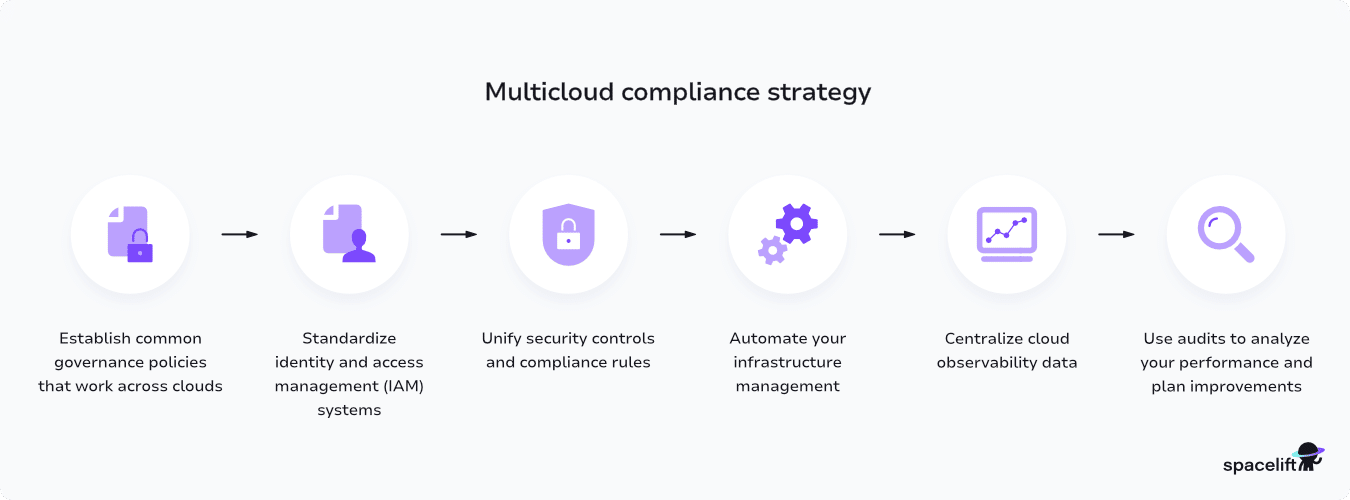
Begin by defining your compliance objectives and setting out cloud-agnostic policies that’ll let you meet them. Instead of adopting cloud-specific governance models, establish your own framework of rules, controls, and monitors that you can deploy across each cloud.
Having a single definition for each role and responsibility makes it clear how different clouds should be configured. This ensures all workloads are consistently aligned with each other to avoid errors and conflicts. Clearly stating requirements such as “all infrastructure deployments require two approvals” or “drift detection scans must run daily in each cloud” encourages you to configure your clouds against those needs, instead of unintentionally bending policies to match provider-level systems.
Centralizing identity outside of individual cloud providers enables users to settle on one set of credentials for each environment. Operators, meanwhile, can configure access controls in one place, such as to ensure least-privilege access requirements and Role-Based Access Control (RBAC) settings apply consistently to each cloud.
Consolidating IAM policies also gives you a single source of truth to refer to during audits. This supports multicloud compliance by preventing actions from being overlooked just because they happened in a less frequently used cloud account.
Decoupling identity from infrastructure ensures records can be preserved indefinitely, even if you stop using a specific cloud provider.
Policy-as-code rules, automated scan tools, and process checkpoints such as checks embedded in CI/CD pipelines form the backbone of day-to-day compliance management. These solutions allow you to centralize and automate the configuration of compliance controls across your cloud environments. They prevent mistakes and ensure continuous enforcement, so operators can focus on defining requirements rather than reviewing every change.
To get started, it’s best to prioritize encryption settings, network-level traffic management within and between clouds, and enforcement of internal security policies across your workload fleet.
Use your CI/CD systems and internal developer platforms to run checks in real-time, then provide instant feedback to developers and compliance teams. This will ensure that the resources in your cloud accounts always meet your compliance thresholds when they’re created.
Automating infrastructure management using infrastructure as code (IaC) and CI/CD-based deployment pipelines lets you embed policy enforcement directly into your provisioning workflows. This enables you to prevent non-compliant resources from ever reaching your cloud accounts.
Infrastructure automation benefits multicloud compliance in other ways, too. It establishes a single source of truth for your policies, enables you to easily generate activity audit logs, and provides a natural baseline for detecting and correcting configuration drift.
It also allows you to use consistent processes to deploy to each cloud provider, leaving fewer gaps for compliance failures to appear.
Aggregating logs and metrics from each cloud provider within a single observability platform is key to achieving effective monitoring of your full compliance posture. Unless you unify your data, you can only track what’s happening within individual cloud accounts. But understanding the bigger picture is key to detecting emerging threats that could spread across environments.
Try using observability solutions like Grafana and Datadog to monitor your cloud environments, build combined dashboards, and correlate different security and compliance events. You should also instrument your compliance systems so you can track KPIs such as how many policy checks fail, which teams trigger them, and the workloads that they target. This extra visibility will let you make informed decisions when designing new compliance controls or investigating breaches.
Regular audits are key to maintaining long-term multicloud compliance. More providers mean more places where issues could occur. Use automated scans and periodic manual reviews to catch these problems before they impact your multicloud estate.
This provides the data you need to demonstrate that your compliance posture meets all applicable internal and regulatory requirements.
Audit findings should also drive updates to your compliance policies and controls.
If an audit reveals you’re at risk of breaching certain commitments, then you should return to the start of the cycle by designing improved policies that address the weakness. This creates a positive feedback cycle of improvement, in which audit outcomes steer the evolution of your compliance strategy.
Implementing your compliance strategy is just the beginning of your multicloud compliance journey. Here are seven best practices that’ll help ensure your systems remain effective as you scale your operations.
Compliance mustn’t be the work of a single specialist team. It’s important to build awareness of how different cloud actions affect compliance within development, security, and operations teams too. Encouraging collaboration between stakeholders will make compliance a natural part of daily workflows, rather than an afterthought.
Tracking policy violations and audit outcomes against your KPIs lets you understand the frequency and severity of compliance breaches. You can then make an informed assessment of how effective your controls really are. These metrics provide an objective baseline to prioritize improvements against, removing the need to make assumptions about where compliance issues may lie.
Schedule regular reviews of your compliance strategy to update policies and design architectural improvements. This allows stakeholders to tweak your approach so it better reflects how your multicloud environment has evolved, including accommodating new tools and cloud providers.
It’s important to conduct a robust risk assessment before you introduce new providers, infrastructure components, or management tools to your stack. Taking time upfront to understand how a change could affect your compliance posture is far less costly than discovering unexpected effects after the change goes live.
Automating compliance scans from within Cloud Security Posture Management (CSPM) and Cloud-Native Application Protection Platform (CNAPP) solutions makes it possible to reliably catch violations as your cloud footprint grows. Increasing your use of automation can improve detection accuracy, reduce response times, and simplify data collection for later analysis. Similarly, using infrastructure orchestration platforms to automate drift detection and resolution can help cap how long your cloud accounts can exist in a misconfigured state.
Maintaining detailed documentation for the what, why, and how of your multicloud governance systems will keep your strategy maintainable long-term. Audit trails that log policy changes, violations, and incidents also provide crucial evidence when you need to demonstrate compliance to regulators or auditors. The information within will make internal investigations more efficient too, in case something does go wrong.
Your multicloud compliance obligations don’t end with governing the cloud accounts you directly control. You should also keep tabs on the compliance postures of the SaaS vendors and third-party services that you depend upon. Documenting the standards they meet, along with how they’re used within your stack, helps prevent compliance blind spots that could just as easily expose your organization to risk.
Compliance tooling maps to the control families that an auditor tests, not to product categories. Use this to work out what you are missing rather than what to buy next.
| What the auditor tests | What you need across providers | Tools that do it | What it still will not give you |
| Identity and access | One identity per person and per workload, consistent roles, reviewable in one place | Okta, Microsoft Entra ID, or Google Workspace federated to each cloud through SAML or OIDC; workload identity federation for service-to-service access | Any judgment about whether the permissions you granted are appropriate. Federation centralizes authentication, not authorization design |
| Configuration governance, prevention | A rule written once and enforced before deployment, in every cloud | Open Policy Agent for cross-provider rules; AWS Service Control Policies, Azure Policy, and Google Cloud organization policies for guardrails that hold even when someone works in a console | Coverage of resources created outside your pipelines, unless the native guardrails are in place too |
| Configuration governance, detection | Continuous evaluation of what is actually deployed against benchmarks and framework mappings | CSPM and CNAPP platforms such as Wiz, Prisma Cloud, and Orca Security | Prevention. These report a misconfiguration after it exists, which produces a backlog rather than a guardrail |
| Encryption and key management | Consistent encryption at rest and in transit, plus a key custody story you can defend | Each provider’s native KMS, or an external key manager for centralized custody and rotation | The custody decision itself. Native KMS spreads keys across providers; centralizing adds operational overhead |
| Logging and retention | Every provider’s audit trail in one place, normalized, retained for the full audit period | CloudTrail, Azure Activity Log, and Google Cloud Audit Logs shipped into one SIEM or log platform | Normalized schemas. The work is in the normalization and the egress bill, not the choice of tool |
| Change evidence | A record of what changed, who approved it, and what the policy check returned | Infrastructure as code with an orchestration platform recording plans, approvals, policy decisions, and drift; Checkov or Trivy for pre-deployment scanning | Anything about changes that bypassed the pipeline. Evidence only exists where changes are forced to travel |
Sequence matters more than coverage.
Start with identity, because it converts three access reviews into one and every other control depends on knowing who did what.
Add prevention in the provisioning path next, because it stops the problem rather than counting it. Then aggregate logs, because that is what turns controls into evidence.
Add detection last, once the estate is large enough that you cannot reason about it directly.
A platform like Spacelift can help your organization manage cloud infrastructure more efficiently.
Spacelift is the infrastructure orchestration platform built for the AI-accelerated software era. It manages the full lifecycle for both traditional infrastructure as code and AI-provisioned infrastructure, supporting tools like OpenTofu, Terraform, Ansible, Pulumi, Kubernetes, and CloudFormation.
Security is one of Spacelift’s top priorities, with features such as policy as code, encryption, Single Sign-On (SSO), MFA, and private worker pools built into the product. Spacelift is SOC 2 Type II audited and provides compliance and security artifacts, including GDPR resources and its DPA, through the Spacelift Trust Center.
It is also the first IaC orchestration platform to receive FedRAMP authorization, delivering flexible, policy-driven automation to federal agencies and contractors seeking secure, compliant infrastructure workflows.
The power of Spacelift lies in its fully automated approach. Once you’ve created a Spacelift stack for your project, changes to the infrastructure as code files in your repository are automatically applied to your infrastructure.
For non-critical workloads like tests, POCs, and demos, Spacelift Intelligence adds an AI-powered layer that enables natural language provisioning, diagnostics, and operational insight, so developers can request infrastructure without writing configuration code while platform teams retain full governance and visibility.
Spacelift’s pull request integrations keep everyone informed of what will change by displaying which resources are going to be affected by new merges. Spacelift also allows you to enforce policies and automated compliance checks that prevent dangerous oversights from occurring.
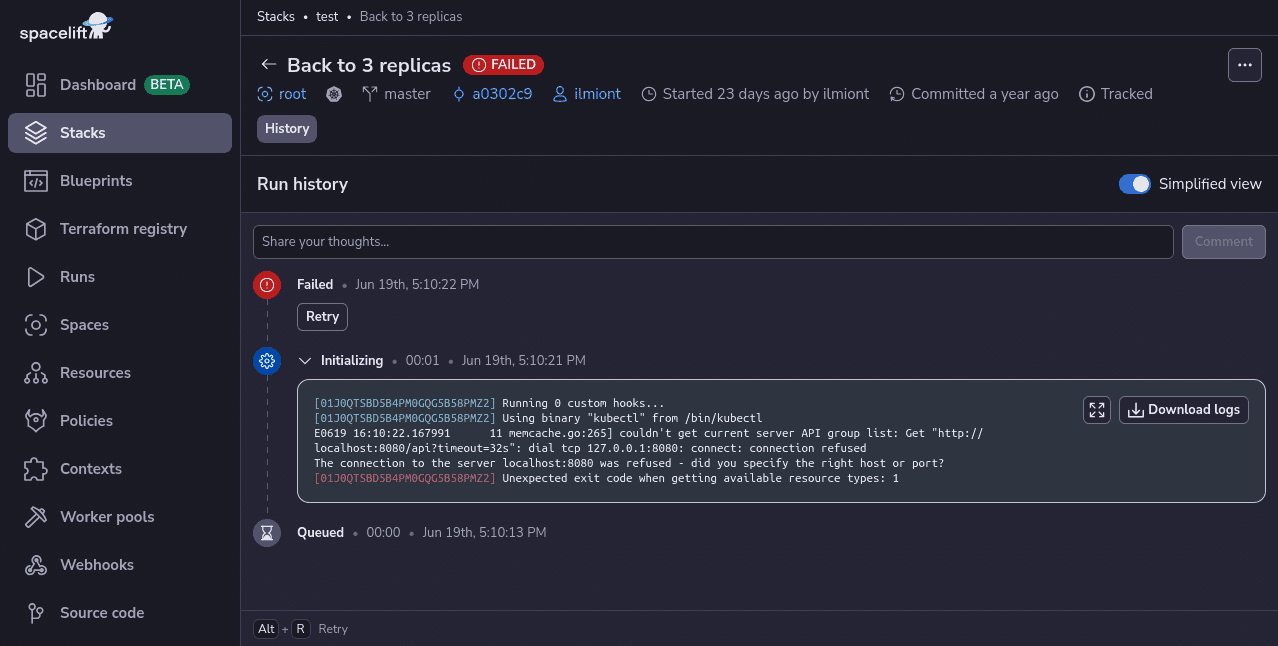
Spacelift includes drift detection capabilities that periodically check your infrastructure for discrepancies compared to your repository’s state. It can then launch reconciliation jobs to restore the correct state, ensuring your infrastructure operates predictably and reliably.
With Spacelift, you get:
If you want to learn more about Spacelift, create a free account today or book a demo with one of our engineers.
Multicloud compliance is inherently more complex than compliance management with a single provider. Inconsistent cloud security models, incompatible policy systems, and fragmented visibility all make it harder to enforce governance requirements and conduct effective audits.
The good news is that following standard cloud best practices will get you a long way toward addressing many of these problems. Unifying IAM solutions, utilizing IaC-driven automation, and consolidating observability data within dedicated external platforms will guide you towards building a compliance framework that closes the gaps between clouds.
Ultimately, it’s best to view multicloud compliance as a continuous operational process that’s built into your architecture from the start. Intentionally planning for compliance will help you steer away from adhoc policies and provider-specific features that can’t be scaled across clouds. This will leave you less exposed to the threats of data breaches and regulatory penalties.
Multicloud can be secure, but it is not secure by default. Safety depends on consistent identity governance, unified visibility, and standardized policy enforcement across each provider, since AWS, Azure, and Google Cloud each apply different native controls.
Each provider uses different security models, APIs, logging formats, and shared-responsibility boundaries, forcing teams to reconcile fragmented evidence and controls instead of mapping a single framework (like SOC 2, HIPAA, or GDPR) to one environment.
Policy drift caused by inconsistent enforcement across providers, which produces blind spots, misconfigurations, and incomplete audit evidence. This is the leading cause of failed audits and undetected data exposure in 2026 multicloud environments.
此内容由惯性聚合(RSS阅读器)自动聚合整理,仅供阅读参考。 原文来自 — 版权归原作者所有。