


惯性聚合 高效追踪和阅读你感兴趣的博客、新闻、科技资讯
阅读原文 在惯性聚合中打开

推荐订阅源

J
Java Code Geeks
Google DeepMind News
H
Hackread – Cybersecurity News, Data Breaches, AI and More
T
The Blog of Author Tim Ferriss
A
About on SuperTechFans
N
Netflix TechBlog - Medium
阮一峰的网络日志
阮一峰的网络日志
H
Help Net Security
I
InfoQ
月光博客
月光博客
量子位
Blog — PlanetScale
Blog — PlanetScale
钛媒体:引领未来商业与生活新知
钛媒体:引领未来商业与生活新知
云风的 BLOG
云风的 BLOG
雷峰网
雷峰网
OSCHINA 社区最新新闻
OSCHINA 社区最新新闻
Jina AI
Jina AI
Engineering at Meta
Engineering at Meta
G
Google Developers Blog
D
DataBreaches.Net
宝玉的分享
宝玉的分享
V
Visual Studio Blog
让小产品的独立变现更简单 - ezindie.com
人人都是产品经理
人人都是产品经理

Keep the gradient flowing

Policy Gradients Part 1: The REINFORCE Estimator On the Link Between Optimization and Polynomials, Part 6. Optimization Nuggets: Stochastic Polyak Step-size, Part 2 Optimization Nuggets: Stochastic Polyak Step-size On the Convergence of the Unadjusted Langevin Algorithm The Russian Roulette: An Unbiased Estimator of the Limit Notes on the Frank-Wolfe Algorithm, Part III: backtracking line-search On the Link Between Optimization and Polynomials, Part 5 Optimization Nuggets: Implicit Bias of Gradient-based Methods Optimization Nuggets: Exponential Convergence of SGD On the Link Between Optimization and Polynomials, Part 4 On the Link Between Optimization and Polynomials, Part 3 On the Link Between Optimization and Polynomials, Part 2 On the Link Between Polynomials and Optimization, Part 1 How to Evaluate the Logistic Loss and not NaN trying Notes on the Frank-Wolfe Algorithm, Part II: A Primal-dual Analysis Three Operator Splitting Notes on the Frank-Wolfe Algorithm, Part I Optimization inequalities cheatsheet A fully asynchronous variant of the SAGA algorithm Hyperparameter optimization with approximate gradient Lightning v0.1 scikit-learn-contrib, an umbrella for scikit-learn related projects. SAGA algorithm in the lightning library On the consistency of ordinal regression methods Holdout cross-validation generator IPython/Jupyter notebook gallery PyData Paris - April 2015 Data-driven hemodynamic response function estimation Plot memory usage as a function of time
Isotonic Regression
Fabian Pedregosa · 2013-04-16 · via Keep the gradient flowing

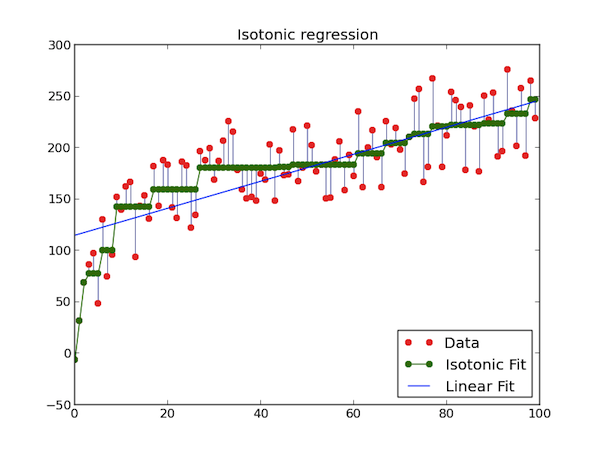
My latest contribution for scikit-learn is an implementation of the isotonic regression model that I coded with Nelle Varoquaux and Alexandre Gramfort. This model finds the best least squares fit to a set of points, given the constraint that the fit must be a non-decreasing function. The example on the scikit-learn website gives an intuition on this model.
isotonic regression

The original points are in red, and the estimated ones are in green. As you can see, there is one estimation (green point) for each data sample (red point). Calling $y \in \mathbb{R}^n$ the input data, the model can be written concisely as an optimization problem over $x$

$$ \text{argmin}_x |y - x |^2 \\ \text{subject to } x_0 \leq x_1 \leq \cdots \leq x_n $$

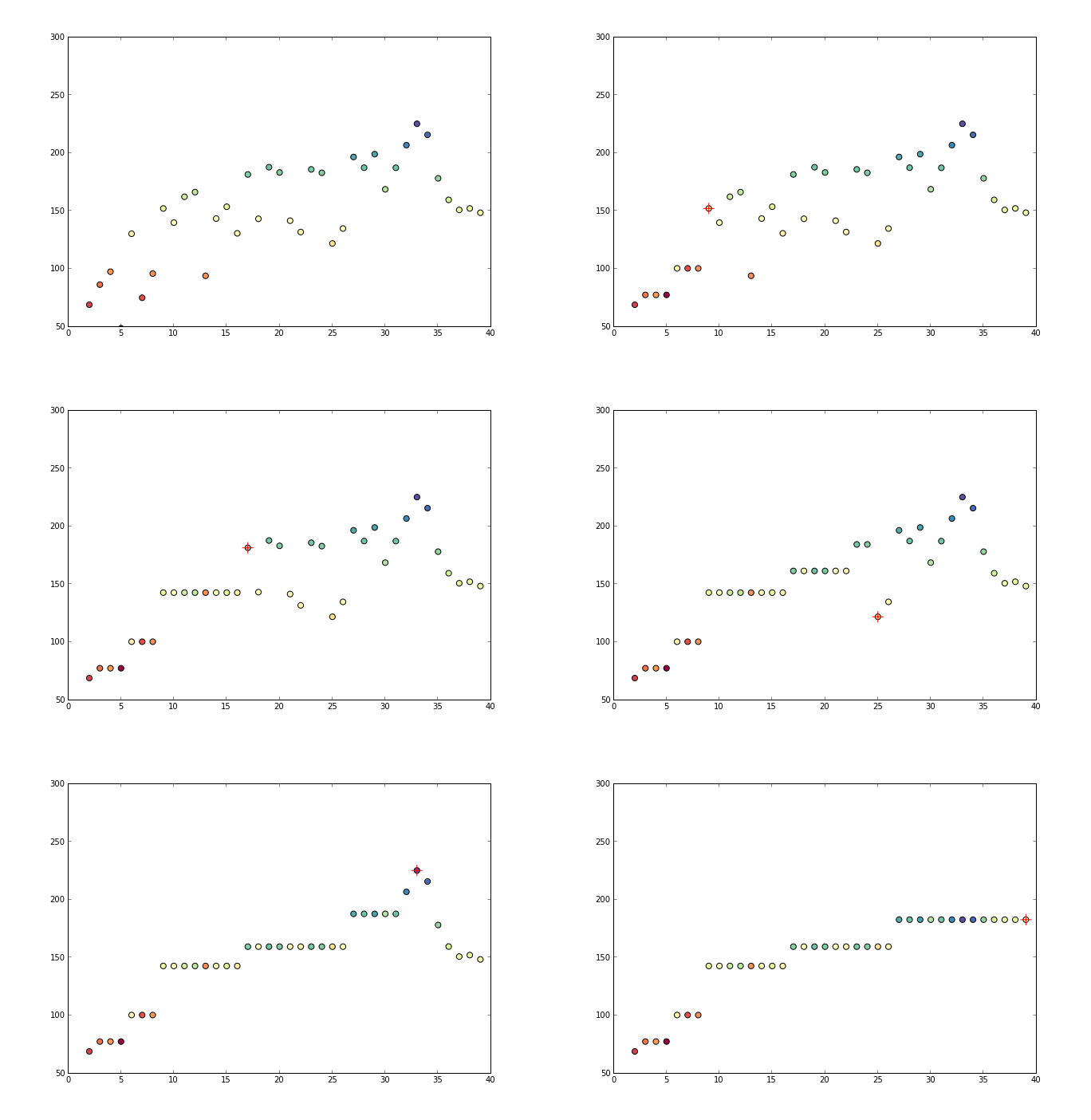
The algorithm implemented in scikit-learn 3 is the pool adjacent violators algorithm 1, which is an efficient linear time $\mathcal{O}(n)$ algorithm. The algorithm sweeps through the data looking for violations of the monotonicity constraint. When it finds one, it adjusts the estimate to the best possible fit with constraints. Sometimes it also needs to modify previous points to make sure the new estimate does not violate the constraints. The following picture shows how it proceeds at each iteration
isotonic regression