
惯性聚合 高效追踪和阅读你感兴趣的博客、新闻、科技资讯
阅读原文 在惯性聚合中打开

推荐订阅源

U
Unit 42
T
The Blog of Author Tim Ferriss
H
Help Net Security
博客园 - 叶小钗
云风的 BLOG
云风的 BLOG
OSCHINA 社区最新新闻
OSCHINA 社区最新新闻
D
DataBreaches.Net
博客园 - 聂微东
A
About on SuperTechFans
大猫的无限游戏
大猫的无限游戏
P
Proofpoint News Feed
Martin Fowler
Martin Fowler
博客园 - 【当耐特】
S
SegmentFault 最新的问题
Blog — PlanetScale
Blog — PlanetScale
酷 壳 – CoolShell
酷 壳 – CoolShell
G
Google Developers Blog
I
InfoQ
freeCodeCamp Programming Tutorials: Python, JavaScript, Git & More
GbyAI
GbyAI
B
Blog
Engineering at Meta
Engineering at Meta
V
V2EX
Hugging Face - Blog
Hugging Face - Blog

Keep the gradient flowing

Policy Gradients Part 1: The REINFORCE Estimator On the Link Between Optimization and Polynomials, Part 6. Optimization Nuggets: Stochastic Polyak Step-size, Part 2 Optimization Nuggets: Stochastic Polyak Step-size On the Convergence of the Unadjusted Langevin Algorithm The Russian Roulette: An Unbiased Estimator of the Limit Notes on the Frank-Wolfe Algorithm, Part III: backtracking line-search On the Link Between Optimization and Polynomials, Part 5 Optimization Nuggets: Implicit Bias of Gradient-based Methods Optimization Nuggets: Exponential Convergence of SGD On the Link Between Optimization and Polynomials, Part 4 On the Link Between Optimization and Polynomials, Part 3 On the Link Between Optimization and Polynomials, Part 2 On the Link Between Polynomials and Optimization, Part 1 How to Evaluate the Logistic Loss and not NaN trying Notes on the Frank-Wolfe Algorithm, Part II: A Primal-dual Analysis Three Operator Splitting Notes on the Frank-Wolfe Algorithm, Part I Optimization inequalities cheatsheet A fully asynchronous variant of the SAGA algorithm Hyperparameter optimization with approximate gradient Lightning v0.1 scikit-learn-contrib, an umbrella for scikit-learn related projects. SAGA algorithm in the lightning library On the consistency of ordinal regression methods Holdout cross-validation generator IPython/Jupyter notebook gallery PyData Paris - April 2015 Plot memory usage as a function of time Surrogate Loss Functions in Machine Learning
Data-driven hemodynamic response function estimation
Fabian Pedregosa · 2014-12-05 · via Keep the gradient flowing

My latest research paper[1] deals with the estimation of the hemodynamic response function (HRF) from fMRI data.
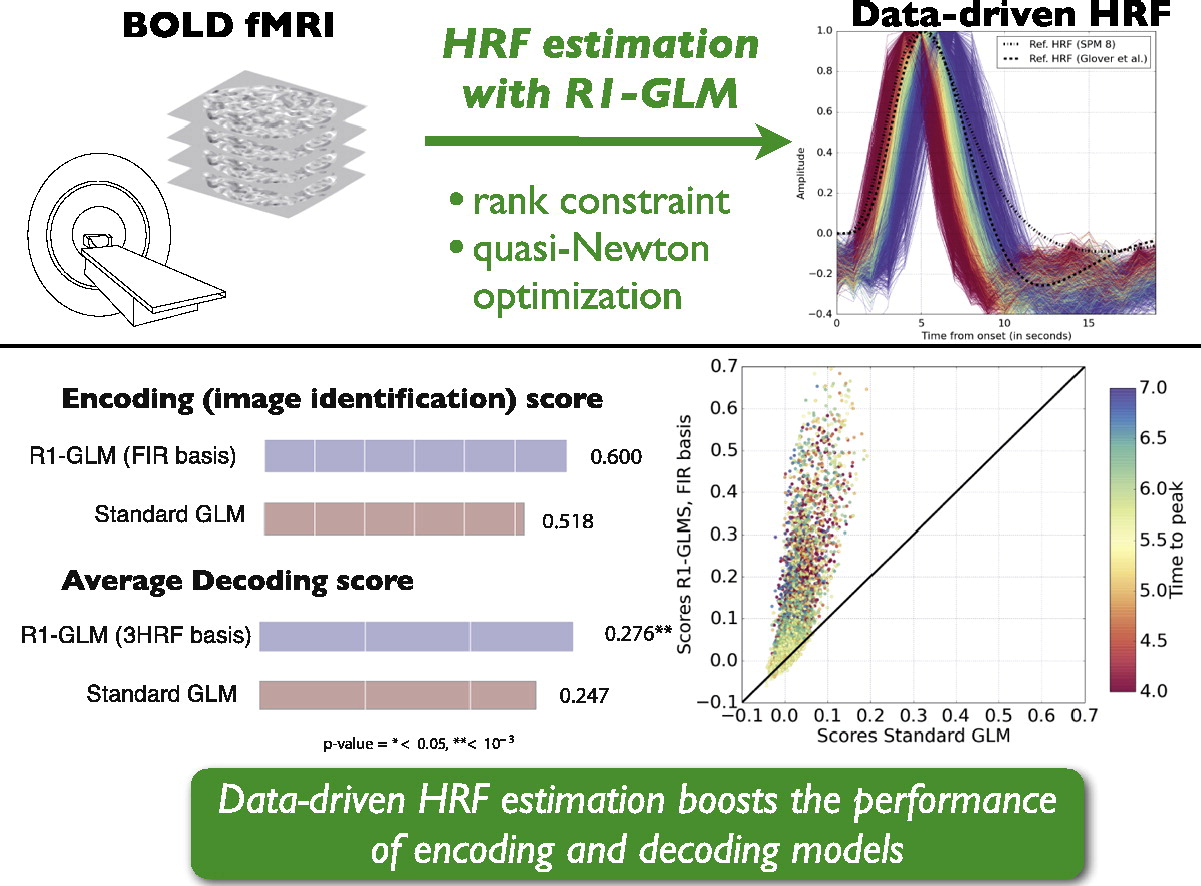
This is an important topic since the knowledge of a hemodynamic response function is what makes it possible to extract the brain activation maps that are used in most of the impressive applications of machine learning to fMRI, such as (but not limited to) the reconstruction of visual images from brain activity [2] [3] or the decoding of numbers [4].

Besides the more traditional paper that describes the method, I've put online the code I used for the experiments. The code at this stage is far from perfect but it should help in reproducing the results or improving the method. I've also put online an ipython notebook with the analysis of a small piece of data. I'm obviously glad to receive feedback/bug reports/patches for this code.