


惯性聚合 高效追踪和阅读你感兴趣的博客、新闻、科技资讯
阅读原文 在惯性聚合中打开

推荐订阅源

有赞技术团队
有赞技术团队
Martin Fowler
Martin Fowler
N
Netflix TechBlog - Medium
WordPress大学
WordPress大学
罗磊的独立博客
H
Help Net Security
MongoDB | Blog
MongoDB | Blog
A
About on SuperTechFans
让小产品的独立变现更简单 - ezindie.com
D
Docker
云风的 BLOG
云风的 BLOG
Microsoft Security Blog
Blog — PlanetScale
Blog — PlanetScale
P
Proofpoint News Feed
钛媒体:引领未来商业与生活新知
钛媒体:引领未来商业与生活新知
I
InfoQ
J
Java Code Geeks
博客园 - 聂微东
大猫的无限游戏
大猫的无限游戏
Engineering at Meta
Engineering at Meta
美团技术团队
小众软件
小众软件
Stack Overflow Blog
Stack Overflow Blog
C
Check Point Blog

Keep the gradient flowing

Policy Gradients Part 1: The REINFORCE Estimator On the Link Between Optimization and Polynomials, Part 6. Optimization Nuggets: Stochastic Polyak Step-size, Part 2 Optimization Nuggets: Stochastic Polyak Step-size On the Convergence of the Unadjusted Langevin Algorithm The Russian Roulette: An Unbiased Estimator of the Limit Notes on the Frank-Wolfe Algorithm, Part III: backtracking line-search On the Link Between Optimization and Polynomials, Part 5 Optimization Nuggets: Implicit Bias of Gradient-based Methods Optimization Nuggets: Exponential Convergence of SGD On the Link Between Optimization and Polynomials, Part 4 On the Link Between Optimization and Polynomials, Part 3 On the Link Between Optimization and Polynomials, Part 2 On the Link Between Polynomials and Optimization, Part 1 How to Evaluate the Logistic Loss and not NaN trying Notes on the Frank-Wolfe Algorithm, Part II: A Primal-dual Analysis Three Operator Splitting Notes on the Frank-Wolfe Algorithm, Part I Optimization inequalities cheatsheet Hyperparameter optimization with approximate gradient Lightning v0.1 scikit-learn-contrib, an umbrella for scikit-learn related projects. SAGA algorithm in the lightning library On the consistency of ordinal regression methods Holdout cross-validation generator IPython/Jupyter notebook gallery PyData Paris - April 2015 Data-driven hemodynamic response function estimation Plot memory usage as a function of time Surrogate Loss Functions in Machine Learning
A fully asynchronous variant of the SAGA algorithm
Fabian Pedregosa · 2016-10-12 · via Keep the gradient flowing

My friend Rémi Leblond has recently uploaded to ArXiv our preprint on an asynchronous version of the SAGA optimization algorithm.

The main contribution is to develop a parallel (fully asynchronous, no locks) variant of the SAGA algorighm. This is a stochastic variance-reduced method for general optimization, specially adapted for problems that arise frequently in machine learning such as (regularized) least squares and logistic regression. Besides the specification of the algorithm, we also provide a convergence proof and convergence rates. Furthermore, we fix some subtle technical issues present in previous literature (proving things in the asynchronous setting is hard!).

The core of the asynchronous algorithm is similar to Hogwild!, a popular asynchronous variant of stochastc gradient descent (SGD). The main difference is that instead of using SGD as a building block, we use SAGA. This has many advantages (and poses some challenges): faster (exponential!) rates of convergence and convergence to arbitrary precision with a fixed step size (hence clear stopping criterion), to name a few.

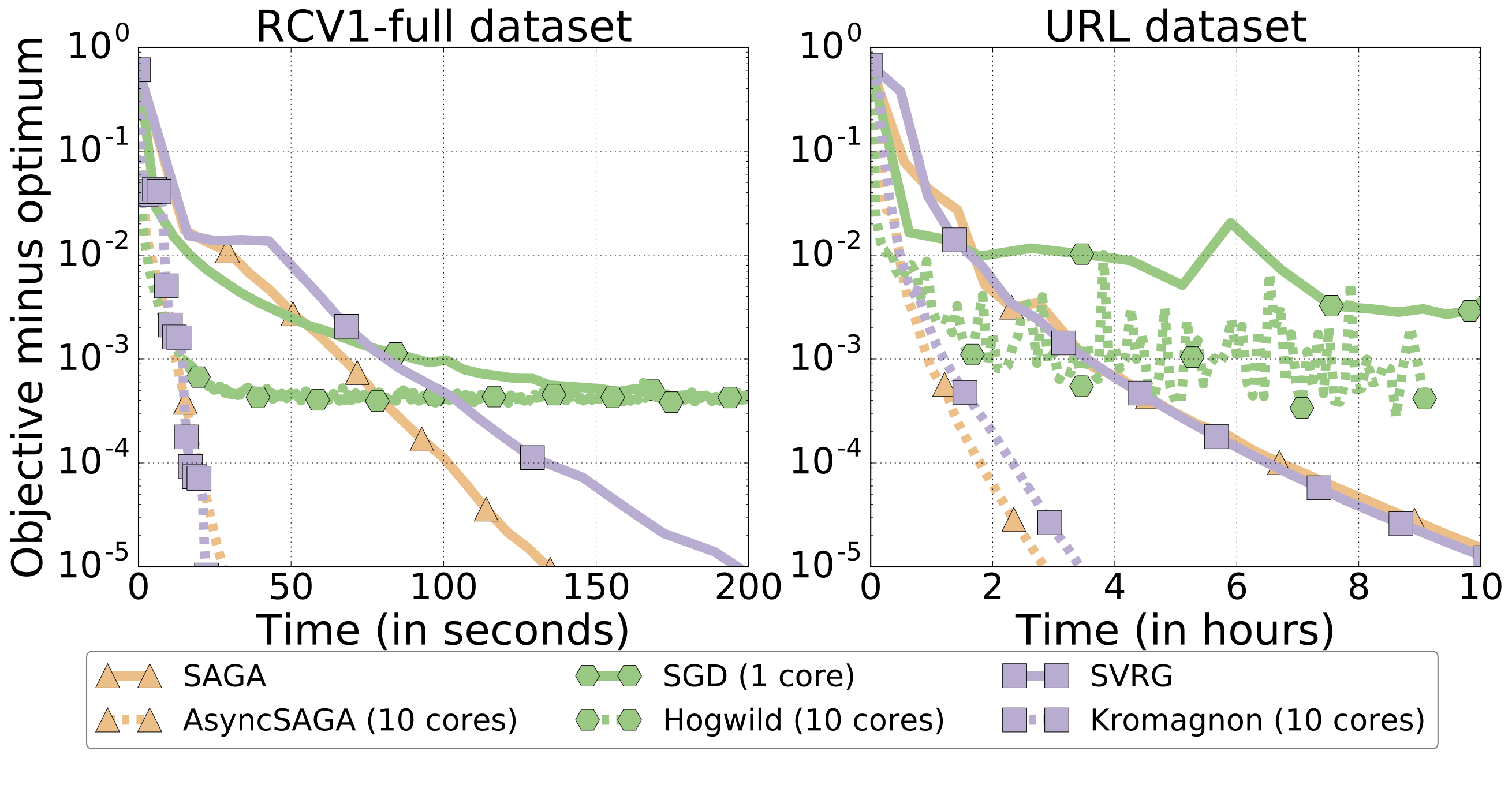
The speedups obtained versus the sequential version are quite impressive. For example, we have observed to commonly obtain 5x-7x speedups using 10 cores:
Update April 2017: this work has been presented at AISTATS 2017.

Had a great time presenting our work at #AISTATS2017, can't wait for the next edition! pic.twitter.com/W58K5IVRio

— Fabian Pedregosa (@fpedregosa) April 24, 2017

Update Dec 2017: a follow-up of this work generalizes the algorithm to the more general class of composite objective functions. See our paper "Breaking the Nonsmooth Barrier: A Scalable Parallel Method for Composite Optimization"