

惯性聚合 高效追踪和阅读你感兴趣的博客、新闻、科技资讯
阅读原文 在惯性聚合中打开

推荐订阅源

MyScale Blog
MyScale Blog
Microsoft Azure Blog
H
Help Net Security
N
News and Events Feed by Topic
Recent Announcements
D
Docker
M
MIT News - Artificial intelligence
L
LangChain Blog
I
InfoQ
奇客Solidot–传递最新科技情报
奇客Solidot–传递最新科技情报
P
Proofpoint News Feed
博客园_首页
MongoDB | Blog
MongoDB | Blog
美团技术团队
S
Schneier on Security
G
GRAHAM CLULEY
月光博客
月光博客
有赞技术团队
有赞技术团队
Vercel News
Vercel News
Scott Helme
Scott Helme
P
Privacy International News Feed
Last Week in AI
Last Week in AI
Recorded Future
Recorded Future
Threat Intelligence Blog | Flashpoint
The Cloudflare Blog
Attack and Defense Labs
Google Online Security Blog
Simon Willison's Weblog
量子位
S
Security @ Cisco Blogs
cs.CL updates on arXiv.org
V
Visual Studio Blog
cs.AI updates on arXiv.org
NISL@THU
NISL@THU
N
Netflix TechBlog - Medium
K
KPMG report finds enterprise disconnect between AI and its ROI | CIO
Recent Commits to openclaw:main
Spread Privacy
Spread Privacy
freeCodeCamp Programming Tutorials: Python, JavaScript, Git & More
小众软件
小众软件
罗磊的独立博客
Security Archives - TechRepublic
T
Threatpost
L
Lohrmann on Cybersecurity
www.infosecurity-magazine.com
S
Security Affairs
Cloudbric
Cloudbric
爱范儿
爱范儿
H
Heimdal Security Blog
PCI Perspectives
PCI Perspectives

VMware Blogs

Diagnostics for VMware Cloud Foundation (VCF) 9.1 with Old Versions of VCF Components Mastering Infrastructure Policies in VMware Cloud Foundation Automation 9.1 Modernizing the Private Cloud: Why VCF 9.1 Lifecycle Management is a Game Changer Announcing the VMware Cloud Foundation 9.1 Upgrade Planning Tool VCF Breakroom Chats Episode 86 – Containers Made Easy: The New “Container-as-a-Service” in VCF 9.1 Securing Your VCF 9.1 Infrastructure with the Symantec Identity Security Platform Virtually Speaking: The AI Reality Check with Dave Linthicum Zero Touch Provisioning: Activating Edge Sites with VMware Cloud Foundation Edge 9.1 VCF Breakroom Chats Episode 85 – Cloning Success at Scale: Inside VCF 9.1’s App Stack Formation VMware Cloud on AWS の使用状況を確認できる API Unlocking the Full Potential of Programmable Infrastructure with VMware Cloud Foundation 9.1 – New Features and Capabilities Smarter Patching at Scale: Vulnerability Assessment and Remediation with VMware Tanzu Platform Encrypted vMotion Offload to Intel QAT in VMware Cloud Foundation 9.1 Deepen Your Expertise: Four Key Benefits of Attending Increase Deployment Flexibility with VCF Edge Automation 1.0.3 Avi Advantage: Automating Certificate Management of VCF Workloads More Memory, Less Effort: Configuring Memory Tiering in VCF 9.1 VCF 9.1 Licensing: Programmatic, Centralized, and Built to Scale Why APJ Networking Professionals Need Private Cloud Expertise VCF 9.1 Networking: Simpler VPC Connectivity Control VCF 9.1 Networking: Exploring Network Services for Virtual Private Clouds VCF Networking 9.1: Seamless DDI Integration with Infoblox The Open Source Advantage: Building from Source for Ultimate Security Expand Shared VMDKs with Clustered Applications in VMware vSAN for VCF 9.1 Monetizing Zero-Trust Security with VCF 9.1 and VMware vDefend VMware vSAN Protection and Recovery Enhancements for VCF 9.1 Deliver Production SQL Server DBaaS with VMware Data Services Manager 9.1 Maximizing Profitability: VCF 9.1 Cost-Focused Approach for VMware Cloud Service Providers Modernizing Your Infrastructure: Introducing VMware Cloud Foundation 9.1 to VCSPs VCF 9.1 is Available: Explore the New Features in Hands-on Labs What’s New with vSphere in VMware Cloud Foundation 9.1? Resizing VMware vCenter in VMware Cloud Foundation 9 Non-Disruptive VMware vCenter Patching in VMware Cloud Foundation 9.1 VMware vCenter Virtual Hardware Gets an Upgrade in vSphere with VCF 9.1 AI Has Changed the Threat Landscape. Is Your Infrastructure Ready? Simplifying Storage with the New Effective Capacity View in VMware vSAN for VCF 9.1 Auto-RAID in VMware vSAN for VCF 9.1 – Comprehensive System-Managed Data Resilience Introducing VMmark 4.1: Enhanced Power Efficiency Benchmarking for Private Cloud Infrastructure Advanced Memory Tiering Enhancements in VMware Cloud Foundation 9.1 VCF 9.1 Is Here. See It in Action. 博通發布 VMware Cloud Foundation 9.1 How Broadcom Is Helping Enterprises Win the AI Security Sprint How to Prepare for the World of AI Driven Exploits Avi Innovations for VCF 9.1: Powering Kubernetes, Agentic AI and VPC Workloads VCF 9.1: The Secure, Cost-Effective Private Cloud Platform for Production AI Announcing VCF 9.1: Modern Private Cloud Built for Efficiency and Resilience Announcing VMware Cloud Foundation Edge 9.1: A Scalable, Autonomous Edge Platform Accelerate, Streamline, and Control Your Self-Service Private Cloud with VMware Cloud Foundation 9.1 Deploy Modern Apps Faster, Scale Smarter, and Lower Your TCO with VMware vSphere Kubernetes Service in VCF 9.1 Scale Smarter, Save More: Redefining Infrastructure Economics with VMware vSphere in VCF 9.1 AI with VCF 9.1 on AMD GPUs: Build with open frameworks and simplify management, at a lower TCO Streamline, Simplify and Protect all your AI workloads with VCF 9.1 Simplify Workload Connectivity and Enhance Network Scale and Performance with VCF 9.1 VMware and CrowdStrike Deliver New Integration for Cyber Recovery Workflows How Many Users Can Your LLM Server Really Handle? From Infrastructure to Agents: A Hands-On Guide to Secure Private AI with Broadcom – Part 2 The New Frontier: Leading the Cloud-Native Evolution Replicating VMware vSphere Configuration Profile Desired State Webinar Recap: Design and Architecture Considerations for VMware vSphere Kubernetes Service on VMware Cloud Foundation Kubernetes 1.36: What Actually Changed for Enterprise Platforms Enhance Lateral Security and Ingress Load Balancing for Kubernetes Workloads Analyst Insight Series #3: Policy-Driven Governance and Multi-Tenant Control Post-Quantum Readiness on VMware Cloud Foundation Registration Is Live for Las Vegas | $ave with Early-Bird May 21, 2026: What’s New in VMware Tanzu Data Intelligence 10.4 From Infrastructure to Agents: A Hands-On Guide to Secure Private AI with Broadcom – Part 1 Stop Guessing: Advanced Monitoring and Troubleshooting for Data Services CPU, Disk, Network, and Memory Workload Profiles for DVD Store Database Testing How VMware Salt Automates Compliance Across Private Cloud Analyst Insight Series #2: Operational Scalability and Lifecycle Management MCP vs. APIs: Why You Need Both for AI Applications The Real Constraint on Enterprise AI isn’t GPUs; It’s Power Deploying Harbor Service in Air-Gapped VMware Cloud Foundation 9.0 Why Enhanced DirectPath Wins for High-Performance Apps Bridging the (.Local) Gap: A Split-Domain Design for VMware Cloud Foundation Deployment Observability on VMware vSphere Kubernetes Service VMware Cloud on AWS: Introducing the Usage Report APIs Converging VMware vSphere to VMware Cloud Foundation 9.0: The Top 10 Questions Answered May 6, 2026: What’s New in Tanzu Platform 10.4: Powering Agentic Apps at Scale VMware Tanzu RabbitMQ Powers the Modern Data Lakehouse with New Spark Integration and Enterprise Tooling Tanzu Data Intelligence 10.4 Delivers AI-Driven Analytics, Unified Real-Time Operations, and Sovereign Resilience Enterprise-Ready Agents Made Simple & Safe with VMware Tanzu Platform Agent Foundations Introducing Tanzu Platform 10.4: Extending Platform as a Service to Agentic Applications How AI-Assisted Analytics in Tanzu Data Intelligence Can Help Remove the SQL Bottleneck From Prototype to Production: Securing Database MCP at Enterprise Scale The Compelling Case for a Private Cloud Data Intelligence Platform The Unification Dividend: Consolidating Database Operations on VMware Cloud Foundation The Modern Spring Workflow Is Enterprise-Ready and AI-Boosted [TAM Blog] セキュアブート証明書の有効期限切れに関する注意点と対応について Accelerate Lateral Security and Ingress Load Balancing for Kubernetes Workloads From Platform to Data: Building a Cloud-Native Developer Experience On-Prem with VMware Cloud Foundation How VMware Cloud Foundation (VCF) Training Helps Keep Top Tech Talent in APJ Build Your Case for Attending VMware Explore 2026 Spring 開発元が提供する商用サポート「VMware Tanzu® Spring Essentials」とは VMware Cloud on AWS より i7i.metal-24xl インスタンスの提供開始 VMware Advanced Memory Tiering Tips for Success VMware Cloud Foundation Edge 9.0: Two-Host Edge Site Deployment with Brownfield Import Your Database Is About to Become an AI Tool. Is It Ready? Applying GitOps Principles to Maintain Desired State Configuration using VMware vSphere Configuration Profile – Part 3 Webinar Recap: Converging VMware vSphere to VMware Cloud Foundation 9.0
Avi Load Balancer Analytics: Root Cause Application Performance Issues in Minutes
lei yang · 2026-04-29 · via VMware Blogs

Application slowness and downtime severely affect customer satisfaction, cause business interruptions, and can potentially impact revenue. When a critical app fails in complex, distributed environments, quickly identifying the root cause is the biggest challenge. During high-severity incidents, IT teams struggle in troubleshooting war rooms. Teams are constantly frustrated, with a fundamental question: does the issue lie with the underlying infrastructure, or the application itself?
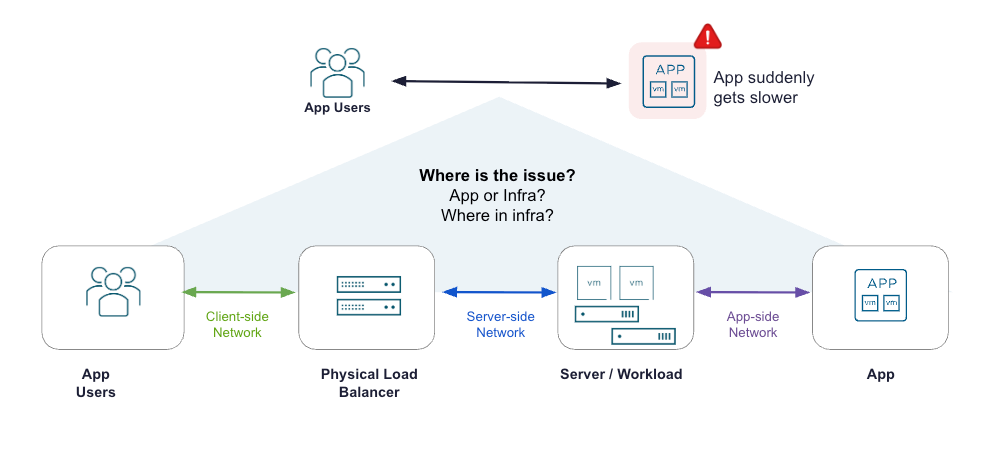
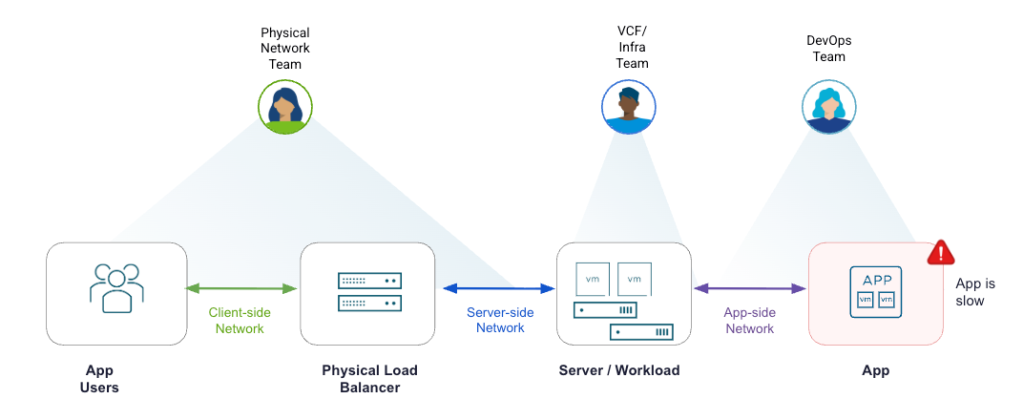
In the traditional approach, Network, Infrastructure, and DevOps teams are forced to operate in silos. They rely on different tools and disparate datasets without end-to-end visibility. What they end up with is an exhausting cycle of back-and-forth communication. Finding the root cause becomes a cumbersome, friction-heavy ordeal that takes days, if not weeks, to resolve. Legacy load balancers, despite receiving both client-side and service-side transactions, are only able to offer fragmented metrics. 
How Avi Accelerates Troubleshooting with App Health Score

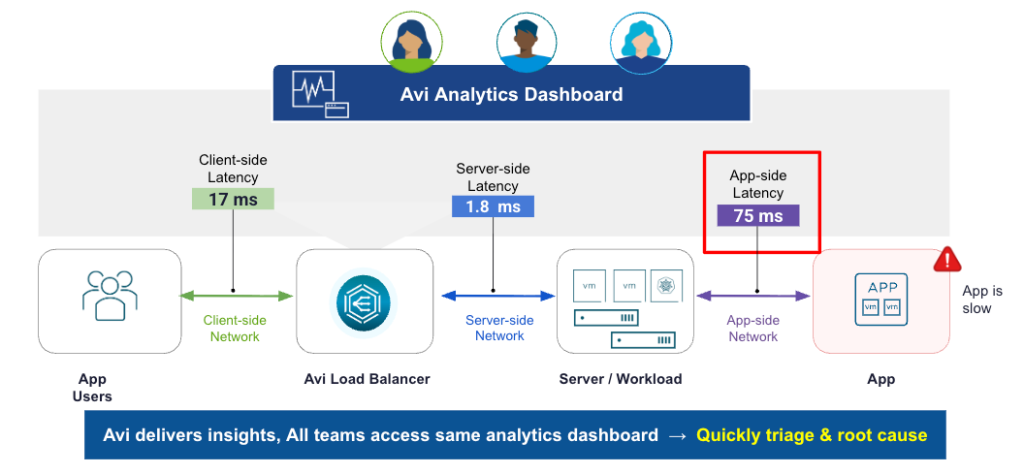
Avi’s software-defined load balancing architecture is the key to its uncontested analytics advantage. Avi captures complete, transaction-level telemetry across every flow in a unified dashboard, empowering siloed teams to gain access to the same end-to-end application latency analytics across client, server and application. All teams can instantly pinpoint the root cause of performance bottlenecks or security threats with precision. Let us take a closer look:
Reduced Mean Time to Innocence (MTTI) with Granular Analytics:

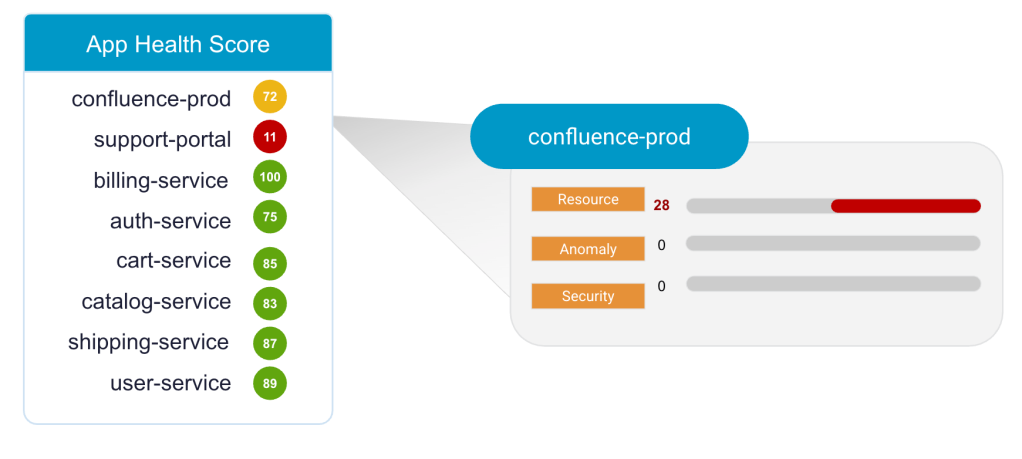
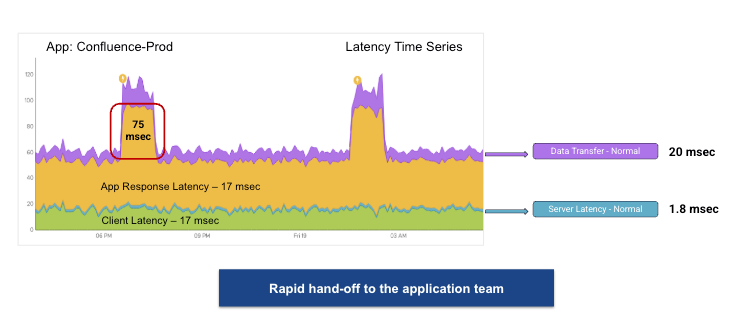
Avi Analytics synthesizes app performance data into easily interpretable health scores ranging from 0-100. Avi App Health Score provides a comprehensive measure of an application’s or virtual service’s overall health, combining performance, resource availability, anomalous behavior and security risk factors. These scores deliver actionable insights, allowing administrators to quickly pinpoint issues from the dashboard. For example, a yellow score of 72 for “confluence prod” immediately signals service degradation due to underlying resources, highlighting critical problems with relevant troubleshooting information.
Furthermore, Avi Analytics significantly reduces MTTI by providing granular visibility into every application transaction. By centralizing these metrics within a unified dashboard, cross-functional teams can immediately identify the 75ms latency comes from the application, not network or client. This data-driven approach reduces lengthy triaging, allowing organizations to pinpoint the exact origin of performance bottlenecks with surgical precision.
Improved Application Resiliency with Built-in Web App Security:

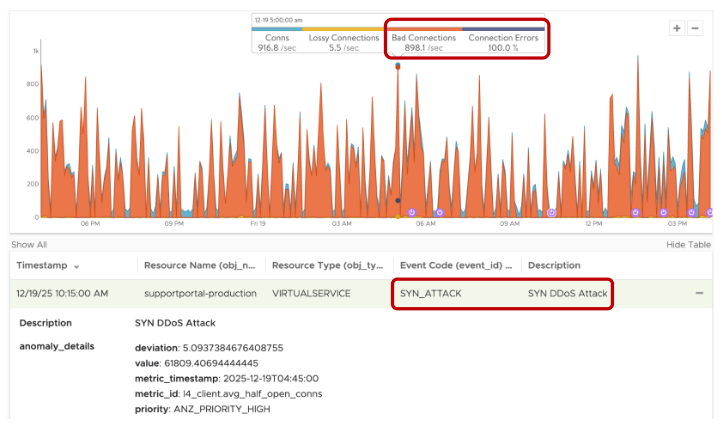
By integrating security insights directly into the App Health Score, Avi improves application protection with built-in web app firewall (WAF). The platform’s real-time analytics identify high-frequency connection errors and flag sophisticated web attacks such as DDoS attacks – detection to automated mitigation in minutes. The result is a more app resiliency that maintains high availability and performance, even under heavy load or targeted web-based threats.
Minimum Application Downtime with Transient Issues Identification:

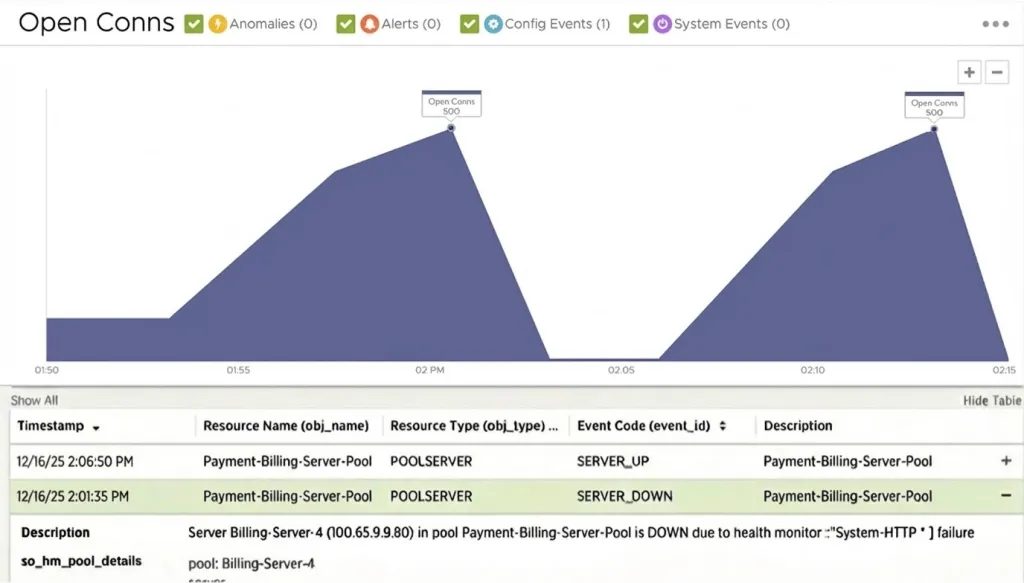
Avi accelerates root-cause analysis by leveraging deep historical analytics, effectively removing the need for teams to wait for intermittent issues to recur. While traditional hardware load balancers are almost impossible to identify transient “needle in the haystack” anomalies, Avi’s detailed transaction logs enable engineers to drill down into specific pool server IP addresses and identify VM resource exhaustion – which is an underlying application issue. 
The Avi Analytics Advantage: Application Latency Analytics

Legacy load balancers fail to meet the performance, agility, and scalability needs of modern applications. Troubleshooting application performance issues has turned into a reactive, tedious process. Avi collects in-traffic analytics and provides a unified “single source of truth” that reduces the operational “lengthy triaging” across network, security, and application teams

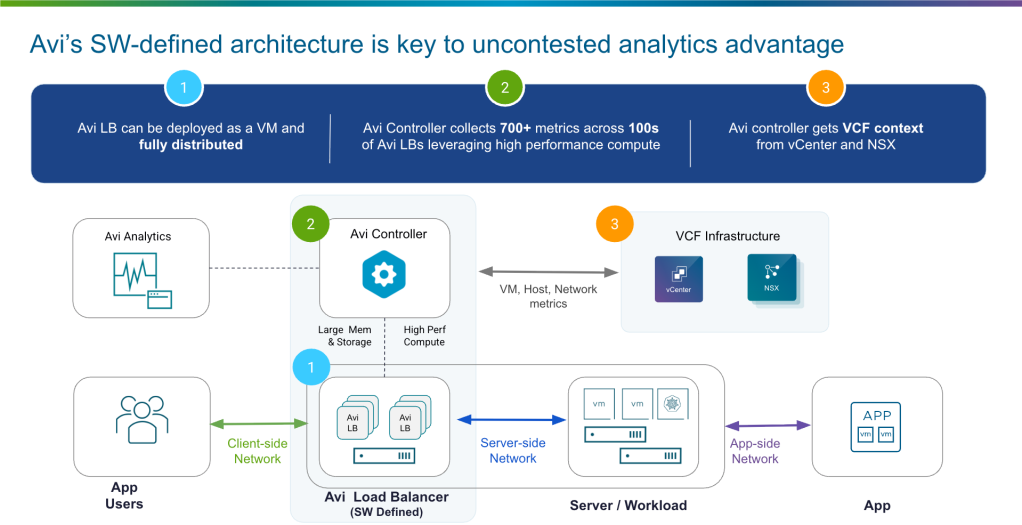
Software-Defined Architecture: Avi achieves real-time, in-depth visibility by decoupling the centralized control plane from the distributed data plane. Avi is deployed as virtual machines alongside compute infrastructure. Avi captures granular telemetry from the traffic flow, offering comprehensive analytics and end-to-end visibility from a single console to accelerate troubleshooting, automate scaling, and proactively ensure high application performance.

Comprehensive Data and Scope: Avi Controller continuously aggregates over 700 performance metrics from distributed load balancers. Leveraging high-performance compute, Avi processes a massive telemetry data lake, applying advanced ML/AI inferences to analyze patterns and anomalies. Avi Analytics transforms infrastructure data into actionable application insights, enabling IT teams to move beyond reactive troubleshooting to proactive optimization.

Plug-and-Play VCF Context: Avi uniquely integrates deeply and natively with the VCF private cloud. With VCF workload context, Avi provides consistent visibility across VMs and containers. This contextual awareness aligns application delivery and security with the infrastructure, reducing blind spots and streamlining load balancing on VCF.
How a Large Financial Organization Reduced Tickets by 90%

The network teams at a very large financial organization were constantly over burdened with a huge backlog of application troubleshooting tickets before implementing Avi Analytics. The limited visibility provided by their legacy load balancers meant that all application issues were directed to the network teams, even those not caused by the network. This created a significant bottleneck, with operations handling almost all tickets. 
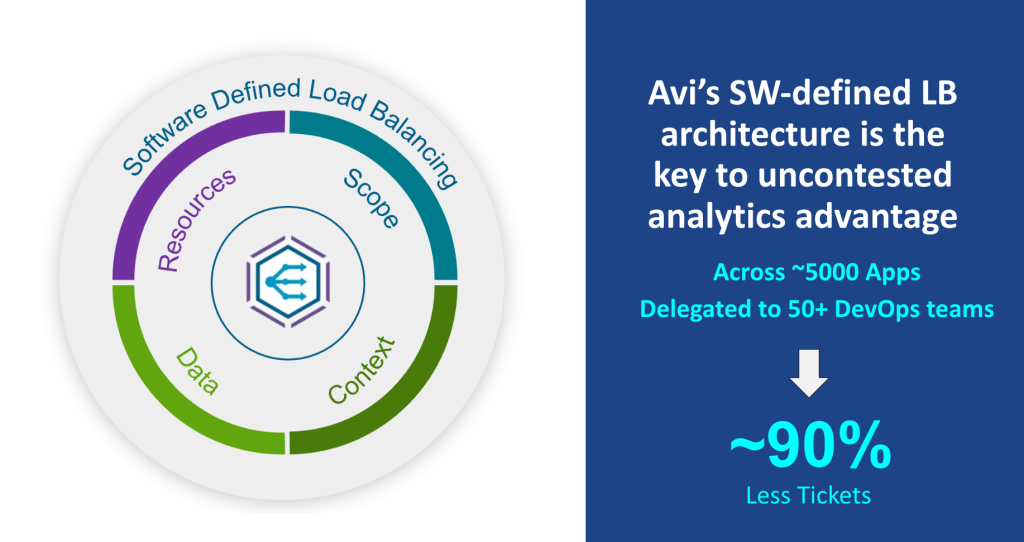
With the deployment of Avi Analytics, the organization empowered over 50 DevOps teams with direct access to a unified analytics dashboard. This gave teams actionable insights across more than 90,000 virtual IPs, allowing them to independently diagnose whether an issue was rooted in the application or the network.

The shift to modern, analytics-driven load balancing resulted in a dramatic 90% reduction in application-related tickets reaching the network team. Consequently, operations staff were able to re-deploy their resources from ticket handling to focus on higher-value, strategic projects, highlighting the clear advantage of this approach over traditional load balancing.

See Avi Analytics in Action

Here is a comprehensive demo of the Avi Analytics dashboard in action.