

惯性聚合 高效追踪和阅读你感兴趣的博客、新闻、科技资讯
阅读原文 在惯性聚合中打开

推荐订阅源

爱范儿
爱范儿
博客园_首页
U
Unit 42
Apple Machine Learning Research
云风的 BLOG
云风的 BLOG
MongoDB | Blog
MongoDB | Blog
美团技术团队
H
Help Net Security
G
Google Developers Blog
B
Blog RSS Feed
让小产品的独立变现更简单 - ezindie.com
aimingoo的专栏
aimingoo的专栏
Google DeepMind News
J
Java Code Geeks
M
MIT News - Artificial intelligence
腾讯CDC
IT之家
IT之家
Vercel News
Vercel News
C
Check Point Blog
博客园 - 三生石上(FineUI控件)
Last Week in AI
Last Week in AI
I
InfoQ
博客园 - 司徒正美
A
About on SuperTechFans

VMware Blogs

Diagnostics for VMware Cloud Foundation (VCF) 9.1 with Old Versions of VCF Components Mastering Infrastructure Policies in VMware Cloud Foundation Automation 9.1 Modernizing the Private Cloud: Why VCF 9.1 Lifecycle Management is a Game Changer Announcing the VMware Cloud Foundation 9.1 Upgrade Planning Tool VCF Breakroom Chats Episode 86 – Containers Made Easy: The New “Container-as-a-Service” in VCF 9.1 Securing Your VCF 9.1 Infrastructure with the Symantec Identity Security Platform Virtually Speaking: The AI Reality Check with Dave Linthicum Zero Touch Provisioning: Activating Edge Sites with VMware Cloud Foundation Edge 9.1 VCF Breakroom Chats Episode 85 – Cloning Success at Scale: Inside VCF 9.1’s App Stack Formation VMware Cloud on AWS の使用状況を確認できる API Unlocking the Full Potential of Programmable Infrastructure with VMware Cloud Foundation 9.1 – New Features and Capabilities Smarter Patching at Scale: Vulnerability Assessment and Remediation with VMware Tanzu Platform Encrypted vMotion Offload to Intel QAT in VMware Cloud Foundation 9.1 Deepen Your Expertise: Four Key Benefits of Attending Increase Deployment Flexibility with VCF Edge Automation 1.0.3 Avi Advantage: Automating Certificate Management of VCF Workloads More Memory, Less Effort: Configuring Memory Tiering in VCF 9.1 VCF 9.1 Licensing: Programmatic, Centralized, and Built to Scale Why APJ Networking Professionals Need Private Cloud Expertise VCF 9.1 Networking: Simpler VPC Connectivity Control VCF Networking 9.1: Seamless DDI Integration with Infoblox The Open Source Advantage: Building from Source for Ultimate Security Expand Shared VMDKs with Clustered Applications in VMware vSAN for VCF 9.1 Monetizing Zero-Trust Security with VCF 9.1 and VMware vDefend VMware vSAN Protection and Recovery Enhancements for VCF 9.1 Deliver Production SQL Server DBaaS with VMware Data Services Manager 9.1 Maximizing Profitability: VCF 9.1 Cost-Focused Approach for VMware Cloud Service Providers Modernizing Your Infrastructure: Introducing VMware Cloud Foundation 9.1 to VCSPs VCF 9.1 is Available: Explore the New Features in Hands-on Labs What’s New with vSphere in VMware Cloud Foundation 9.1?
VCF 9.1 Networking: Exploring Network Services for Virtua...
Dimitri Desmidt · 2026-05-16 · via VMware Blogs

VMware Cloud Foundation (VCF) delivers the compute, storage, and networking services required to power modern cloud environments. In this blog, we focus specifically on the network services available within VCF 9.1 Virtual Private Clouds (VPCs).

Note: For a refresh into the fundamentals of VCF VPCs, check out our previous posts:
Self-service networking with Virtual Private Clouds.

Whether you are deploying simple web apps or complex, multi-tiered architectures, VCF 9.1 equips your VPCs with a complete suite of self-service network tools:

  • Core Connectivity: Switching and Routing to keep your workload traffic flowing seamlessly.
  • IP Management: Native DHCP Server or integration with 3rd-party IPAM Server (Infoblox)
  • Traffic Control: Comprehensive NAT options including 1:1 External-IP, N:1 Outbound-NAT, and custom SNAT/DNAT
  • Performance & Scale: Application delivery via load balancing (LB), with the flexibility to use either Native NSX or the Advanced Load Balancer (AVI) plugin.
  • Secure Access: VPN services (Note: VPN is exclusive to the Centralized design)

Connecting Your VPCs: Distributed vs. Centralized Designs

When it comes to connecting your VPCs to the physical data center network, VCF 9.1 offers two distinct architectural modes: Distributed and Centralized.
Choosing the right mode depends on your underlying infrastructure and service requirements.

1. The Distributed Mode

The Distributed mode is built for simplicity and streamlined operations.

While it offers nearly all standard network services (with the exception of VPNs), it drastically reduces architectural overhead.
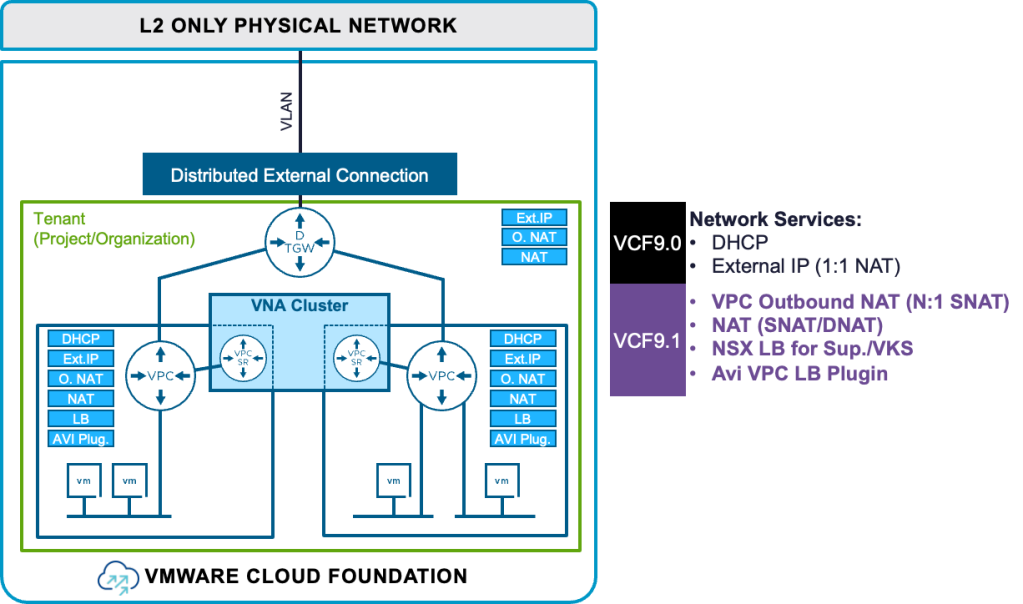
  • Simplified Architecture: Requires no edge nodes, no Tier-0 Gateways, and zero BGP configuration.
  • Deployment Constraint: This streamlined design can only be implemented if all ESX hosts are connected to the same Layer 2 network.

2. The Centralized Mode

The Centralized mode is designed for maximum flexibility and comprehensive feature support, making it adaptable to more complex environments.
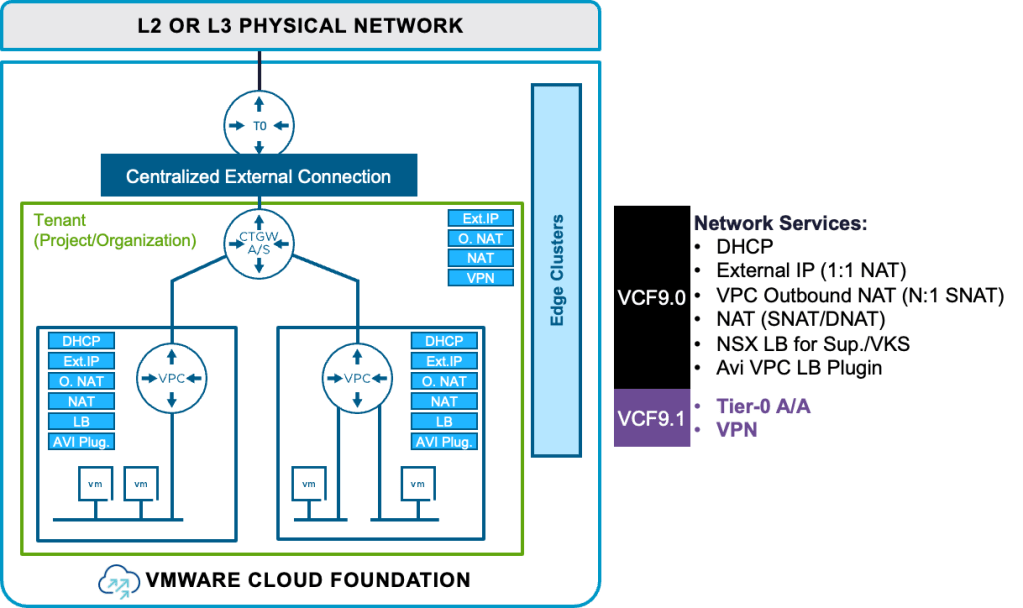
  • Full Service Availability: Delivers all available network services, including full VPN capabilities.
  • Flexible Architecture: Highly adaptable and can be seamlessly deployed across any Layer 2 or Layer 3 physical data center network topology.

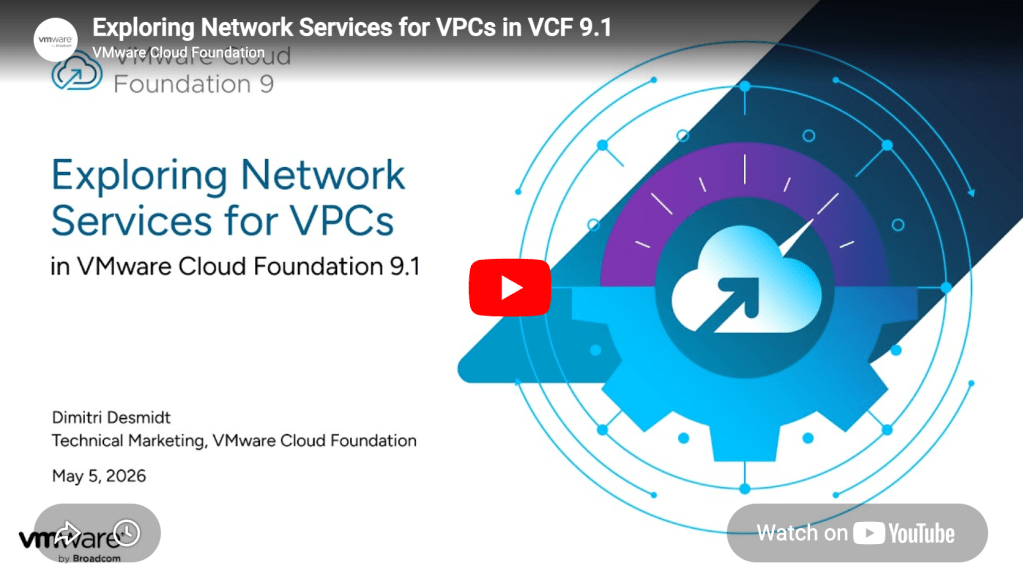
Ready to see these capabilities in action?
Check out our quick demo for a look at provisioning and managing these network services within VCF 9.1.
We will walk you through exactly how easy it is to equip your VPCs with the network services they need to power your applications.

Discover more from VMware Cloud Foundation (VCF) Blog

Subscribe to get the latest posts sent to your email.