







This blog is co-authored by Iga Januszek, Dave Stone, and Purnima Phansalkar.
In fast-moving markets, the difference between acting on an insight and missing it is often measured in minutes. Customers tell us the same thing over and over: by the time their data warehouse returns the answer, the window to act has already closed. Not because the data wasn't there. Not because the team wasn't paying attention. But because the moment everyone logs in at once, the moment every dashboard refreshes at the same time, the warehouse buckles under the load. Queries slow down. Reports lag. Opportunities pass.
This is the most common pain enterprises feel today. And it's one of four converging pressures forcing organisations to rethink their analytics infrastructure.
EDB Postgres AI Warehouse Analytics was built to solve all four.
High concurrency BI performance is where most enterprises feel the pressure most acutely. Analysts, developers, and AI agents are all querying simultaneously, and the combination is more demanding than it might appear. Unlike analysts who query intermittently, agents query continuously, at scale, and without pause, compounding throughput demands in ways traditional warehouse architectures were never designed to handle. Kyobo Book Center experienced this directly: even before cloud costs became the headline issue, consistent query performance across concurrent workloads was already stretching the limits of their existing architecture. When consistent performance matters to the business, an architecture that degrades under pressure isn't a minor inconvenience. It's a business risk.
Legacy renewal cliffs and price hikes are turning that risk into an urgent decision. Enterprise data warehouse contracts are expiring and pricing is climbing, with vendors using renewal cycles to extract more from customers who have built their businesses around proprietary platforms. Organisations that built their analytics stack on open source Greenplum forks are finding that commercial support and stability aren't keeping pace. Mountain is a case in point, migrating from an open source fork only to find the enterprise support they needed wasn't there, which is what brought them to EDB. And for organisations running Oracle-ecosystem workloads alongside their analytics stack, the migration path is further complicated by data type dependencies that require specialised compatibility support before they can move.
Sovereignty mandates are closing the cloud escape route for a growing number of organisations. Some data legally cannot sit in a hyperscaler. Euronext, for example, was working with a previous vendor whose geographic footprint created real regulatory exposure, and needed a path forward that gave them data residency and control without sacrificing analytics capability.
Cloud bill shock is the fourth pressure, and it hits the organisations that took the cloud route expecting cost efficiency. Consumption-based pricing turns unpredictable workloads into unpredictable bills. Kyobo Book Center saw this directly, their cloud deployment was delivering capability, but the bills were getting out of hand, and on premises requirements meant the cloud only model wasn't sustainable long term.
ETL complexity and data freshness is the fifth pressure, and the one most often hidden in plain sight. Agents and data science teams are forced to work downstream of Extract, Transform, Load (ETL) pipelines, which means every insight, every model, every recommendation is only as fresh as the last pipeline run. The longer and more complex the pipeline, the worse the lag. Teams making decisions on yesterday's data in a business that moves by the minute are not just slow, they are systematically disadvantaged. And as data science workloads grow and AI agents are added to the query load, the ETL bottleneck compounds in ways that become increasingly difficult to engineer around.
These five pains don't exist in isolation. They stack on each other. And together, they describe a market that's moving: 60% of enterprises are looking to modernise their analytics infrastructure, and more than 80% are looking to repatriate at least some workloads from the cloud. (Sources: Data Warehousing Market Report 2026; Why 86% of CIOs Are Rethinking Their Cloud Strategy; 2025 Warehouse Modernization Guidebook).
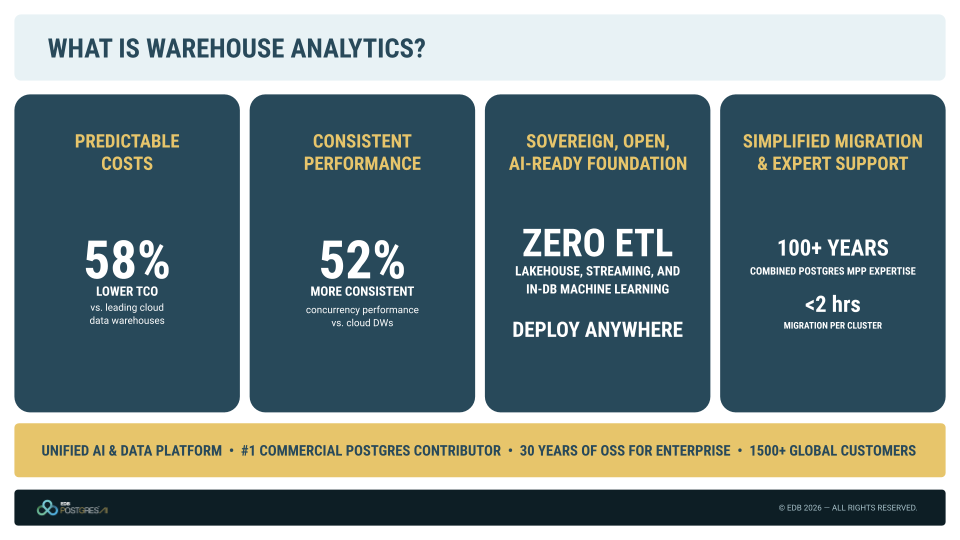
EDB Postgres AI Warehouse Analytics is enterprise-scale data warehousing with sovereign deployment and predictable pricing, built on the open source foundation customers can trust to be there for the long term, so their teams can focus on the harder problems that actually move the business forward.
EDB Postgres AI Warehouse Analytics delivers up to 58% lower total cost of ownership versus leading cloud data warehouses, which is exactly what brought Kyobo Book Center's bills under control. Warehouse Analytics also provides up to 52% more consistent concurrency performance than cloud data warehouses, which is the architecture that keeps analyst teams running at full speed even when everyone is querying at the same time. And for customers migrating from Greenplum, binary compatibility means the switch is straightforward, with migration taking under two hours per cluster and backed by over 100 combined years of Massively Parallel Processing (MPP) Postgres expertise.
Unlike cloud only alternatives, Warehouse Analytics deploys anywhere, on premises, in any cloud, air-gapped, or hybrid, giving customers like Euronext and Mountain the data residency and control their compliance environments demand, without sacrificing performance or modern AI readiness.
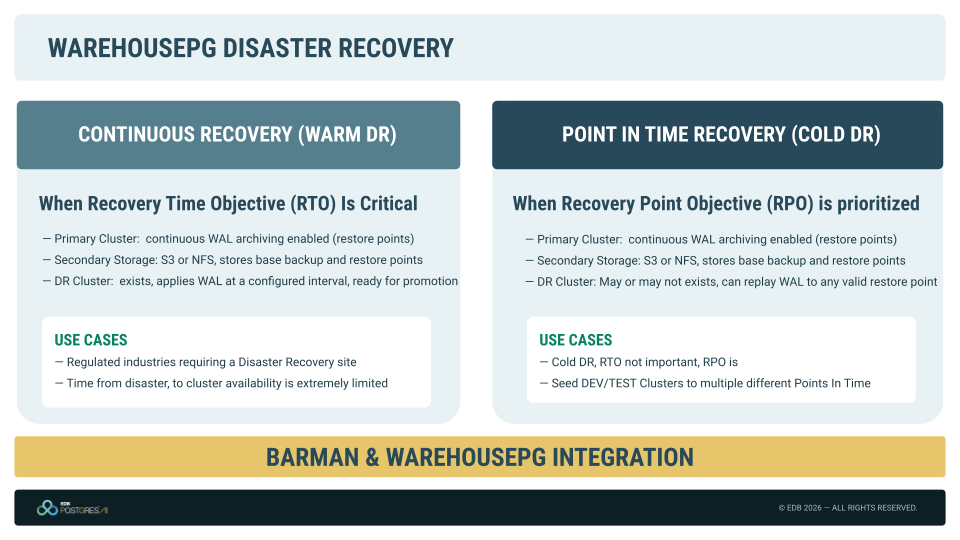
Disaster Recovery, warm and point in time. The Q2 release delivers the enterprise DR capability that many Greenplum customers have depended on from legacy providers, now natively within EDB Postgres AI, integrated with Barman, and with no reliance on a proprietary module that no longer has a development future. Warm DR provides continuous recovery for environments where recovery time is tightly regulated. Point in time recovery gives teams the flexibility to restore to any defined checkpoint, invaluable for customers whose databases are too large for daily backups and who need a precise recovery option when something goes wrong mid week.
Lakehouse interoperability with the Postgres Analytics Accelerator (PGAA). The Postgres Analytics Accelerator extension for WarehousePG enables direct querying of open table formats, Iceberg and Delta Lake, from within the warehouse, without Extract, Transform, Load (ETL) and without moving data out of its sovereign location. Queries run against live lakehouse data in place, eliminating the data movement that introduces lag, cost, and governance risk. This is a first of its kind capability that legacy Greenplum providers don't offer, and it opens a fundamentally new pattern for customers who are managing both a warehouse and a lakehouse and need to bring those worlds together without duplication or delay.
Data Science Extension Pack. Q2 ships approximately 75 data science related Python modules packaged and ready to deploy directly into WarehousePG clusters. Data science teams can now run their workflows natively inside the warehouse, on the data where it already lives, without exporting to external environments or maintaining separate tooling. This directly addresses the ETL lag problem for data science workloads, decisions get made on current data, not yesterday's pipeline output.
ORAFCE UTL_RAW. Additional functionality extending the orafce compatibility layer to support RAW data type manipulation, covering use cases where Oracle-ecosystem applications use RAW data types implemented as a domain over the bytea data type in WarehousePG. For organisations migrating Oracle-ecosystem workloads, this removes a class of data type incompatibilities that previously required manual remediation before migration could proceed.
Warehouse Enterprise Manager (WEM) 1.2. The latest release of Warehouse Enterprise Manager gives DBAs the ability to schedule resource group configurations, visualise query plans, and track historical database growth, so teams can proactively plan capacity rather than react to it. Observability and management are built in, not bolted on, giving teams a single place to run, monitor, and optimize their warehouse estate from day one.
For data analysts, data scientists, and business teams, the change is tangible. Queries that slowed to a crawl when the team logged in together now return in seconds, even as AI agents add to the concurrent load. Real time and historical data join in a single query, no separate pipelines, no waiting for overnight batch jobs. The insight that used to arrive the next morning arrives now, while it still matters. And for data science teams in particular, the new Python Data Science Extension Pack means workflows that previously required exporting data to external environments can now run natively inside the warehouse, on current data, without the ETL lag that has been making models stale before they even run.
For DBAs and platform engineers, the operational picture changes significantly. A single management interface across the full warehouse estate replaces the fragmented tooling that made Greenplum complex to operate. Disaster recovery is no longer a proprietary dependency, it's built in, configurable, and backed by the EDB open source ecosystem. Oracle-ecosystem data type dependencies that previously blocked migration projects are addressed through the ORAFCE UTL_RAW extension, removing a class of compatibility issues that used to require manual remediation. And the certification programme means teams can get skilled up quickly without months of ramp time.
For CIOs and finance leaders, the numbers speak clearly. Predictable per core pricing replaces consumption-based billing that was impossible to forecast, which is exactly what brought Kyobo Book Center's cloud bills under control. Sovereign deployment eliminates the regulatory risk that made cloud only architectures a compliance problem, addressing the same sovereignty mandate that forced Euronext to look for an alternative. And an open foundation built on Postgres, with EDB as its number one commercial contributor, means the vendor lock-in cycle that trapped so many organisations on proprietary platforms ends here.
Watch the Warehouse Analytics Demo walkthrough to see EDB Postgres AI for WarehousePG in action and learn how to run and manage petabyte-scale analytical workloads and distributed clusters in real time, or get certified through the WarehousePG Essentials Course, available now!
Tired of queries that slow to a crawl when the team logs in? Facing a Broadcom or cloud renewal with no good options on the table? Or managing data that legally can’t leave your environment? There’s a modern, open, sovereign alternative ready today with EDB Postgres AI - Analytics without limits, Infrastructure without surprises, Deploy petabyte-scale analytics anywhere with predictable costs and open source control. Talk to an expert today!
此内容由惯性聚合(RSS阅读器)自动聚合整理,仅供阅读参考。 原文来自 — 版权归原作者所有。