







This blog is co-authored by Iga Januszek, Dave Stone, and Purnima Phansalkar.
For more than 20 years, we've heard the same story from customers. It starts the same way, every Monday morning checking the on-prem cluster first, then switching to a different tool for the cloud environment, opening another window for the hybrid deployment, logging into yet another dashboard for the external Postgres clusters that technically aren't their responsibility but somehow always find their way onto their plate. Another login. Another dashboard. Another mental tab to keep open.
What nobody realises until it's too late is that somewhere in that web of tools and alerts, a query started degrading on Friday. It sat there all weekend, quietly. Not because no one was paying attention, but because with so many systems to juggle, it's all too easy to forget to check one. And when you don't know which system to look at first, the question of whether it was an infrastructure issue, a workload spike, or something upstream stays unanswered for far too long.
The thought that follows is one we've heard just as often: couldn't there be one tool that connects all of this, something that just shows me everything, in one place, and tells me when something's wrong before I have to find it myself?
That tool already exists.
That's exactly what EDB Hybrid Manager and the OSS Library were built to do.
Enterprises don’t run Postgres in one place anymore. They run it on-prem, in the cloud, across multiple clouds, in hybrid environments, and each of those environments comes with its own configuration, its own tooling, and its own set of operations. The result is configuration drift: the slow divergence of environments that makes consistency harder to maintain and reliability harder to guarantee.
And the strain doesn’t stay at the infrastructure level. It flows directly to the people managing it. DBAs are spending 30–50% of their time on undifferentiated routine tasks, backups, patching, upgrades, tuning - work that keeps the lights on but pulls focus away from the architecture, innovation, and strategic work the business actually needs from them. What makes it worse is that the scope of those tasks is expanding. Developers and DevOps teams are increasingly being asked to perform DBA work they were never trained for, with tools that weren’t designed for them.
Meanwhile, organizations that want the simplicity of cloud DBaaS face an uncomfortable trade-off: accept vendor lock-in and surrender data sovereignty, or keep managing complexity manually. For enterprises in regulated industries, that trade-off isn’t even a choice, public cloud simply isn’t an option.
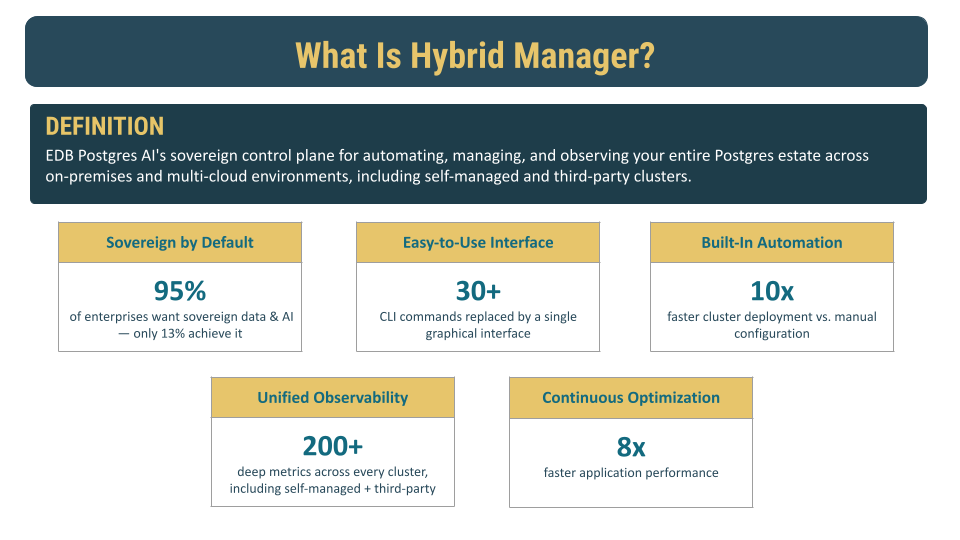
Hybrid Manager is EDB’s sovereign control plane for automating, managing, and observing your entire Postgres estate across on-premises, cloud, and hybrid environments, including self-managed and third-party clusters, all from a single interface.
The key word is sovereign. Hybrid Manager gives customers the cloud-like automation they’ve been looking for, deployed entirely inside their own environment. No vendor lock-in. No data leaving their infrastructure. No compliance risk. Just the operational simplicity of DBaaS, on their terms.
For teams who live in the command line, it replaces 30+ CLI commands with a guided graphical interface that works for any skill level. To create a Kubernetes Postgres cluster today, you're looking at creating namespaces, applying custom resource definitions with dozens of lines of YAML, and manually configuring secrets, storage classes, and backup schedules, all before you've even started. In Hybrid Manager, that's a few clicks. For teams that want to go further, it exposes full APIs so AI agents can complete tasks automatically and on their behalf. And for everyone, it delivers unified observability across the entire Postgres estate, over 200 deep database metrics, real time monitoring, and intelligent alerts, so that blind spots become a thing of the past.
The impact is real and tangible. A PGD cluster that used to take a day or two to configure and required a very specific set of skills to get right, is up and running in around 20 minutes with Hybrid Manager. On the efficiency side, instead of manually running scripts against each instance to analyse index performance, the Recommendations tab surfaces that across all your systems in one view. For a team managing 20 instances, that alone saves hours every week and for the non-expert Postgres DBA, having system parameter recommendations surfaced automatically is, in the words of one of our own engineers, "a godsend."
If Hybrid Manager solves the problem of managing what you have, the OSS Library solves the problem of safely adopting what you need next.
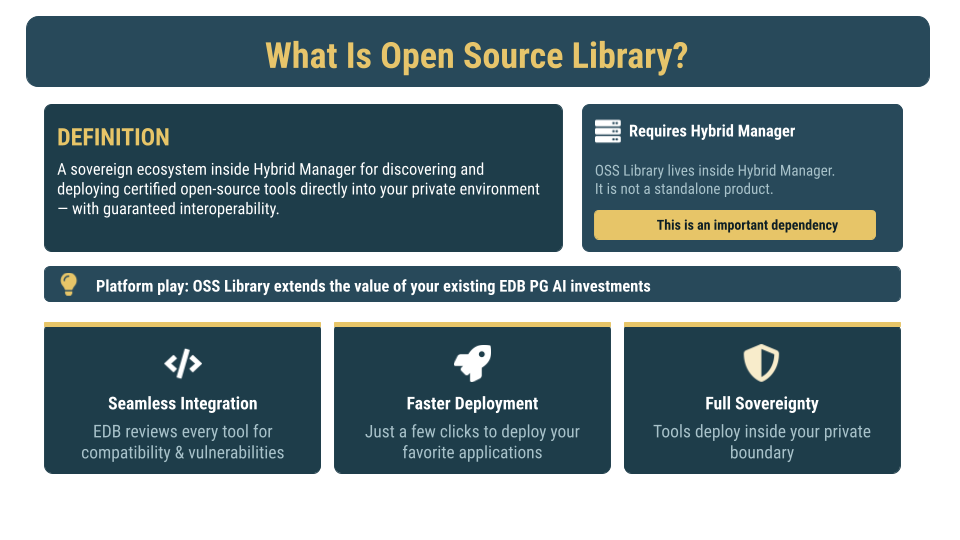
The OSS Library is a sovereign ecosystem built directly inside Hybrid Manager for discovering and deploying certified open-source tools into your private environment, with guaranteed interoperability out of the box. It is not a separate product. It lives inside Hybrid Manager and is available to all Hybrid Manager customers from June.
Here’s the challenge it addresses: 68% of enterprises increased their use of open source tools last year, and that number is only going up. But the process of getting a new open source tool approved and deployed, security reviews, compatibility testing, cross-team procurement approvals, typically takes weeks. Sometimes months. That’s not a compliance process. That’s a momentum killer.
The OSS Library changes the equation entirely. EDB reviews every tool for compatibility and security vulnerabilities before it ever enters the library. Customers browse a curated catalogue of certified applications, including pgAdmin, Apache Airflow, Apache Superset, Metabase, pgBadger, and HammerDB and deploy them in minutes, directly into their sovereign environment, with a few clicks. No bespoke integration work. No security review backlog. No waiting.
And because access to the OSS Library is controlled through project-level roles within the organization, teams know exactly who is using which tools with which data, at scale, and without the usual overhead.
For DBAs and Platform Engineers, the shift is from constant firefighting to actual control. A unified view of the entire Postgres estate means they spot issues before users do. Intelligent recommendations surface optimizations proactively. And the automation engine handles the routine work, so they can redirect their expertise to the work that actually moves the business forward. The exhaustion of managing fragmentation starts to lift.
For Developers and DevOps teams, it’s the removal of two recurring frustrations: being asked to do DBA work without the right tools, and waiting weeks to use the open source tools they’ve already chosen. Hybrid Manager gives them a guided interface that doesn’t require CLI expertise. The OSS Library means the tools they want are available when they need them, not a quarter later. Projects stop stalling before they start.
For Decision Markers, the message is clarity. Hybrid Manager delivers the operational efficiency of cloud DBaaS without the sovereignty risk. The OSS Library eliminates the hidden cost of open-source adoption, the engineering hours lost to procurement, integration, and maintenance overhead, and replaces it with a controlled, compliant, scalable approach. AI initiatives that were stalled because of infrastructure debt start to move again.
Tired of juggling tools across a fragmented Postgres estate? Spending your Mondays chasing down which system missed the alert, instead of focusing on the work that actually matters? Watch the Hybrid Manager Demo for a walkthrough of unified observability, intelligent recommendations, and agentic operations across a hybrid Postgres estate.
One control plane. One library. One less reason to dread Monday morning. Deploy EDB Postgres® AI for turnkey, production-ready Postgres and cloud-like agility across on-premises, multi-cloud, and hybrid environments. Talk to an expert today!
此内容由惯性聚合(RSS阅读器)自动聚合整理,仅供阅读参考。 原文来自 — 版权归原作者所有。