


Morning all,
Amidst… war, plotting and scandal a bumper week of economic data, there were once again (*sticks fingers in ears and pretends war isn’t happening*) nuggets of good news. I wouldn’t be surprised if you missed the latest data on private rent inflation. Happily, it’s not surging in advance of the Renter’s Rights Act with inflation on new lets at 1.8%. Not so happily, the cash freeze on how much those on UC can be paid for housing costs is continuing to squeeze low-income families.
You might have spotted the puzzlingly strong PMI data, but if you aren’t already glued to our Substack (your loss), don’t miss Simon’s piece unpacking this conundrum.
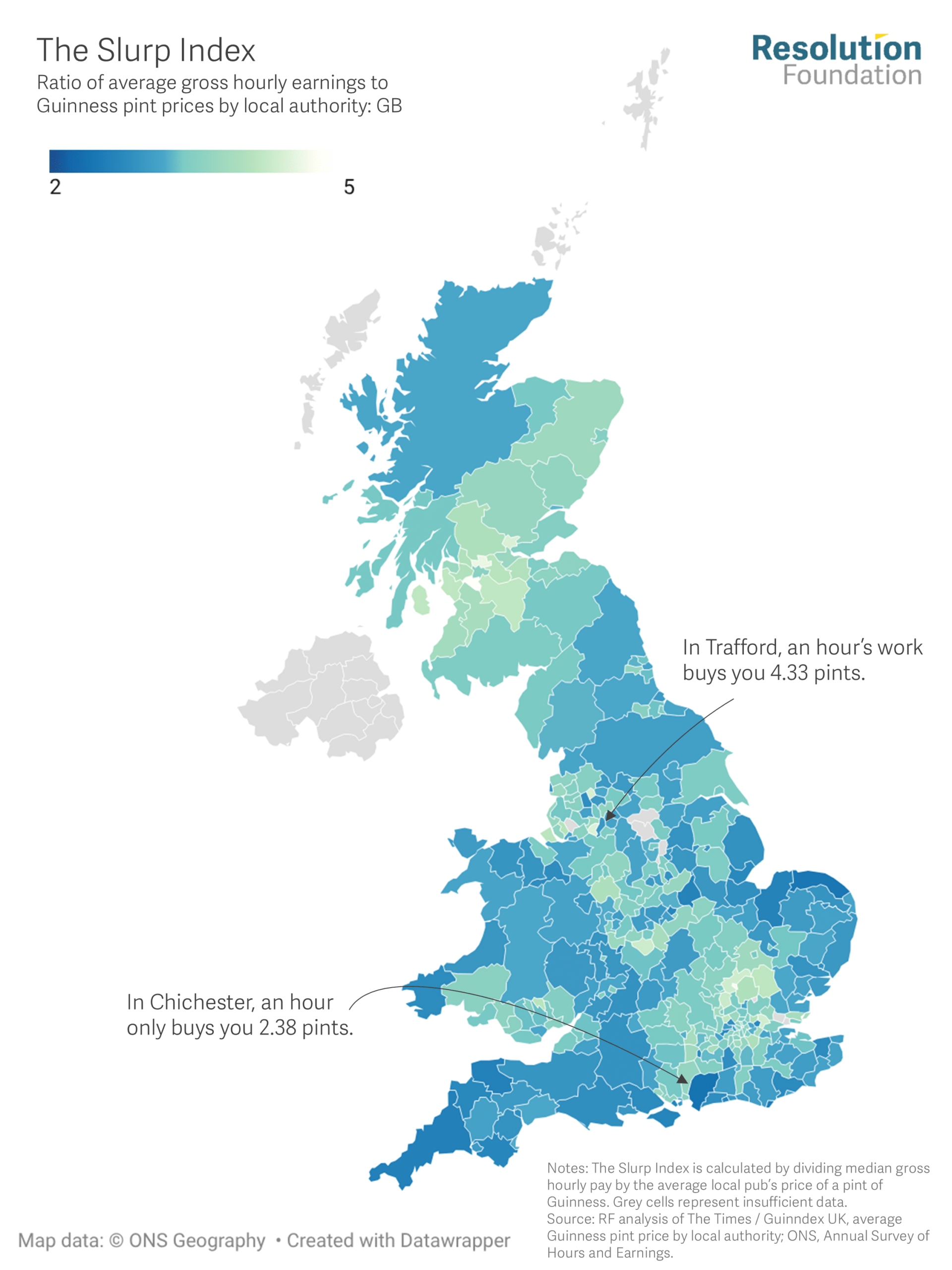
But for those focused on the data that really matters scroll on for our very own Slurp Index, unpacking the price of pints, for Chart of the week.
Have a great weekend,
Ruth
Chief Executive
Resolution Foundation
Village people. When Athens built its 2004 Olympic Village it did something unusual: from the start, the €300 million, 2,300-unit complex – with landscaped parks, new schools and a health clinic – was designed to become social housing once the athletes left. Some 18,000 working families applied, and 2,000 were picked by open lottery. This (doric) column looks at secondary-school kids who moved versus those who lost the draw, and find movers’ grades rose by 0.24 standard deviations, vaulting a median student to the 59th percentile, and that the gains cluster among previously low-achieving teenagers. Some lessons for Manchester 2036?
Entry denied. Has AI started eating entry-level jobs or is the jittery hiring data just tighter monetary policy in a trenchcoat and a fake moustache? A new paper exploits a neat quirk to separate the two: Sweden’s Riksbank started raising interest rates in April 2022, a full seven months before ChatGPT launched, giving a clean window to tell the stories apart. Combing through 4.6 million job ads and the full population register, they find the broad collapse in vacancies since then tracks the rate hike, not the chatbot, but that employment of 22-25 year-olds in the most AI-exposed occupations has fallen by 5.5 per cent relative to their less-exposed and older colleagues. One caveat: October 2022 also saw the launch of a new employment protection law in Sweden, which might have scrambled up the hiring data. Just when you thought you’d found an exogenous shock…
Side hustle. Most of what we know about insecure work comes from headline employment statistics that count one job per person. A new report from the Women’s Budget Group (who I have a feeling we will be seeing more great stuff from having met their brilliant new CEO Dr Daniella Jenkins this week) argues that this has been quietly hiding the shape of young women’s working lives. The authors find that one-in-ten women aged 16-29 were juggling more than one job simultaneously in 2023-24, compared to one-in-fifteen young men. Hospitality is where the pattern is most concentrated: 18 per cent of young women with multiple jobs work in the sector, many of whom miss out on pension auto-enrolment due to earning under the £10,000 threshold. Predictably, the drivers are low wages, insufficient hours, and an abundance of temporary contracts. Flexibility for the employers, jigsaw puzzles for employees.
Baby fever. Policymakers worldwide (including at RF towers) are grappling with why fertility is on such a downward slide, and the mooted economic and cultural causes are endless. This paper adds a neurobiological view and argues that being around babies simply makes people want babies. Their “empathy channel” works like this: exposure to infants in your social environment triggers a brain response that raises your desire to have kids. But as fertility declines and infants become rarer in daily life, that stimulus weakens too, amplifying the original decline in a self-reinforcing loop that they estimate could explain 13 per cent of the birthrate fall. Out of sight, out of mind.
Something for the weekend | Stick or twist
What a difference a war makes. Back then few people knew where the Strait of Hormuz was, and markets were pricing in two interest rate cuts this year. Now? Thursday’s MPC decision will face the question of whether rates ought to be heading the other way entirely.
The Bank is widely expected to ‘stick’ for now. But how quickly to ‘twist’ – raise rates to limit the inflationary effect of the latest global energy shock – is a question which divides reasonable minds. Catch up on our great discussion earlier this week for a deep dive on what’s at play.
One position points to patience. The latest stats confirmed that the labour market remains loose, leaving us better placed than in 2022 to avoid second round effects (where firms fund wage rises by passing costs on to prices). Dodging a wage-price spiral would be welcome – though it’s cold comfort for workers, whose real wages grew by just 0.2 per cent in the year to February.
Pulling the other way is the uncomfortable truth that living through high inflation leaves a lifelong mark. With only one of the last five years seeing below-target inflation, the risk is the memory of an inflationary shock leaves expectations (what central bankers really care about) less well anchored.
Next week, economists and markets expect the Bank to hold at 3.75 per cent. Where rates go from there – and how fast – is still to play for.
Chart of the week
As beer garden season approaches, you may have seen a new Guinness Index of average pint prices across Britain featured in The Times this week. We decided to give it the RF treatment and considered not just the cost of a pint of the black stuff, but how that compared with average hourly earnings in each area. You can see the results below – darker areas represent places where an hour’s work will buy you fewer pints. Trafford wins out with the average hourly wage (£21.63) earning you a full 4 pints (£4.99 each) with some change left over – a fair round by most accounts. Chichester on the other hand is short-changed. An hour’s hard graft here (£16.02) wouldn’t even stretch to 3 pints (£6.72 each). Of course affordability is about earnings as much as it’s about prices. High earning Kensington & Chelsea, where a pint will set you back £7.66, has a similar affordability ratio as Preston, where it will only cost you £5.08. London isn’t quite the rip off you might expect, as wages are generally high enough to compensate for the (occasionally extortionate) pint pricing. The truly unaffordable areas are seaside and rural areas, who enjoy the dubious blessing of lower earnings alongside tourist prices.
此内容由惯性聚合(RSS阅读器)自动聚合整理,仅供阅读参考。 原文来自 — 版权归原作者所有。