



Morning all,
If you’re in the market for some pub-quiz-winning trivia, as the results roll in keep an eye on whether Labour’s defeat in the local elections is even more sizeable than the Conservative’s losses in 2019, when 1,300 seats fell out of their control, a loss of more than a quarter (27 per cent) of their previous councillors.
That said, I can confidently share that I’m not the most poll-literate Curtice in town. So, please do sign up to our event next week considering the impact of these elections on the remainder of the parliament, including insights from Sir John Curtice (my dad), Yuan Yang MP and Tom McTague from the New Statesman.
Keep reading to find out how the public think pensions reform should go, and why we’re letting Michael Gove off the hook.
Have a great weekend,
Ruth
Chief Executive
Resolution Foundation
Don’t quit your day job. When California raised its fast-food minimum wage to $20 an hour in 2024, it significantly raised the pay of many workers provided a great experiment for assessing the impact of minimum wages. Arin Dube’s new paper produces a nerd-fest of estimates of the employment effects. All show no or modest effects and finds a margin earlier studies missed: quits collapsed. As wages rose by 7 per cent, the gap between workers’ current jobs and their outside options narrowed, leading quarterly separation rates to fall by around 3 to 6 percentage points. This mutes the employment effect even for a sector specific wage where the option for consumers and employers to switch to lower cost alternatives is available. Fewer leavers meant higher wages for burger flipping didn’t bite jobs.
Pension priorities? In preparation for the Pension Commission’s first report, here’s a poll on pension priorities which asked people to rank whether policies would make them support a politician more (or less). The public’s preferred pension policies (try saying that five times fast) were to widen automatic contributions to (almost) all employees and raise employer contributions. The biggest eyebrow raiser was that more respondents backed requiring higher employee contributions than wanted to freeze the pension age at 67. But the polling did make clear the pension age freeze came with higher taxes. We have advocated raising the state pension age to 68, given fiscal constraints and the case for generational fairness. Indeed, the poll found a stark generational divide on whether we should keep the triple lock. Given the real value of the basic State Pension has grown by 19 per cent since 2010 while unemployment support has fallen by 6 per cent, the Pension Commission should address this widening divide. Abolishing the triple lock is a tough political sell, but with pensioner incomes no lower on average than working-age incomes, there is no justification for uprating them by random rachet.
Pass the Factor 50. OK so maybe we planned this one before we checked the forecast for next week…but there’s always space for some interesting analysis on death by heat exposure. These authors found that about 60 per cent of the extra deaths among elderly people during heatwaves could be explained by neighbourhood-level differences in heat exposure, not just by the overall city temperature rising. Drilling into their Rio de Janeiro case study reveals that better preventative care only reduces the death toll when the heat stress is genuinely citywide – when the danger is concentrated in a few sweltering neighbourhoods with little cover, all that matters is proximity to the emergency room. Heatwaves, like real estate, are all about location.
Suffering for our studies. Tougher final exams, less coursework, and mandatory resits for fails in Maths and English – can we blame Michael Gove’s reforms for the rise in poor youth mental health? It seems not. This article considers how, amidst criticisms of the new system turning schools into exam factories, Scotland diverged from Gove’s vision of a knowledge-rich curriculum. They opted instead for a skills-focused curriculum with fewer exams. Despite this, a 2022 survey found that happiness and wellbeing scores remained similar either side of the border. At the same time attainment in England improved compared to the OECD average, while Scotland saw declines. So tell the kids – don’t stress, the exams are good for you.
Rate expectations. Any economics textbook can tell you that cutting interest rates boosts consumer spending. But are economists sure they know why? A new Bank of England paper uses UK administrative data on six million expiring fixed rate mortgage deals and finds that a 1 percentage point cut in mortgage rates raises consumption by about 3 per cent (c. £950) over the next 6 months. But surprisingly, most of the rise comes from households borrowing against their higher home values, rather than cashing in on higher spending power off the back of lower monthly mortgage bills. The reverse effect, the authors note, also holds. If high rates keep house prices flat this year, expect consumer spending to feel the chill too.
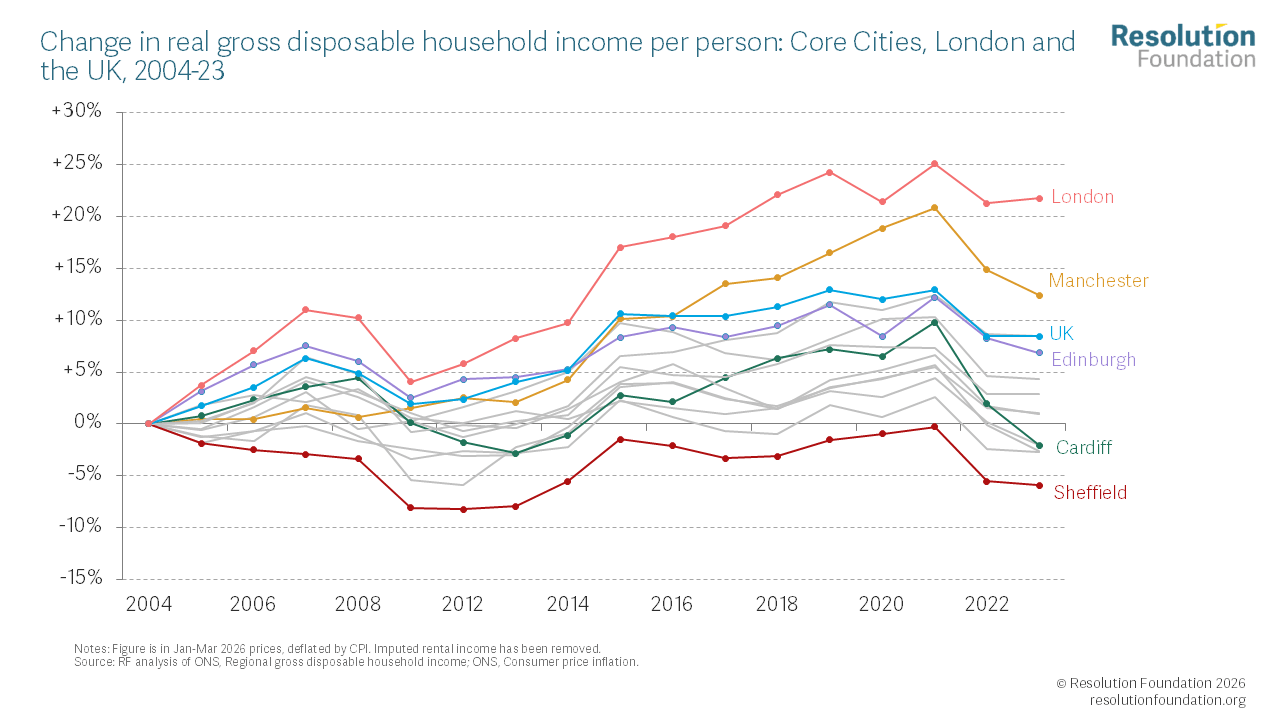
As you get lost in the new political maps of the UK coming out over the next few hours and days, we wanted to add a living standards map to the picture. This week’s chart shares something I recently presented to the CEOs of the alliance of twelve Core Cities committed to working together to boost the city regions. It shows how living standards (measured as real gross disposable household income per person) have changed in those cities (and London) between 2004 and 2023. London pulls far ahead, with a 22 per cent uplift in (mean) living standards over this period. Manchester (12 per cent) and Edinburgh (8 per cent), nab silver and bronze. But even third-place Edinburgh falls below the UK wide average and things fall off rapidly after that. In fact, more than half of the Core Cities saw living standards fall in real terms over this period, with Sheffield experiencing the sharpest drop of 6 per cent. And despite Manchester’s impressive catch-up, it remains nearly £15,000 behind London in absolute terms: £17,500 per person versus London’s £32,300. Surely we can do better than that.
此内容由惯性聚合(RSS阅读器)自动聚合整理,仅供阅读参考。 原文来自 — 版权归原作者所有。