








Afternoon all,
Parliament’s prorogued, the sun is shining, and interest rates are holding steady. I’d say we’re in for a restful long weekend, except for, you know…
The Bank of England shared their predictions for the economy this week – taking into account the war in the Middle East. It’s a triple-whammy of bad news. Higher inflation, higher interest rates, and lower growth (raising unemployment and jeopardising the Chancellor’s fiscal plans). Meanwhile the ONS revised down their population projections, potentially creating more bad fiscal news (although less than had been feared).
Speaking of unemployment, we released a brilliant paper about the UK’s NEET crisis this week, arguing that brightening the prospects of our young people will require improvements across mental health, the benefit system and vocational education.
In happier news, tariffs on whisky have been removed. Exports of whisky from the UK to the States were worth more than £1 billion in 2024 but dipped 5 per cent last year – 2.6 times more than the overall fall in our goods exports to the US that year. So, this easing of trade tensions is one we could all raise a dram to – slàinte.
This all sounds fascinating, right? Well, if you’re interested in working on the research we’re renowned for, please consider applying to one of the positions open in our research team.
Read on for train maps, tipping points and renters’ rights.
Have a great (long) weekend,
Ruth
Chief Executive
Resolution Foundation
Banned together. Four months in, Australia’s ban on under-16s using social media has encountered the laws of social physics. A new paper finds only a quarter (27 per cent) of 14-15 year olds are complying with the ban. The authors argue it’s because we haven’t reached an effective ‘tipping point’ where enough kids are off their phones to nullify the pull of the network effect. As a result, most kids are circumventing the ban and assuming their peers are doing the same – although I’d argue that it’s pretty early to be throwing our hands up and calling it off. The impact on future cohorts may be very different. At least I really hope so, because the stakes are high. This year’s World Happiness Report singles out English-speaking countries as being particularly susceptible to harmful effects on wellbeing from social media use – something for us Brits to consider.
Track to the future. Are only one-third of Britain’s railways electric? Answer: yes, but you’re kind of asking the wrong question, as Hannah Ritchie explains in another great Substack (including a fun railway map). The viral 38 per cent figure measures track length, not where the trains actually run, so reweighting by passenger-kilometres brings Britain up to two-thirds electrification. The real embarrassment is freight: almost none of our goods travel on electrified track, against majorities in France, Spain and the Netherlands.
Driven to it. Speaking of fun maps… A new working paper takes a clever crack at quantifying just how trapped we are by our cars. The authors build a “Car Dependency Index” for 18 cities across mainland Europe and North America, comparing how many amenities you can reach by car versus public transport in each city. In 16 of the 18, the car wins – and in Rome, New York and Malaga it’s not even close. They also find that how well-connected your neighbourhood is largely determines whether you own a car, even after adjusting for incomes. In other words: people aren’t choosing cars so much as being cornered into them by the shape of their city.
Sleepless in Stuttgart. And finally, the beloved performance review: ostensibly a conversation about your future, in practice a reliable source of 3am ceiling-staring. New analysis of German data shows that workers facing appraisals report deteriorating sleep satisfaction, a penalty that holds across genders, ages and personality types. Reviews linked to short-term financial outcomes (monthly pay, yearly bonuses) do the most damage. Motivation by day, rumination by night.
Something for the weekend | Rights here, rights now
Today brings a seismic shift for the fifth of households who live in the Private Rented Sector (PRS), with the Renters’s Rights Act coming into effect. Key changes include:
Many of these were key election promises from the Government – but will they improve experiences of the PRS in practice?
Significantly more people rent than 25 years ago, when the PRS was dominated by people in their 20s; today children are more likely to live there than adults. Yet 16 per cent of renters don’t feel their housing is secure enough to make long term decisions.
Many have warned that these new rights will drive up rents. But recent evidence shows rent inflation is heading downwards – to 1.8 per cent for new lets.
And of course tenants can still be evicted if they don’t keep up with their rent payments – a particular challenge for families who rely on Universal Credit to make ends meet. Their housing support is pegged in cash terms to rents in 2022-2023, since when the cost of renting has increased nearly a fifth (17 per cent). This year the gap between the value of housing support and the cost of rent is on track to reach a record high.
Chart of the week
Why are nearly a million young people, and rising, currently inactive (or NEET)? In our aforementioned NEET paper we considered the trend and its causes, and for Chart of the week we’re highlighting one key finding. Education – not unemployment or health – is the reason the UK consistently lags its peers on youth inactivity. Of the 23 OECD countries with lower NEET rates than the UK, all but one have a higher rate of education and all but two close the gap entirely by having higher levels of education. This chart shows the proportion of 18-24 year olds in education (including those who combine it with employment) in OECD countries, compared to the UK. As you can see, only New Zealand has fewer young people in classes. Fixing our NEET crisis will require a swathe of improvement ranging from the labour market to mental health – but the importance of vocational education is significantly underappreciated. That is how countries like the Netherlands keep their NEET rate a third of ours.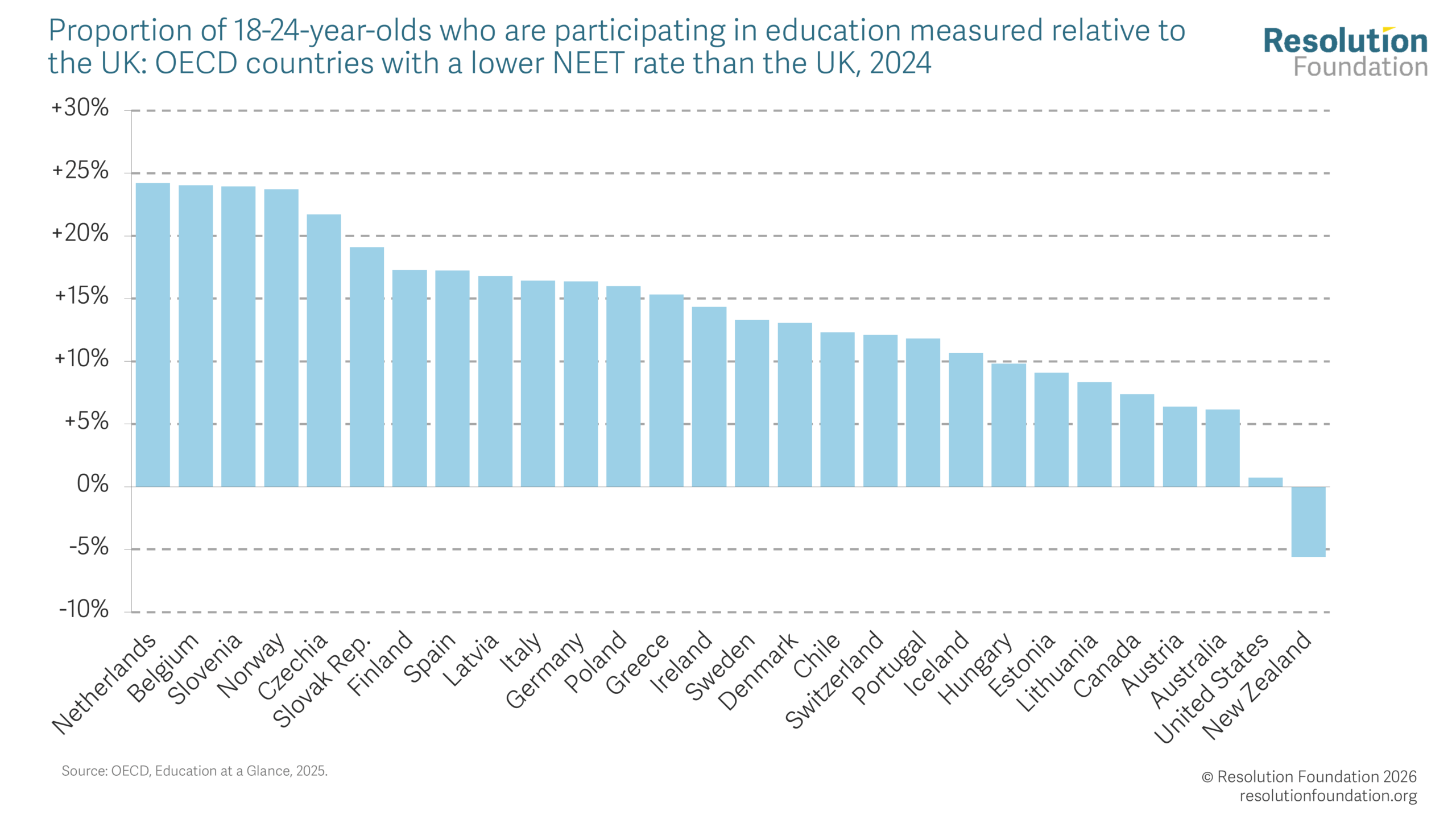
此内容由惯性聚合(RSS阅读器)自动聚合整理,仅供阅读参考。 原文来自 — 版权归原作者所有。