





Mike Brewer and the RF team unpack what the current conflict in the Middle East means for living standards
by
This post was originally published on our Substack.
Never has the phrase ‘fog of war’ been more apt. The fighting in the Middle East had looked all set to escalate just before dialing down, and nobody knows if an incomplete truce can hold. Reacting to every development, oil and gas prices have seemed almost as volatile as the news. But through all the chaos, it is now possible to gauge the rough likely scale of the effect on British living standards. As discussed at a great event this morning, the typical working-age household currently looks set to be £480 worse off this year than they would have been without the conflict. Below, I talk through where this number comes from, and how it varies across different groups in the population, and what the Government should be doing.
Prospects for a bumper year for living standards have been snuffed out
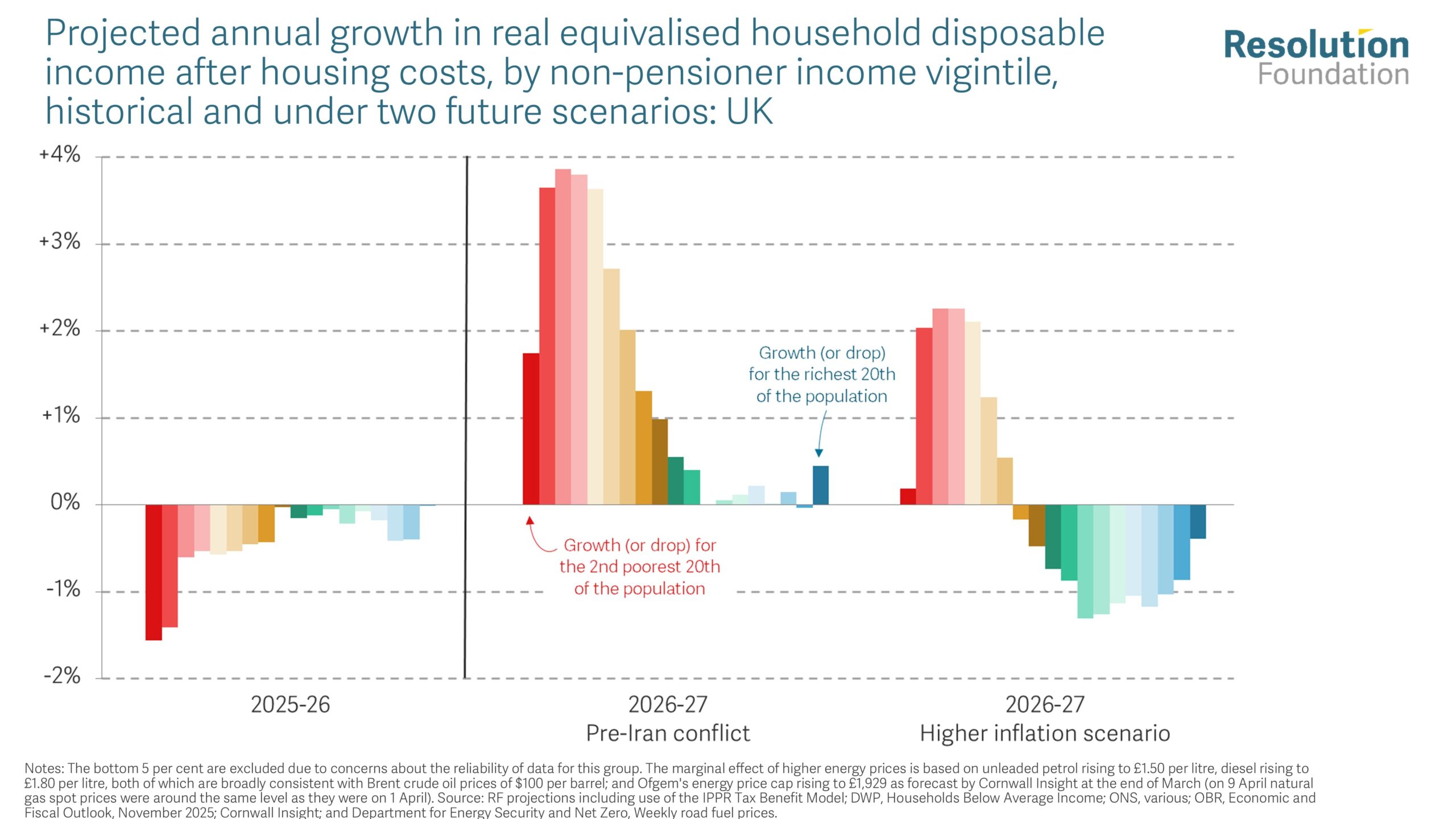
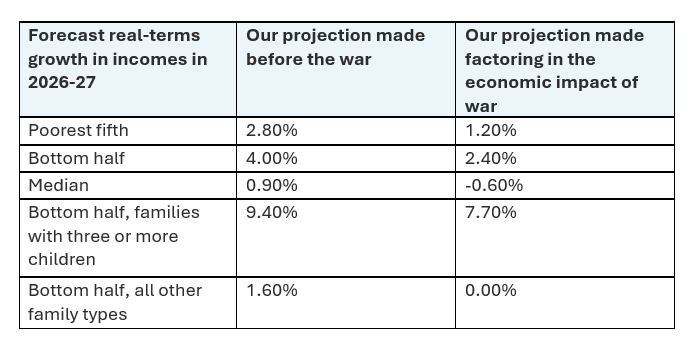
Just a couple of months ago, our expectation was that 2026-27 would be a long-needed bumper year for living standards, at least among the bottom-half, in part due to decisions to boost the standard allowance in Universal Credit and get rid of the two-child limit. But we now estimate – based on market forecasts for the rise in energy prices from the end of week commencing April 6 – that average income growth for the poorest fifth this year is now set to be just 1.2 per cent, down from our forecast of 2.8 per cent made before the war. (This estimate accounts for the fact that rises in the price of energy and food hurt lower-income households by more than better-off households, because essentials make up a greater share of their budgets).
The picture remains brighter for families in the bottom half of the income distribution with three or more children, though. Such families have been intensely squeezed over recent years but, thanks to the abolition of the two-child limit, year-on-year income growth for these families in 2026-27 is estimated to be 7.7 per cent even after the inflation shock, compared to no growth at all – an average of 0.0 per cent – across all other families in the bottom-half of the distribution.
Further up the distribution, rising energy prices will likely leave living standards falling outright: the middling working-age household, previously on track for 0.9 per cent growth, is now set to see its income dip by 0.6 per cent – a difference of £480 – over the course of the current financial year. As the chart below shows, the scale of income losses for richer households will be even greater.
The living standards deterioration in numbers
Rising food prices could make things tougher still…
Most attention so far has been on the price of energy, and the availability and price of fuel. But we know from the war in Ukraine that higher energy and fuel prices will soon turn into higher prices across the economy, not least in food. (Indeed, the current conflict may have more persistent impacts on food production than did the war in Ukraine because it is exerting a more direct pinch on fertiliser production and distribution). Our estimate is that a (say) 10 per cent rise in global food commodity prices will eventually push up the cost of food for UK households by about 2 per cent. Importantly, the peak impact is felt more than a year after the rise in commodity prices, meaning the inflation shock from the war could persist into 2027. [1]
What should the Government do?
Of course, the full and final economic effects cannot be established until we know exactly how the war will develop and end. But we do know that unless we see large falls in energy prices soon, the increased cost of energy bills and petrol at the pump will be passed on to households. Energy bills are all but certain to jump in the summer: it is for this reason that we have been urging the Government to accelerate work on a social tariff ahead of winter, when soaring energy costs would hit hardest. This approach would efficiently target support towards households facing the most serious crunch – those with lower incomes and higher energy costs – without saddling taxpayers with an unrealistic bill.
Finally, the economic fallout from the war will stretch well beyond energy bills and food prices. We’ll be diving into the wider economic effects, and what it means for fiscal and monetary policy, next week. Join us here!