


惯性聚合 高效追踪和阅读你感兴趣的博客、新闻、科技资讯
阅读原文 在惯性聚合中打开

推荐订阅源

小众软件
小众软件
N
News and Events Feed by Topic
A
About on SuperTechFans
aimingoo的专栏
aimingoo的专栏
The Cloudflare Blog
H
Heimdal Security Blog
Schneier on Security
Engineering at Meta
Engineering at Meta
Google Online Security Blog
宝玉的分享
宝玉的分享
AI
AI
The GitHub Blog
The GitHub Blog
MongoDB | Blog
MongoDB | Blog
www.infosecurity-magazine.com
The Last Watchdog
The Last Watchdog
T
Troy Hunt's Blog
S
Security @ Cisco Blogs
H
Hacker News: Front Page
F
Fortinet All Blogs
博客园_首页
S
Secure Thoughts
N
News and Events Feed by Topic
P
Proofpoint News Feed
Microsoft Azure Blog
I
InfoQ
Spread Privacy
Spread Privacy
Hacker News - Newest:
Hacker News - Newest: "LLM"
cs.CL updates on arXiv.org
C
Check Point Blog
Hugging Face - Blog
Hugging Face - Blog
Hacker News: Ask HN
Hacker News: Ask HN
C
CXSECURITY Database RSS Feed - CXSecurity.com
酷 壳 – CoolShell
酷 壳 – CoolShell
Stack Overflow Blog
Stack Overflow Blog
L
LINUX DO - 最新话题
Exploit-DB.com RSS Feed
S
Schneier on Security
Know Your Adversary
Know Your Adversary
OSCHINA 社区最新新闻
OSCHINA 社区最新新闻
Scott Helme
Scott Helme
P
Privacy & Cybersecurity Law Blog
S
Securelist
freeCodeCamp Programming Tutorials: Python, JavaScript, Git & More
O
OpenAI News
K
KPMG report finds enterprise disconnect between AI and its ROI | CIO
PCI Perspectives
PCI Perspectives
L
LangChain Blog
雷峰网
雷峰网
Security Archives - TechRepublic
V2EX - 技术
V2EX - 技术

Pinecone

Pinecone Assistant: A Managed Knowledge Layer for Production AI Applications Multi-domain RAG in n8n: why one knowledge base is not enough Allspice Transforms the Culinary Experience with Semantic Search Powered by Pinecone | Pinecone Building RAG workflows in n8n: choosing the right Pinecone node Knowledge needs a meta-knowledge layer Garbage Day: How Pinecone Safely Deletes Billions of Objects at Scale When "Performance" Means Two Different Things Pinecone BYOC: Pinecone in your AWS, GCP, or Azure account, no vendor access True, Relevant, and Wrong: The Applicability Problem in RAG Use the Pinecone Plugin for Claude Code to develop AI Applications Faster Millions at Stake: How Melange's High-Recall Retrieval Prevents Litigation Collapse Powering High-stakes Patent Search at Scale: How Melange Built a Reliable AI System on Pinecone | Pinecone Pinecone Assistant Node in n8n: Turn Any Data Source Into Knowledge RAG with Access Control Pinecone Dedicated Read Nodes are now in Public Preview Inside Pinecone: Slab Architecture New Bulk Data Operations: Update, Delete, and Fetch by Metadata The Hidden Cost of Building: Lessons from Aquant Simplifying Vector Embeddings with Pinecone Integrated Inference Capabilities Pinecone joins Microsoft Marketplace as a Launch Partner GTM Engineering: Clay + Pinecone for AI-powered Sales Outbound Build an AI knowledge assistant with Google Docs and Pinecone Moving Pinecone forward with Ash Ashutosh as CEO and Edo spearheading our growing AI ambitions as Chief Scientist Pinecone Founder Edo Liberty to Spearhead Pinecone’s Growing AI Ambitions; Appoints Ash Ashutosh as CEO to Expand Vector Database Market Leadership Fast, Accurate Retrieval for Creators at Scale: Delphi’s Path Toward a Million Conversational Agents with Pinecone | Pinecone Announcing Pinecone Pioneers: A Program for Builders, Organizers, and Community Leaders What is Context Engineering? Chunking Strategies for LLM Applications Beyond the hype: Why RAG remains essential for modern AI Obviant Makes 30% More Accurate Defense Acquisition Recommendations Combining Sparse and Dense Retrieval with Pinecone | Pinecone Build more knowledgeable AI applications with new LLMs and greater control in Pinecone Assistant #NYTECHWEEK 2025 Retrieval-Augmented Generation (RAG) Accurate and Efficient Metadata Filtering in Pinecone’s Serverless Vector Database | Pinecone Terminal X AI Agents, Powered by Pinecone, Turn Complex Financial Data Into Production-grade Insights at Scale | Pinecone Aquant Delivers Scalable, Expert-level Service Intelligence with Pinecone | Pinecone Cascading retrieval with multi-vector representations: balancing efficiency and effectiveness Vector databases aren't just for large-scale enterprise AI Unveiling DIME: Reproducibility, Scalability, and Formal Analysis of Dimension Importance Estimation for Dense Retrieval | Pinecone Fast and Effective Early Termination for Simple Ranking Functions | Pinecone Domain-specific AI Agents at Scale: CustomGPT.ai Serves 10,000+ Customers with Pinecone | Pinecone Using Pinecone asynchronously with FastAPI A Flexible Resource for Top-Weighted Comparisons Between Sets and Rankings | Pinecone Build secure, scalable agentic AI workflows with Rubrik Annapurna and Pinecone Tool up: Pinecone’s first MCP servers are here Add context to your agent with Pinecone Assistant MCP remote server E2Rank: Efficient and Effective Layer-wise Reranking | Pinecone ColBERT-serve: Efficient Multi-Stage Memory-Mapped Scoring | Pinecone Efficient Constant-Space Multi-Vector Retrieval | Pinecone How Vanguard Worked with Pinecone to Boost Customer Support with Faster Calls and 12% More Accurate Responses | Pinecone Pinecone Named to Fast Company's Annual List of the World's Most Innovative Companies of 2025 Launch Week: Pinecone for agents, search, recommendations, and more Optimizing Pinecone for agents (and more) Retrieval Inference for scale and performance How 1up Turns Sales Reps Into Product Experts with Pinecone | Pinecone Don’t be dense: Launching sparse indexes in Pinecone Unlock High-Precision Keyword Search with pinecone-sparse-english-v0 Evolving Pinecone's architecture to meet the demands of Knowledgeable AI Pinpoint references faster with citation highlights in Pinecone Assistant Bringing the leading vector database to your cloud Getting started with llama-text-embed-v2 Natural Language Counterfactual Explanations for Graphs Using Large Language Models | Pinecone Easily build knowledgeable chat and agent-based applications in minutes with Pinecone Assistant, now generally available How to build an agentic, chat or RAG knowledge system using Pinecone Assistant Real-time RAG with Pinecone and Estuary Flow BigQuery to Pinecone in Real-Time with Estuary Flow Stravito Turns Market and Consumer Data Into Actionable Insights with Pinecone Inference | Pinecone Accelerate prototyping and development with Pinecone Local First-of-its-kind Pinecone Knowledge Platform to Power Best-in-class Retrieval for Customers Introducing integrated inference: Embed, rerank, and retrieve your data with a single API Strengthening security and increasing control with CMEK and API key roles Introducing Pinecone Rerank V0 Introducing cascading retrieval: Unifying dense and sparse with reranking From Idea to Action: How Pinecone Assistant Meaningfully Accelerates AI Business Building AI apps on Azure with Pinecone just got a lot easier Building a reliable, curated, and accurate RAG system with Cleanlab and Pinecone Four features of the Assistant API you aren't using - but should Deploying Pinecone with Infrastructure as Code (IaC) Streamlining CI/CD with Pinecone Local September 2024 Product Update Results of the Big ANN: NeurIPS'23 competition | Pinecone Introducing import from object storage for more efficient data transfer to Pinecone serverless Simplify, enhance, and evaluate RAG development with Pinecone Assistant, now in public preview Vectors and Graphs: Better Together August 2024 Product Update Pinecone Helps Deep Talk Deliver World-Class AI Assistants with Lower Engineering Overhead | Pinecone Assembled Delivers Better, Faster AI- Driven Support with Pinecone | Pinecone Llama 3.1 Agent using LangGraph and Ollama Build knowledgeable AI with Pinecone serverless, now generally available on Microsoft Azure Pinecone serverless is now generally available on Google Cloud, adding knowledge to AI assistants and other applications Accelerating Legal Discovery and Analysis with Pinecone and Voyage AI Bridging Dense and Sparse Maximum Inner Product Search | Pinecone Refine Retrieval Quality with Pinecone Rerank Introducing reranking to Pinecone Inference to simplify building accurate AI July 2024 Product Update Connect to Pinecone within your platform to enable a seamless AI development experience Introducing Pinecone API Versioning RAG Brag with Inkeep Co-Founder Nick Gomez LangGraph and Research Agents Introducing Pinecone Inference to streamline your AI workflow
Time Series Analysis Through Vectorization
Diego Lopez Yse · 2023-06-30 · via Pinecone

The components and complexities of time series, and how vectorization can deal with them.

Time series data is all around us. The daily closing price of JP Morgan’s stock, the monthly sales of your company, the annual GDP value of Spain, or the daily maximum temperature values in a given region, are all examples of times series.

A time series is a sequence of observations of data points measured over a time interval. The concept is not new, but we are witnessing an explosion of this type of data as the world gets increasingly measured. Today, sensors and systems are continuously growing the universe of time series datasets. From wearables to cell phones and self-driving cars, the number of connected devices worldwide is set to hit 46 billion.

Depending on the frequency of observations, a time series may typically be hourly, daily, weekly, monthly, quarterly or annual — the data is in order, with a fixed time difference between the occurrence of successive data points.
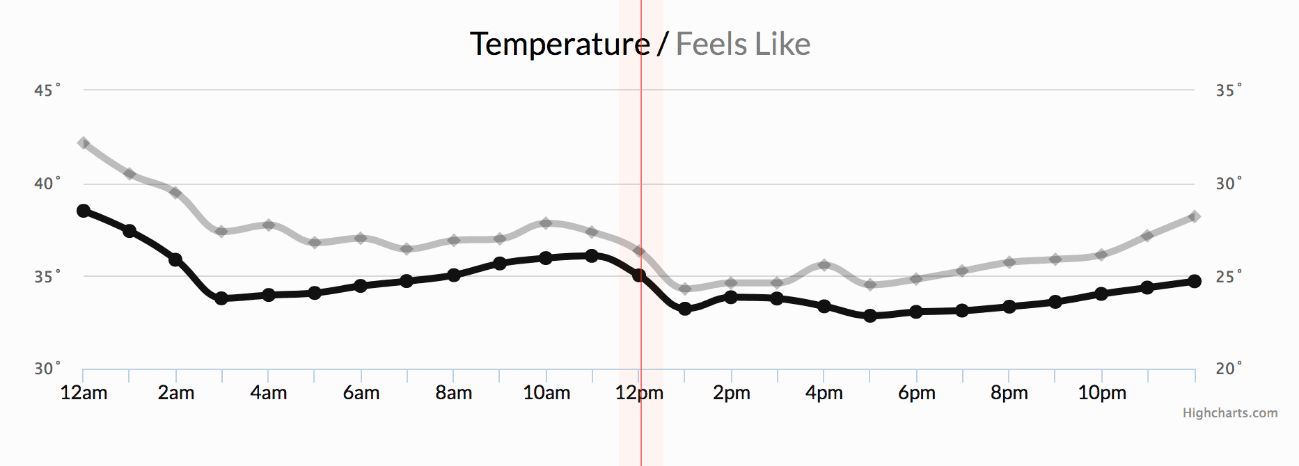
Example of time series: temperature records.

Example of time series: temperature records.

Example of time series: stock price evolution.

Example of time series: stock price evolution.

Example of time series: health monitoring records.

Example of time series: health monitoring records.

The concept and applications of time series have become so important, that several tech giants had taken the lead by developing state of the art solutions to ingest, process and analyse them like never before:

  1. Prophet is open-source software released by Facebook’s Core Data Science team. It’s used in many applications across Facebook for producing reliable forecasts for planning and goal setting, and it includes many possibilities for users to tweak and adjust forecasts. The solution is robust to outliers, missing data, and dramatic changes in the time series.
  2. Amazon Forecast is a fully managed service that uses Machine Learning to deliver highly accurate forecasts based on the same technology that powers Amazon.com. It builds precise forecasts for virtually any business condition, including cash flow projections, product demand and sales, infrastructure requirements, energy needs, and staffing levels.
  3. Uber’s Forecasting Platform team created Omphalos, which is a time series back testing framework that generates efficient and accurate comparisons of forecasting models across languages and streamlines the model development process, thereby improving the customer experience.
  4. SAP Analytics Cloud offers an automatic time series forecasting solution to perform advanced statistical analysis and generate forecasts by analyzing trends, fluctuations and seasonality. The algorithm works by analyzing the historical data to identify the existing patterns in the data and then using those patterns, projects the future values.

Time Series is Different

The “time component” in a time series provides an internal structure that must be accounted for, which makes it very different to any other data type, and sometimes more difficult to handle than traditional datasets.

This is the main difference with sequential data, where the order of the data matters, but the timestamp is irrelevant or doesn’t matter (as in the case of a DNA sequence, where the sequence is important but the concept of time is irrelevant).

This means that, unlike other Machine Learning challenges, you can’t just plug in an algorithm at a time series dataset and expect to have a proper result. Time series data can be transformed into supervised learning problems, but the key step is to consider their temporal structure like trends, seasonality, and forecast horizon.

Since there are so many prediction problems that involve time series, first we need to understand their main components.

Anatomy of Time Series

Unlike other data types, time series have a strong identity on their own. This means that we can’t use the usual strategies to analyze and predict them, since traditional analytical tools fail at capturing their temporal component.

A good way to get a feel of how a time series pattern behaves is to break the time series into its many distinct components. The decomposition of a time series is a task that deconstructs a time series into several pieces, each representing one of the underlying categories of the pattern. Time series decomposition is built on the assumption that data arises as the result of the combination of some underlying components:

  • Base Level: This represents the average value in the series.
  • Trend: is observed when there is a sustained increasing or decreasing slope observed in the time series.
  • Seasonality: Occurs when there is a distinct repeated pattern observed between regular intervals due to seasonal factors, whether it is the month of the year, the day of the month, weekdays, or even times of the day. For example, retail stores sales will be high during weekends and festival seasons.
  • Error: The random variation in the series.

All series have a base level and error, while the trend and seasonality may or may not exist. This way, a time series may be imagined as a combination of the base level, trend, seasonality, and error terms.

Another aspect to consider is cyclic behavior. This happens when the rise and fall pattern in the series does not happen in fixed calendar-based intervals, like increases in retail sales that occur around December in response to Christmas or increases in water consumption in summer due to warmer weather.

Care should be taken to not confuse the ‘cyclic’ effect with the ‘seasonal’ effect. So, how to differentiate between a ‘cyclic’ vs ‘seasonal’ pattern?

If patterns are not of fixed calendar-based frequencies, then it is cyclic. Because, unlike seasonality, cyclic effects are typically influenced by the business and other socio-economic factors.
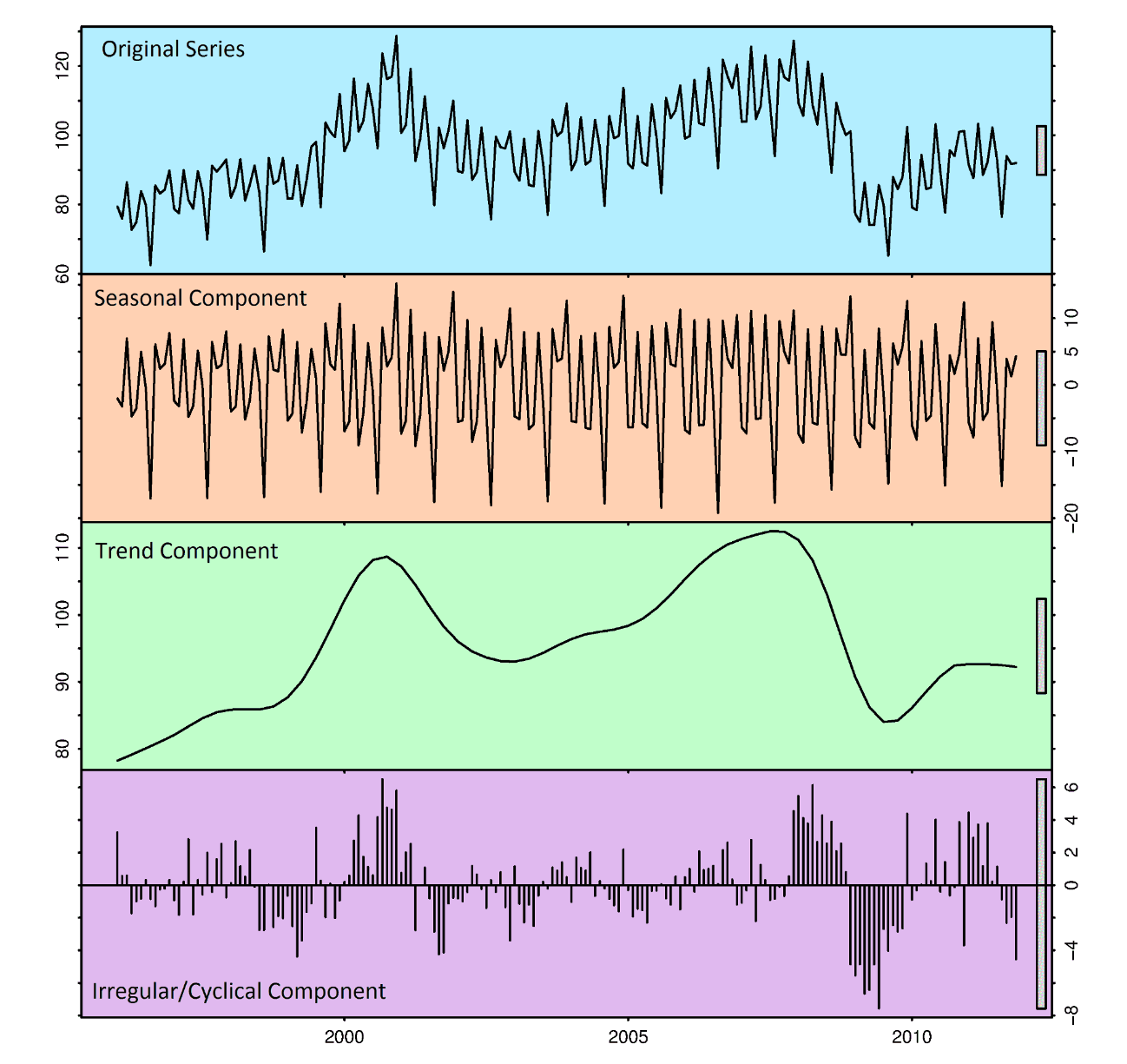
Time series components

A number of components can be extracted from a time series: Seasonality, Trend, Cycle and Error (Irregular).

Forecasting

What if besides analyzing a time series, we could predict it? Forecasting is the process of predicting future behaviors based on current and past data.

A time series represents the relationship between two variables: time is one of them, and the measured value is the second one. From a statistical point of view, we can think of the value we want to forecast as a “random variable”.

A random variable is a variable that is subject to random variations so it can take on multiple different values, each with an associated probability.

A random variable doesn’t have a specific value, but rather a collection of potential values. After a measurement is taken and the specific value is revealed, then the random variable ceases to be a random variable and becomes data.

The set of values that this random variable could take, along with their relative probabilities, is known as the “probability distribution”. When forecasting, we call this the forecast distribution. This way, when referring to the “forecast,” we usually mean the average value of the forecast distribution.
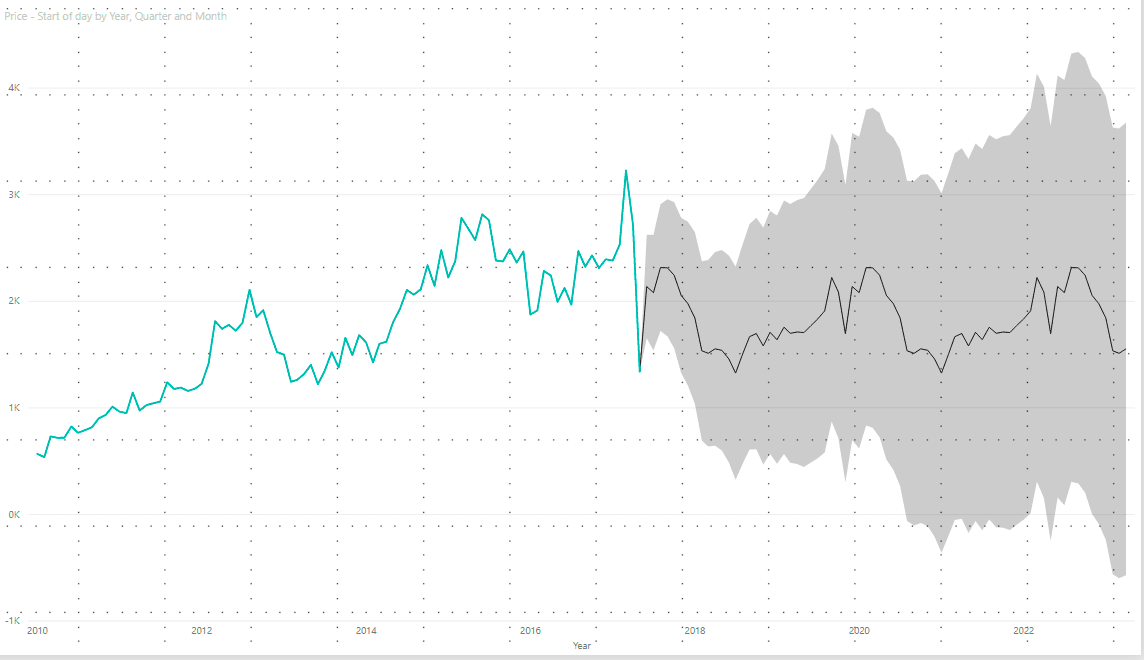
Time series forecast

A forecast example: the black line after the real data (in green) represents the forecasted value, and the shaded grey area the confidence interval of the forecast.

The example on the image above highlights the importance of considering uncertainty. Can we assure how the future will unfold? Of course not, and for this reason it’s important to define prediction intervals (lower and upper boundaries) in which the forecast value is expected to fall.

Statistical time series methods have dominated the forecasting landscape because they are heavily studied and understood, robust, and effective on many problems. Some popular examples of these are ARIMA (autoregressive integrated moving average), Exponential Smoothing methods such as Holt-Winters, and Theta.

However, recent impressive results of Machine Learning methods on time series forecasting tasks triggered a big shift towards these types of models. The year 2018 marked a crucial year when the M4 forecasting competition was won for the first time with a model using Machine Learning techniques. Using this kind of approach, models are able to extract patterns not just from a single time series, but from collections of them. Machine Learning models like Artificial Neural Networks can ingest multiple time series and produce tremendous performances. Nevertheless, these models are “black boxes” that become challenging when interpretability is required.

Decomposing a time series into its different elements allows us to perform unbiased forecasting and brings insights into what might happen in the future. Forecasting is a key activity through different industries and sectors, and those who get it right have a competitive advantage over those who don’t.

By now it becomes clear that we need more than standard techniques to deal with time series. Time series embeddings represent a novel way to uncover insights and perform Machine Learning tasks.

Embeddings to the Rescue

Distance measurement between data examples is a key component of many classification, regression, clustering, and anomaly detection algorithms for time series. For this reason, it’s critical to develop time series representations that can be used to improve the results over these tasks.

Time series embeddings are a representation of time data in the form of vector embeddings that can be used by different models, improving their performance. Vector embeddings are well known and pretty successful in domains like Natural Language Processing and Graphs, but uncommon within time series. Why? Because time series can be challenging to vectorize. Sequential data elude a straightforward definition of similarity because of the necessity of alignment between examples, but time series similarity is also dependent on the task at hand, further complicating the matter.

Fortunately, there are methods that make time-series vectorization a straightforward process. For example, Time2Vec serves as a vector representation for time series that can be used by many models and Artificial Neural Networks architectures like Long Short Term Memory (LSTM), which excel at time series challenges. Time2Vec can be reproduced and used with Python.
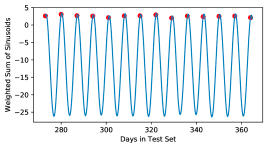
Time series embedding with time2vec

The red dots on the figure represent multiples of 7. In this example, it can be observed that Time2Vec successfully learns the correct period of the time series and oscillates every 7 days. The phase-shifts have been learned in a way that all multiples of 7 are placed on the positive peaks of the signal to facilitate separating them from the other days.

Once your time series are vectorized, you can use Pinecone to store and search for them in an easy-to-use and efficient environment. Check out this example showing how to perform time-series “pattern” matching to find out the most similar stock trends.