
惯性聚合 高效追踪和阅读你感兴趣的博客、新闻、科技资讯
阅读原文 在惯性聚合中打开

推荐订阅源

量子位
cs.AI updates on arXiv.org
F
Fortinet All Blogs
博客园 - 聂微东
奇客Solidot–传递最新科技情报
奇客Solidot–传递最新科技情报
Hugging Face - Blog
Hugging Face - Blog
V
Visual Studio Blog
小众软件
小众软件
有赞技术团队
有赞技术团队
雷峰网
雷峰网
钛媒体:引领未来商业与生活新知
钛媒体:引领未来商业与生活新知
AWS News Blog
AWS News Blog
C
Cisco Blogs
美团技术团队
T
Threat Research - Cisco Blogs
C
CERT Recently Published Vulnerability Notes
人人都是产品经理
人人都是产品经理
宝玉的分享
宝玉的分享
Threat Intelligence Blog | Flashpoint
酷 壳 – CoolShell
酷 壳 – CoolShell
Stack Overflow Blog
Stack Overflow Blog
W
WeLiveSecurity
D
DataBreaches.Net
博客园 - 司徒正美
Blog — PlanetScale
Blog — PlanetScale
IT之家
IT之家
云风的 BLOG
云风的 BLOG
Cyber Security Advisories - MS-ISAC
Simon Willison's Weblog
Google DeepMind News
T
The Blog of Author Tim Ferriss
Know Your Adversary
Know Your Adversary
NISL@THU
NISL@THU
OSCHINA 社区最新新闻
OSCHINA 社区最新新闻
The Cloudflare Blog
Vercel News
Vercel News
月光博客
月光博客
T
Tailwind CSS Blog
H
Help Net Security
aimingoo的专栏
aimingoo的专栏
P
Proofpoint News Feed
Application and Cybersecurity Blog
Spread Privacy
Spread Privacy
cs.CL updates on arXiv.org
Cisco Talos Blog
Cisco Talos Blog
Microsoft Security Blog
V
V2EX
WordPress大学
WordPress大学
Cyberwarzone
Cyberwarzone
Recent Announcements

Pinecone

Pinecone Assistant: A Managed Knowledge Layer for Production AI Applications Allspice Transforms the Culinary Experience with Semantic Search Powered by Pinecone | Pinecone Building RAG workflows in n8n: choosing the right Pinecone node Knowledge needs a meta-knowledge layer Garbage Day: How Pinecone Safely Deletes Billions of Objects at Scale When "Performance" Means Two Different Things Pinecone BYOC: Pinecone in your AWS, GCP, or Azure account, no vendor access True, Relevant, and Wrong: The Applicability Problem in RAG Use the Pinecone Plugin for Claude Code to develop AI Applications Faster Millions at Stake: How Melange's High-Recall Retrieval Prevents Litigation Collapse Powering High-stakes Patent Search at Scale: How Melange Built a Reliable AI System on Pinecone | Pinecone Pinecone Assistant Node in n8n: Turn Any Data Source Into Knowledge RAG with Access Control Pinecone Dedicated Read Nodes are now in Public Preview Inside Pinecone: Slab Architecture New Bulk Data Operations: Update, Delete, and Fetch by Metadata The Hidden Cost of Building: Lessons from Aquant Simplifying Vector Embeddings with Pinecone Integrated Inference Capabilities Pinecone joins Microsoft Marketplace as a Launch Partner GTM Engineering: Clay + Pinecone for AI-powered Sales Outbound Build an AI knowledge assistant with Google Docs and Pinecone Moving Pinecone forward with Ash Ashutosh as CEO and Edo spearheading our growing AI ambitions as Chief Scientist Pinecone Founder Edo Liberty to Spearhead Pinecone’s Growing AI Ambitions; Appoints Ash Ashutosh as CEO to Expand Vector Database Market Leadership Fast, Accurate Retrieval for Creators at Scale: Delphi’s Path Toward a Million Conversational Agents with Pinecone | Pinecone Announcing Pinecone Pioneers: A Program for Builders, Organizers, and Community Leaders What is Context Engineering? Chunking Strategies for LLM Applications Beyond the hype: Why RAG remains essential for modern AI Obviant Makes 30% More Accurate Defense Acquisition Recommendations Combining Sparse and Dense Retrieval with Pinecone | Pinecone Build more knowledgeable AI applications with new LLMs and greater control in Pinecone Assistant #NYTECHWEEK 2025 Retrieval-Augmented Generation (RAG) Accurate and Efficient Metadata Filtering in Pinecone’s Serverless Vector Database | Pinecone Terminal X AI Agents, Powered by Pinecone, Turn Complex Financial Data Into Production-grade Insights at Scale | Pinecone Aquant Delivers Scalable, Expert-level Service Intelligence with Pinecone | Pinecone Cascading retrieval with multi-vector representations: balancing efficiency and effectiveness Vector databases aren't just for large-scale enterprise AI Unveiling DIME: Reproducibility, Scalability, and Formal Analysis of Dimension Importance Estimation for Dense Retrieval | Pinecone Fast and Effective Early Termination for Simple Ranking Functions | Pinecone Domain-specific AI Agents at Scale: CustomGPT.ai Serves 10,000+ Customers with Pinecone | Pinecone Using Pinecone asynchronously with FastAPI A Flexible Resource for Top-Weighted Comparisons Between Sets and Rankings | Pinecone Build secure, scalable agentic AI workflows with Rubrik Annapurna and Pinecone Tool up: Pinecone’s first MCP servers are here Add context to your agent with Pinecone Assistant MCP remote server E2Rank: Efficient and Effective Layer-wise Reranking | Pinecone ColBERT-serve: Efficient Multi-Stage Memory-Mapped Scoring | Pinecone Efficient Constant-Space Multi-Vector Retrieval | Pinecone How Vanguard Worked with Pinecone to Boost Customer Support with Faster Calls and 12% More Accurate Responses | Pinecone Pinecone Named to Fast Company's Annual List of the World's Most Innovative Companies of 2025 Launch Week: Pinecone for agents, search, recommendations, and more Optimizing Pinecone for agents (and more) Retrieval Inference for scale and performance How 1up Turns Sales Reps Into Product Experts with Pinecone | Pinecone Don’t be dense: Launching sparse indexes in Pinecone Unlock High-Precision Keyword Search with pinecone-sparse-english-v0 Evolving Pinecone's architecture to meet the demands of Knowledgeable AI Pinpoint references faster with citation highlights in Pinecone Assistant Bringing the leading vector database to your cloud Getting started with llama-text-embed-v2 Natural Language Counterfactual Explanations for Graphs Using Large Language Models | Pinecone Easily build knowledgeable chat and agent-based applications in minutes with Pinecone Assistant, now generally available How to build an agentic, chat or RAG knowledge system using Pinecone Assistant Real-time RAG with Pinecone and Estuary Flow BigQuery to Pinecone in Real-Time with Estuary Flow Stravito Turns Market and Consumer Data Into Actionable Insights with Pinecone Inference | Pinecone Accelerate prototyping and development with Pinecone Local First-of-its-kind Pinecone Knowledge Platform to Power Best-in-class Retrieval for Customers Introducing integrated inference: Embed, rerank, and retrieve your data with a single API Strengthening security and increasing control with CMEK and API key roles Introducing Pinecone Rerank V0 Introducing cascading retrieval: Unifying dense and sparse with reranking From Idea to Action: How Pinecone Assistant Meaningfully Accelerates AI Business Building AI apps on Azure with Pinecone just got a lot easier Building a reliable, curated, and accurate RAG system with Cleanlab and Pinecone Four features of the Assistant API you aren't using - but should Deploying Pinecone with Infrastructure as Code (IaC) Streamlining CI/CD with Pinecone Local September 2024 Product Update Results of the Big ANN: NeurIPS'23 competition | Pinecone Introducing import from object storage for more efficient data transfer to Pinecone serverless Simplify, enhance, and evaluate RAG development with Pinecone Assistant, now in public preview Vectors and Graphs: Better Together August 2024 Product Update Pinecone Helps Deep Talk Deliver World-Class AI Assistants with Lower Engineering Overhead | Pinecone Assembled Delivers Better, Faster AI- Driven Support with Pinecone | Pinecone Llama 3.1 Agent using LangGraph and Ollama Build knowledgeable AI with Pinecone serverless, now generally available on Microsoft Azure Pinecone serverless is now generally available on Google Cloud, adding knowledge to AI assistants and other applications Accelerating Legal Discovery and Analysis with Pinecone and Voyage AI Bridging Dense and Sparse Maximum Inner Product Search | Pinecone Refine Retrieval Quality with Pinecone Rerank Introducing reranking to Pinecone Inference to simplify building accurate AI July 2024 Product Update Connect to Pinecone within your platform to enable a seamless AI development experience Introducing Pinecone API Versioning RAG Brag with Inkeep Co-Founder Nick Gomez LangGraph and Research Agents Introducing Pinecone Inference to streamline your AI workflow Build Privacy-aware AI software using Pinecone
Multi-domain RAG in n8n: why one knowledge base is not enough
Jenna Pederson · 2026-03-28 · via Pinecone

Special offer for n8n users: Build with the Assistant node before May 1, 2026 to get a discount when upgrading to Pinecone's Standard plan. Add the Pinecone Assistant node and connect to Pinecone in n8n to claim this offer.

When you're building a RAG (retrieval-augmented generation) workflow in n8n, the first instinct is usually to point everything at one knowledge base and let retrieval sort it out. For small, uniform datasets, that works. But once your knowledge base starts covering meaningfully different domains—different clients, different products, different locations, different teams—that single knowledge base starts working against you.

Here's the problem: context pollution. When a guest at a vacation rental asks "how do I turn on the heat?", they shouldn't be getting answers pulled from a different property's HVAC documentation. But when all your property guides live in one knowledge base, that's exactly what can happen. The knowledge base doesn't know which property the guest is staying at—it just finds what's semantically close and returns it. For a property manager, a guest getting the wrong HVAC instructions means a support call, a bad review, or no rebooking. At scale, that's not a UX problem—it's a revenue and trust problem. And for teams managing dozens of domains, a single polluted knowledge base becomes a debugging nightmare that slows every update.

The fix is the same instinct that makes us separate spreadsheet data into tabs: different domains need different contexts.

The architecture

Instead of one knowledge base serving all queries, you maintain one specialized knowledge base per domain and add a routing layer that maps incoming queries to the right one before retrieval happens.

For the vacation rental scenario I've been using as a demo—managing requests for multiple rental properties—the n8n workflow has two main paths:

  • A file upload path: A Google Drive Trigger watches for new files in each property's folder. When a file is added, a Google Drive node downloads it, and the Pinecone Assistant node uploads it to that property's dedicated Pinecone Assistant.
  • A chat path: A Chat Trigger feeds into an AI Agent node, which reads the guest's message, determines which property they're asking about, and routes to the correct Pinecone Assistant Tool node.

As shown in the visual below, the result is three separate Pinecone Assistants—one each for lakeside, birchwood, and hillcrest—each containing only the documentation for that property.
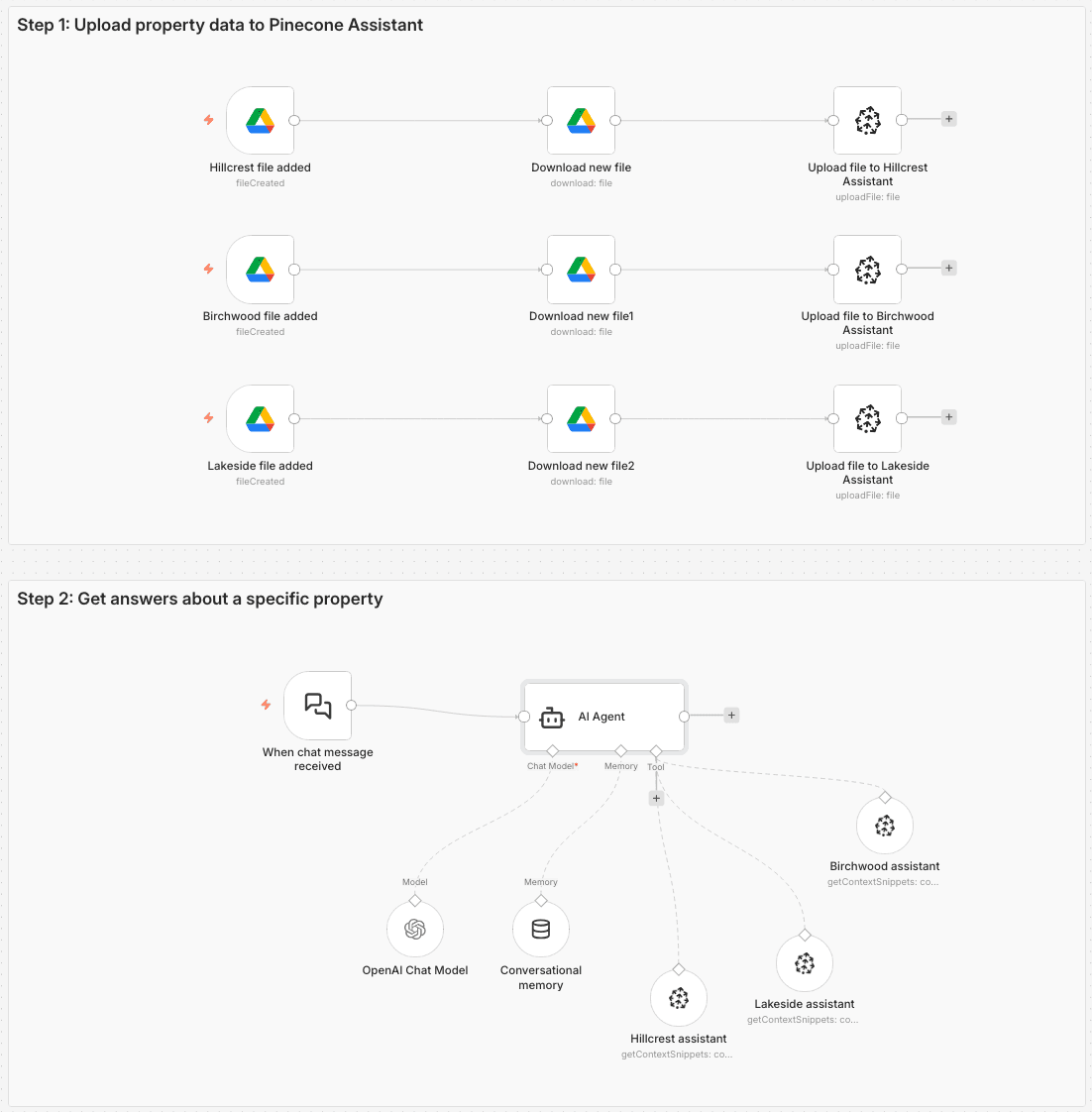
n8n workflow with upload path from Google Drive to 3 different Assistants and a chat path routing a guest message to the correct Assistant.

Where the Pinecone Assistant node fits in

The Pinecone Assistant node in n8n is doing more work than it might look like. Under the hood, Pinecone Assistant handles chunking your documents with a sensible chunking strategy, converting those chunks into vector embeddings, executing the semantic search, and re-ranking results before returning them.

We could also use the Pinecone Vector Store node here with namespaces or even metadata filtering, but it brings added complexity in this scenario. While we’d have complete control over every component, we’d have more decisions to make and have to manage 5+ nodes (vector store, embedding model, data loader, text splitter, reranker) and additional API keys. Separate Assistants give you complete context isolation and cleaner debugging.

What this means practically is that the n8n workflow gets to focus on the routing logic—which is the actually interesting problem—rather than on wiring up chunking, embedding models, and re-ranking steps separately.

Why domain separation changes retrieval quality

Accuracy

When all your knowledge lives in one assistant, "How do I reset the thermostat?" might pull answers from three different properties. The correct answer for Lakeside may be completely wrong for Hillcrest. Giving each domain its own Pinecone Assistant means every result is at least from the right context. Fewer wrong answers means less time spent on support escalations and a higher trust signal for end users.

Maintainability

With a single shared knowledge base, debugging a bad answer means understanding how every document in the entire knowledge base might be interfering. With domain-specific assistants, you can test, update, and debug each one independently. Change the wifi password for one property without worrying about effects on the others. This reduces debugging time and limits the blast radius to exactly what changed.

Scalability

The pattern that works for three properties works for thirty. Adding a fourth property means creating a new Pinecone Assistant, uploading its documents, and adding one routing condition to the AI Agent node. You don't touch anything else.

The routing layer matters more than you'd think

The quality of your routing logic has an outsized effect on the whole system. If the AI Agent node misidentifies the domain—or worse, can't decide and blends results from multiple assistants—you lose most of the benefit of domain separation.

We also can’t rely on the guest always including their property name because they don’t know that this system serves guests at multiple properties.

The system message I landed on makes the routing decision explicit and gives the agent a clear fallback: if the property isn't inferable from the message, ask. Don't guess. Don't default to the most recently mentioned property. Ask.

Here’s the system message:

You are a helpful assistant for a vacation rental property manager and their guests. Based on the user's message, decide if they are requesting information about the "hillcrest", "birchwood", "lakeside" property. You route requests based on property name to the appropriate pinecone assistant tool to fetch answers about the property.

If you cannot infer the property from the user's message, do not call any tools and instead ask for more information in the chat.

If the person requests to be contacted, do not call any tools and instead return a response indicating that someone will reach out to them.

Use a friendly, helpful tone.

Bonus: add a confidence check before routing. One step further: you can add a lightweight confidence check before routing happens at all. Use a Basic LLM Chain node to evaluate the incoming message and return a structured confidence score — essentially asking the model to rate how clearly the message maps to a known domain. Then feed that score into an If or Switch node: if confidence is high enough, route to the appropriate Pinecone Assistant Tool node as normal; if it's too low, short-circuit to a clarifying response before any retrieval happens. It's a cheap gate that prevents a whole class of bad retrievals before they start.

Adapting the pattern

The vacation rental scenario is a stand-in for any workflow where you have meaningfully different knowledge domains:

  • Franchise locations (each location gets its own Pinecone Assistant)
  • Client accounts in an agency context (client A's docs stay in client A's assistant)
  • Support tiers (enterprise documentation doesn't pollute SMB tier answers)
  • Internal teams (runbooks, HR policies, and sales playbooks shouldn't share a knowledge base)
  • Multi-tenant applications (each end-user or customer gets their own assistant so one tenant's data is never retrievable by another)

The signal that you need domain separation: when a wrong answer can be explained by "it pulled from the wrong part of the knowledge base," and that part is logically unrelated to the question.

The full n8n workflow

The n8n workflow template for the vacation rental implementation is available here. It includes the full file upload path (Google Drive Trigger → Google Drive node → Pinecone Assistant node) and the chat path (Chat Trigger → AI Agent node → Pinecone Assistant Tool nodes → response).

To adapt it, the main things to change are the routing conditions in the AI Agent's system message and the number of domain-specific Pinecone Assistant Tool nodes. The rest of the structure stays the same.

Wrap up

RAG isn't a monolithic system—it's a pattern you can shape to match how your data is actually organized. If your knowledge base covers multiple distinct domains, separating them into dedicated Pinecone Assistants and routing queries to the right one before retrieval is a straightforward way to improve accuracy, make debugging easier, and keep scaling manageable. The n8n workflow template gives you a working starting point; the routing logic is the main thing to make your own. The payoff: guests get the right answer for their property, every time—and you can debug, update, or scale any one domain without touching the rest.

You can find the rest of our n8n resources here: