



惯性聚合 高效追踪和阅读你感兴趣的博客、新闻、科技资讯
阅读原文 在惯性聚合中打开

推荐订阅源

S
Schneier on Security
博客园_首页
量子位
博客园 - 司徒正美
S
SegmentFault 最新的问题
J
Java Code Geeks
小众软件
小众软件
博客园 - 【当耐特】
The Register - Security
让小产品的独立变现更简单 - ezindie.com
Microsoft Azure Blog
G
Google Developers Blog
Blog — PlanetScale
Blog — PlanetScale
T
Tailwind CSS Blog
博客园 - Franky
cs.AI updates on arXiv.org
G
GRAHAM CLULEY
Cyberwarzone
Cyberwarzone
腾讯CDC
Apple Machine Learning Research
V
Visual Studio Blog
钛媒体:引领未来商业与生活新知
钛媒体:引领未来商业与生活新知
The Hacker News
The Hacker News
aimingoo的专栏
aimingoo的专栏
V
Vulnerabilities – Threatpost
P
Palo Alto Networks Blog
Scott Helme
Scott Helme
L
LINUX DO - 热门话题
F
Full Disclosure
D
DataBreaches.Net
Martin Fowler
Martin Fowler
Cisco Talos Blog
Cisco Talos Blog
L
LINUX DO - 最新话题
云风的 BLOG
云风的 BLOG
C
Check Point Blog
T
Threatpost
Google DeepMind News
WordPress大学
WordPress大学
W
WeLiveSecurity
K
KPMG report finds enterprise disconnect between AI and its ROI | CIO
有赞技术团队
有赞技术团队
Hugging Face - Blog
Hugging Face - Blog
freeCodeCamp Programming Tutorials: Python, JavaScript, Git & More
L
Lohrmann on Cybersecurity
Last Week in AI
Last Week in AI
T
Tor Project blog
T
Troy Hunt's Blog
OSCHINA 社区最新新闻
OSCHINA 社区最新新闻
S
Security Affairs
SecWiki News
SecWiki News

Pinecone

Pinecone Assistant: A Managed Knowledge Layer for Production AI Applications Multi-domain RAG in n8n: why one knowledge base is not enough Allspice Transforms the Culinary Experience with Semantic Search Powered by Pinecone | Pinecone Building RAG workflows in n8n: choosing the right Pinecone node Knowledge needs a meta-knowledge layer When "Performance" Means Two Different Things Pinecone BYOC: Pinecone in your AWS, GCP, or Azure account, no vendor access True, Relevant, and Wrong: The Applicability Problem in RAG Use the Pinecone Plugin for Claude Code to develop AI Applications Faster Millions at Stake: How Melange's High-Recall Retrieval Prevents Litigation Collapse Powering High-stakes Patent Search at Scale: How Melange Built a Reliable AI System on Pinecone | Pinecone Pinecone Assistant Node in n8n: Turn Any Data Source Into Knowledge RAG with Access Control Pinecone Dedicated Read Nodes are now in Public Preview Inside Pinecone: Slab Architecture New Bulk Data Operations: Update, Delete, and Fetch by Metadata The Hidden Cost of Building: Lessons from Aquant Simplifying Vector Embeddings with Pinecone Integrated Inference Capabilities Pinecone joins Microsoft Marketplace as a Launch Partner GTM Engineering: Clay + Pinecone for AI-powered Sales Outbound Build an AI knowledge assistant with Google Docs and Pinecone Moving Pinecone forward with Ash Ashutosh as CEO and Edo spearheading our growing AI ambitions as Chief Scientist Pinecone Founder Edo Liberty to Spearhead Pinecone’s Growing AI Ambitions; Appoints Ash Ashutosh as CEO to Expand Vector Database Market Leadership Fast, Accurate Retrieval for Creators at Scale: Delphi’s Path Toward a Million Conversational Agents with Pinecone | Pinecone Announcing Pinecone Pioneers: A Program for Builders, Organizers, and Community Leaders What is Context Engineering? Chunking Strategies for LLM Applications Beyond the hype: Why RAG remains essential for modern AI Obviant Makes 30% More Accurate Defense Acquisition Recommendations Combining Sparse and Dense Retrieval with Pinecone | Pinecone Build more knowledgeable AI applications with new LLMs and greater control in Pinecone Assistant #NYTECHWEEK 2025 Retrieval-Augmented Generation (RAG) Accurate and Efficient Metadata Filtering in Pinecone’s Serverless Vector Database | Pinecone Terminal X AI Agents, Powered by Pinecone, Turn Complex Financial Data Into Production-grade Insights at Scale | Pinecone Aquant Delivers Scalable, Expert-level Service Intelligence with Pinecone | Pinecone Cascading retrieval with multi-vector representations: balancing efficiency and effectiveness Vector databases aren't just for large-scale enterprise AI Unveiling DIME: Reproducibility, Scalability, and Formal Analysis of Dimension Importance Estimation for Dense Retrieval | Pinecone Fast and Effective Early Termination for Simple Ranking Functions | Pinecone Domain-specific AI Agents at Scale: CustomGPT.ai Serves 10,000+ Customers with Pinecone | Pinecone Using Pinecone asynchronously with FastAPI A Flexible Resource for Top-Weighted Comparisons Between Sets and Rankings | Pinecone Build secure, scalable agentic AI workflows with Rubrik Annapurna and Pinecone Tool up: Pinecone’s first MCP servers are here Add context to your agent with Pinecone Assistant MCP remote server E2Rank: Efficient and Effective Layer-wise Reranking | Pinecone ColBERT-serve: Efficient Multi-Stage Memory-Mapped Scoring | Pinecone Efficient Constant-Space Multi-Vector Retrieval | Pinecone How Vanguard Worked with Pinecone to Boost Customer Support with Faster Calls and 12% More Accurate Responses | Pinecone Pinecone Named to Fast Company's Annual List of the World's Most Innovative Companies of 2025 Launch Week: Pinecone for agents, search, recommendations, and more Optimizing Pinecone for agents (and more) Retrieval Inference for scale and performance How 1up Turns Sales Reps Into Product Experts with Pinecone | Pinecone Don’t be dense: Launching sparse indexes in Pinecone Unlock High-Precision Keyword Search with pinecone-sparse-english-v0 Evolving Pinecone's architecture to meet the demands of Knowledgeable AI Pinpoint references faster with citation highlights in Pinecone Assistant Bringing the leading vector database to your cloud Getting started with llama-text-embed-v2 Natural Language Counterfactual Explanations for Graphs Using Large Language Models | Pinecone Easily build knowledgeable chat and agent-based applications in minutes with Pinecone Assistant, now generally available How to build an agentic, chat or RAG knowledge system using Pinecone Assistant Real-time RAG with Pinecone and Estuary Flow BigQuery to Pinecone in Real-Time with Estuary Flow Stravito Turns Market and Consumer Data Into Actionable Insights with Pinecone Inference | Pinecone Accelerate prototyping and development with Pinecone Local First-of-its-kind Pinecone Knowledge Platform to Power Best-in-class Retrieval for Customers Introducing integrated inference: Embed, rerank, and retrieve your data with a single API Strengthening security and increasing control with CMEK and API key roles Introducing Pinecone Rerank V0 Introducing cascading retrieval: Unifying dense and sparse with reranking From Idea to Action: How Pinecone Assistant Meaningfully Accelerates AI Business Building AI apps on Azure with Pinecone just got a lot easier Building a reliable, curated, and accurate RAG system with Cleanlab and Pinecone Four features of the Assistant API you aren't using - but should Deploying Pinecone with Infrastructure as Code (IaC) Streamlining CI/CD with Pinecone Local September 2024 Product Update Results of the Big ANN: NeurIPS'23 competition | Pinecone Introducing import from object storage for more efficient data transfer to Pinecone serverless Simplify, enhance, and evaluate RAG development with Pinecone Assistant, now in public preview Vectors and Graphs: Better Together August 2024 Product Update Pinecone Helps Deep Talk Deliver World-Class AI Assistants with Lower Engineering Overhead | Pinecone Assembled Delivers Better, Faster AI- Driven Support with Pinecone | Pinecone Llama 3.1 Agent using LangGraph and Ollama Build knowledgeable AI with Pinecone serverless, now generally available on Microsoft Azure Pinecone serverless is now generally available on Google Cloud, adding knowledge to AI assistants and other applications Accelerating Legal Discovery and Analysis with Pinecone and Voyage AI Bridging Dense and Sparse Maximum Inner Product Search | Pinecone Refine Retrieval Quality with Pinecone Rerank Introducing reranking to Pinecone Inference to simplify building accurate AI July 2024 Product Update Connect to Pinecone within your platform to enable a seamless AI development experience Introducing Pinecone API Versioning RAG Brag with Inkeep Co-Founder Nick Gomez LangGraph and Research Agents Introducing Pinecone Inference to streamline your AI workflow Build Privacy-aware AI software using Pinecone
Garbage Day: How Pinecone Safely Deletes Billions of Objects at Scale
Lea Wang-Tomic, Benny Nazimov, Hirad Pourtahmasbi · 2026-03-05 · via Pinecone

TLDR: Pinecone’s data plane utilizes immutable blob storage. Every write produces a new file rather than modifying an existing one. While this keeps the write path clean, it generates a constant stream of stale and orphaned objects that drive up storage costs. To solve this, we built Janitor: a system designed to identify unreachable objects, verify safety, and delete with full auditability.


Deleting data safely in a single-node database is easy. The principles are straightforward: do not delete anything that might still be referenced, verify before deletion, and keep an audit trail. But every team building on immutable storage eventually discovers the same thing: the data you no longer need becomes the problem you can't stop paying for.

In real-world systems, deletion gets hard at scale, because "delete" is rarely one operation. Instead, it's a long chain of services, caches, retries, and failure modes. At Pinecone, we learned this the expensive way. Our data plane is built on immutable objects in blob storage—a design that keeps the write path clean but creates a fundamental coordination problem. Because our writing nodes and reading nodes are separate, a writer cannot simply purge an old file the moment it's superseded; separate reading nodes may still be actively serving a live query from that exact object. This disconnect creates a steady stream of files that never go away on their own, which quietly became one of the largest line items in our infrastructure bill.

This is the deletion tax: the growing cost of data you no longer need but can't yet safely remove. Janitor is how we pay it down.
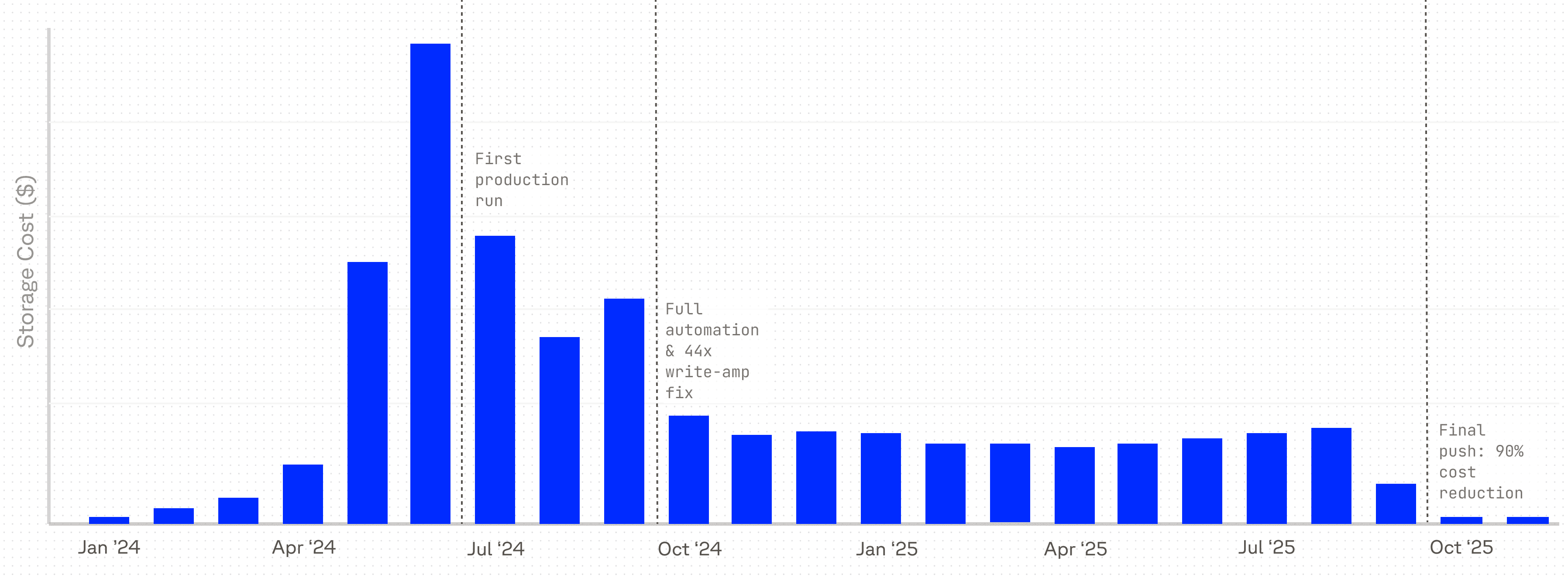
S3 Storage Costs Before and After Implementation of Janitor

Why immutability creates garbage

Immutability is an age-old principle in distributed systems and functional programming. It reduces whole classes of race conditions and makes recovery and audit-ability much simpler. Writes do not modify files in place. Instead, each write produces a new file and metadata is updated automatically with a Compare-and-Swap (CAS) operation to point to the latest state.

The tradeoff is waste. Old versions linger after every write. Worse, if a process crashes between writing a blob and committing its metadata, the file becomes an orphan — present in storage but invisible to every reference path in the system.

So why not just delete aggressively? Because of propagation lag. Different parts of the system (caches, routers, replicas) don't all update at the same time. References to old data can stick around longer than the data itself. Delete too early, and you trade storage costs for reliability problems.

The three deletion modes

Not all stale data is stale for the same reason, and not all of it carries the same risk when removed. Janitor treats "deletion" as three distinct problems, each with its own cadence and failure profile.

Normal mode handles the everyday accumulation. Files that have been superseded by newer writes and are no longer reachable from the manifest (the metadata structure that tracks which blob objects are currently live and which version of the data a query should see). Every system that uses immutable storage generates this kind of waste constantly.

  • Runs scoped cleanup every four hours per shard, with a broader weekly pass across all shards.
  • The main risk is timing: references to old blobs can linger in caches, so something might still be pointing to a file even after it's been logically replaced.

Orphan mode handles a harder problem. Normal mode cleans up files the system knows about but no longer needs. Orphan mode cleans up files the system doesn't know about at all, like blobs written by a service that crashed before committing metadata. No manifest entry, no reference path. Just a file sitting in storage, accumulating cost.

  • Runs as a monthly scan starting from blob storage itself, working backward to prove whether each object is reachable.
  • Required because orphans are invisible to normal operations by definition.

Customer deletion mode is the most operationally sensitive of the three. When a customer deletes an index or namespace, the expectation is that the data goes away, but "goes away" and "goes away immediately and irreversibly" are very different promises.

  • Inserts a deletion operation into the control plane with a resolution date 30 days out.
  • During that window, accidental deletes are recoverable. After it closes, the data is gone for good.

The core protocol: identify → verify → execute

Each mode identifies a different kind of waste. The protocol is what makes sure removing it is safe.

At scale, the important distinction is between hypothesis ("this looks deletable") and permission ("we are sure it is safe to delete"). Janitor's workflow is built around that separation, and it's intentionally conservative. Every run follows the same three phases, regardless of mode.

Identify. Compute a candidate set without deleting anything. The candidate set is just a hypothesis, nothing has been touched yet.

  • In normal mode, this means iterating through the entire manifest and its history to determine what is currently reachable versus what has aged out.
  • In orphan mode, the direction is reversed: start from blob storage, enumerate objects, and work backward to prove whether each one is reachable.
  • Either way, candidates are written to a local SQLite database. Persisting the hypothesis makes the process auditable and restartable. If Janitor crashes here, nothing is lost.

Verify. Recheck the hypothesis against a fresh view of the world. This is where the propagation lag between different parts of the system gets handled.

  • Recompute reachability and confirm every candidate is still safe to remove.
  • If any candidate intersects something currently reachable, the response is to delay or drop it.
  • If the world looks stale, Janitor waits. The cost of a false positive (deleting something live) is vastly higher than the cost of a false negative (keeping something dead around for another cycle), and the verification step is where that asymmetry is enforced.

Execute. Delete only what has been verified. At scale, processes get interrupted, so every run is built to be picked up cleanly if it stops halfway through.

  • Every deletion is treated as idempotent work that can be retried safely.
  • SQLite state tracks exactly what was targeted and what completed, so if a run dies halfway through, the next run knows where to resume.
  • Blob storage retention and restore tooling provide the practical recovery window underneath, but Janitor's checkpoints are what make it possible to investigate what happened, quantify impact, and drive restoration when things go wrong.

Testing month-long behavior in seconds

This is a bit of an aside, but it's arguably the most sophisticated part of the whole build and too interesting to leave out

Janitor's hardest bugs don't show up in a single run. They emerge from the interaction of repeated writes, rebuilds, partial failures, customer deletes, and scheduled cleanups layered on top of each other. Some of which play out over a 30-day window, but waiting a month to find out a test passed isn't an option.

To make that testable, Janitor uses property-based tests with a mock clock. Define a set of possible actions (writes, rebuilds, crashes, deletes, Janitor runs), generate hundreds of randomized sequences, run them through both the real implementation and a simplified reference model, and compare outcomes. The mock clock collapses days and months into sub-second tests. If the two models ever disagree, we have a reproducible bug in hand.

Lessons from Production

Safe deletion at scale comes from layering defenses — a second reachability check before anything is removed, durable checkpoints that make every run inspectable and restartable, and a testing strategy that compresses weeks of behavior into seconds. Before Janitor, deletion was a source of anxiety. Now it runs continuously in the background, cleans up reliably, and generates an audit trail, so when something unexpected happens, the path to understanding it is already there.

For customers, none of this should be visible, and that's the point. Queries don't fail because a file was deleted too early. Accidental index deletes are recoverable within a 30-day window. Storage costs stay predictable instead of silently climbing. Janitor is the kind of infrastructure that ensures the rest of the team doesn't have to think about garbage at all.