



惯性聚合 高效追踪和阅读你感兴趣的博客、新闻、科技资讯
阅读原文 在惯性聚合中打开

推荐订阅源

T
Tenable Blog
Last Week in AI
Last Week in AI
P
Proofpoint News Feed
Engineering at Meta
Engineering at Meta
H
Help Net Security
F
Fortinet All Blogs
MyScale Blog
MyScale Blog
宝玉的分享
宝玉的分享
让小产品的独立变现更简单 - ezindie.com
博客园 - 司徒正美
量子位
N
Netflix TechBlog - Medium
Apple Machine Learning Research
小众软件
小众软件
Recorded Future
Recorded Future
博客园 - 三生石上(FineUI控件)
Vercel News
Vercel News
aimingoo的专栏
aimingoo的专栏
I
InfoQ
Microsoft Security Blog
Scott Helme
Scott Helme
The Last Watchdog
The Last Watchdog
cs.AI updates on arXiv.org
IT之家
IT之家
AI
AI
WordPress大学
WordPress大学
Security Archives - TechRepublic
Google Online Security Blog
U
Unit 42
V2EX - 技术
V2EX - 技术
MongoDB | Blog
MongoDB | Blog
Schneier on Security
博客园 - Franky
H
Heimdal Security Blog
奇客Solidot–传递最新科技情报
奇客Solidot–传递最新科技情报
Jina AI
Jina AI
W
WeLiveSecurity
P
Privacy & Cybersecurity Law Blog
Cloudbric
Cloudbric
B
Blog RSS Feed
N
News | PayPal Newsroom
S
Securelist
Threat Intelligence Blog | Flashpoint
I
Intezer
Hacker News - Newest:
Hacker News - Newest: "LLM"
CTFtime.org: upcoming CTF events
博客园_首页
罗磊的独立博客
H
Hackread – Cybersecurity News, Data Breaches, AI and More
雷峰网
雷峰网

CERN & Society Foundation

Arts at CERN announces the artists for the 2026 Connect India residency – CERN & Society Foundation Beamline for Schools 2026 winners announced – CERN & Society Foundation a non-Member State PhD student working on the LHCb collaboration – CERN & Society Foundation teacher training programme wraps up with excellent results – CERN & Society Foundation Arts at CERN and Nobel Prize Museum announce the Collide Stockholm international residency award recipient – CERN & Society Foundation If the future doesn’t exist, create it – CERN & Society Foundation CERN-MEDICIS update – CERN & Society Foundation Back with a bang! CERN Festival Programme 2026 – CERN & Society Foundation Women in Science March Forward – CERN & Society Foundation New era for the CERN and Society Foundation Board – CERN & Society Foundation Arts at CERN announces selection for Resonance residency – CERN & Society Foundation
Time to create impact with TIMEPIX@school – CERN & Society Foundation
Hannah Gabri · 2026-05-04 · via CERN & Society Foundation

LinkedIn Newsletter: Time to create impact with TIMEPIX@school

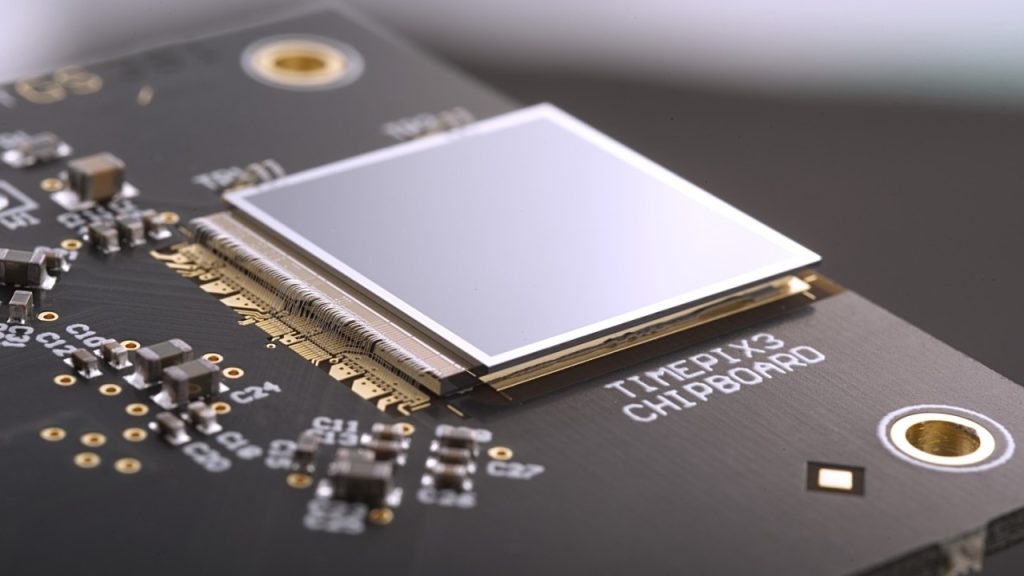
The Timepix3 chip developed at CERN and silicon wafer | Photograph: Maximilien, Brice

“I used the Minipix detector two years ago in a physics project in which I studied the relation between the absorption of alpha radiation and the pressure of the chamber. This helped me a lot to decide what I wanted to study because it made me realise how real physics works and how a real physics lab is and now it is what I am studying.”

Claudia

Spring is upon us, readers!

Flowers are sprouting from the ground; chocolate eggs are emerging from their hiding places and rockets are launching into space …

You may have read news coverage about the Artemis II mission, but did you know that onboard the spacecraft headed to the Moon, alongside the astronauts, were Timepix chips developed at CERN?

At the CERN & Society Foundation we thought this was very cool because … well … it is. But also, because TIMEPIX@school, one of the projects made possible by our donors, brings this same technology to school classrooms.

We recently caught up with the team behind the project (Michael, Rita, Rafael and Yiota) to find out more.

So, tell us, what exactly is TIMEPIX@school?

TIMEPIX@school is an initiative that brings Timepix-based detectors, developed within the CERN Medipix2 collaboration, into classrooms across the world. With these detectors, students can visualise and analyse radiation that is all around them in real time, making the invisible world of radiation visible.

What’s particularly exciting is that the same detector technology is currently used in high-energy physics, medicine, aerospace and art, so students can connect what they learn in school with everyday life.

The programme will be based on a network of regional “hubs” based in CERN Member States and Associate Member States, which can be schools, universities, institutes, or research centres. These hubs will receive a loan of detector kits from CERN and then work with partner schools in their area to bring these detectors into classrooms.

Awesome! What is next for the project?

In May, we will open a Call for Proposals to select a small number of hubs. With the start of the academic year in September, selected hubs will receive detector kits, training and access to educational materials. Hubs will then adapt these materials and distribute them, together with the detector kits, to their partner schools. It’s very much a pilot year for us, where we’ll build the first network, learn from it and prepare for scaling up in the following years, as we aim to reach 20,000 students by 2030.

What do you anticipate the impact of the project will be?

We anticipate impact at several levels:

  • For students, we hope to make science more interesting, relevant and accessible. When students can actually see radiation, ask questions, design experiments and work with real data, it changes how they relate to the subject: it becomes something they can explore, not just something they’re told about.
  • For teachers, TIMEPIX@school will offer opportunities for professional development, helping them gain confidence in teaching modern physics, diversify their teaching practice and connect more closely with current research.
  • And more broadly, we want to open up these kinds of experiences to a wider range of students, especially those who might not usually have access to them. That’s why we will prioritise hubs working with schools in underserved and underrepresented communities, and those engaging female students.

Would you like to …

  1. Support this project?
  2. Find out more about how the technology works?
  3. Become a hub? The official call launches tomorrow. Keep an eye on the TIMEPIX@school website to know more!

The TIMEPIX@school team:

Michael Campbell: Founding spokesperson of the Medipix2, Medipix3 and Medipix4 Collaborations

Ana Rita Pinho: Knowledge Transfer Officer at CERN

Rafael Ballabriga: Spokesperson of the Medipix2 and Medipix3 Collaborations

Panagiota Chatzidaki: Scientific Education Officer for TIMEPIX@school

This article is taken from our LinkedIn newsletter!