


惯性聚合 高效追踪和阅读你感兴趣的博客、新闻、科技资讯
阅读原文 在惯性聚合中打开

推荐订阅源

Stack Overflow Blog
Stack Overflow Blog
云风的 BLOG
云风的 BLOG
Cyber Security Advisories - MS-ISAC
Recent Announcements
Microsoft Security Blog
Microsoft Azure Blog
J
Java Code Geeks
D
DataBreaches.Net
U
Unit 42
P
Proofpoint News Feed
I
InfoQ
Apple Machine Learning Research
Google DeepMind News
博客园 - Franky
博客园_首页
IT之家
IT之家
博客园 - 叶小钗
freeCodeCamp Programming Tutorials: Python, JavaScript, Git & More
酷 壳 – CoolShell
酷 壳 – CoolShell
博客园 - 【当耐特】
Hugging Face - Blog
Hugging Face - Blog
OSCHINA 社区最新新闻
OSCHINA 社区最新新闻
让小产品的独立变现更简单 - ezindie.com
阮一峰的网络日志
阮一峰的网络日志

Futurism

China Deploys Rare Type of Space Junk That Pollutes Orbit for Hundreds of Years Researchers Alarmed as GPS Readings Suddenly Veer Off by 33 Feet, Enough to Crash Self-Driving Cars Scientists Baffled by Bizarre "Anomaly" Deep Beneath the Surface of Mars NASA's Powerful New Space Telescope, Just Cleared for Launch, Was Developed by an Intelligence Agency to "Spy on America's Adversaries" NASA Set Up a Major Test of Its New Strategy Under Trump by Hiring a Startup to Launch a Daring Mission to Rescue a Dying Space Telescope in Orbit. The Unfortunate Result Will Have Long-Ranging Repercussions. Scientists Warn That New Satellites Could Cause Eye Damage for People on the Ground Scientist Reveals Plan to Save Earth From Destruction by the Sun NASA Rescue Mission Spirals Into Crisis Incredible Video Shows Chinese Rocket Get Hit by Lightning Mid-Launch SpaceX Plunges to All-Time Low After Competitor Makes Major Leap China Is Catching Up With SpaceX Fast, Landing First Reusable Rocket Booster on Offshore Platform Scientists Test New Spacecraft Thruster That Uses No Fuel, Just Earth's Magnetic Field, in Orbit Experts Say Mysterious Metallic Orbs Appear to Have Fallen From the Sky Anybody Who Thinks Orbital Data Centers are a Good Idea Is Suffering from AI Psychosis, Experts Argue NASA Prepping to Launch Extremely Risky Rescue Mission Boeing's Starliner Is Such a Disaster That We Don't Even Have Words NASA Has a Major Problem Threatening Its Entire Moon Plans NASA Rover Finds "Complex Organic Matter" on Mars SpaceX Launches Secretive New Spacecraft Shaped Like Flying Saucer Saturn's Icy Moon Is the Perfect Place to Settle, NASA Scientist Argues Scientists Building World's Most Powerful Radio Telescope Deep in the Nevada Desert NASA Loads Moon Rocket onto Giant Trump-Branded Train NASA’s Next Moon Mission Is a Rube Goldberg Machine of Corporate Failure Points Scientists Release Results After Scanning 3I/ATLAS for Alien Signals NASA’s James Webb Discovers That 3I/ATLAS Let One Rip as It Passed Through Solar System Scientists Find Chunk of Lost Planet in Desert ISS Astronauts Ordered to Enter Evacuation Mode Paper Claims the “Asteroid” Japan’s Probe Is Approaching Is Actually a Derelict Spacecraft Scientists Say They’ve Found Fungi That Turn Dead Martian Soil Into Fertile Cropland Jeff Bezos’ Rocket Explodes Into Mushroom Cloud, Dealing Massive Blow to NASA’s Moon Plans
Space Scientists Wince as Astronauts’ Lives Depend on Art...
2026-04-10 · via Futurism

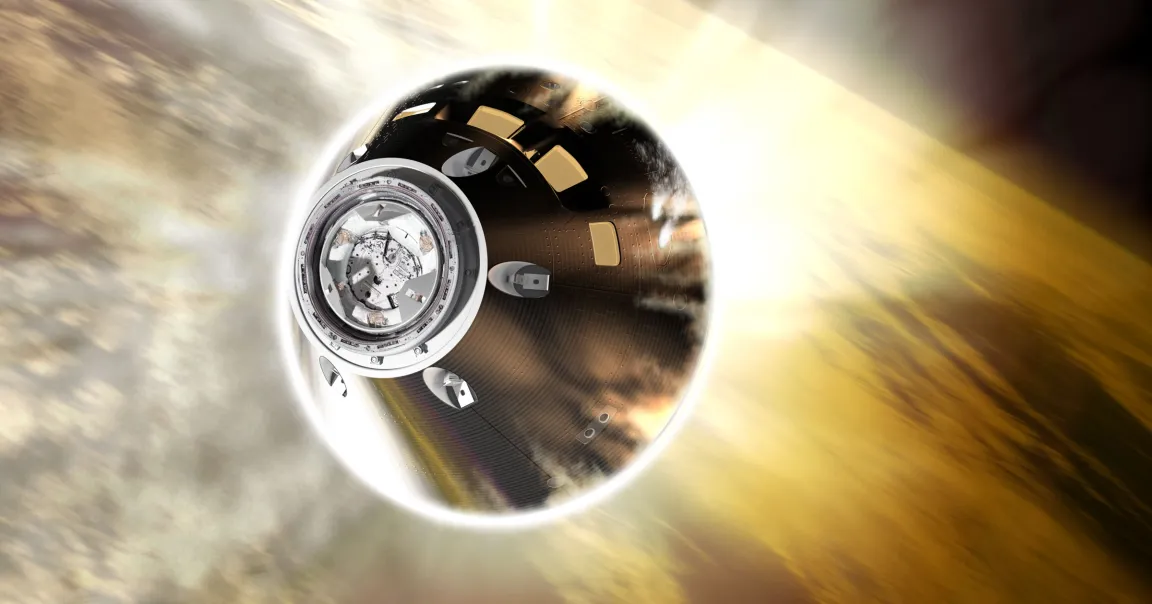
Absorbing the vast majority of the extreme forces during reentry of NASA's Artemis 2 mission is a heat shield that has proven controversial.

NASA

Sign up to see the future, today

Can’t-miss innovations from the bleeding edge of science and tech

NASA’s Artemis 2 mission has successfully journeyed around the far side of the Moon and is currently making its long way back to Earth.

Just after 8 pm Eastern time today, the Orion spacecraft’s crew module will separate from its service module, which allowed the spacecraft to propel itself through space. Then it’ll slam into the Earth’s atmosphere at full force, at a speed of over 23,000 mph, heating it up to 5,000 degrees Fahrenheit as it slows down enough over the next 13 minutes to safely splash down in the Pacific Ocean with the help of three large chutes.

Absorbing the vast majority of these forces — and keeping the astronauts safe during reentry — is Orion’s heat shield, a thick layer of insulating material that has long been mired in controversy.

Following the conclusion of NASA’s Artemis 1 mission, scientists spotted major cracks across more than 100 locations, as outlined in a 2024 report the agency’s Office of Inspector General. Charred chunks had come loose and were missing, highlighting the violent conditions involved while careening through our planet’s atmosphere at extreme speeds.

Experts and former NASA employees continue to ring the alarm bells, warning that the heat shield could put astronauts in danger, especially following the agency’s decision to “move forward with the current Artemis II Orion capsule and heat shield,” as former NASA administrator Bill Nelson announced in December 2024 — albeit with a “modified entry trajectory.”

“What they’re talking about doing is crazy,” former NASA astronaut and heat shield expert Charlie Camarda told CNN in January. “We could have solved this problem way back when. Instead, they keep kicking the can down the road.”

NASA’s leadership maintains that it did its homework to keep the Artemis 2 crew safe during tonight’s reentry. Scientists came up with a revised and steeper “skip reentry” maneuver that will have the Orion spacecraft skip over the atmosphere like a stone, but allow for less time for the temperature to build up compared to Artemis 1.

“We have modified our reentry profile,” NASA administrator, Jared Isaacman reassured the press earlier this year. “We have regained margin to safety, and I feel very good about that with Artemis 2.”

“Every system we’ve demonstrated over the past nine days — life support, navigation, propulsion, communications — all of it depends on the final minutes of flight,” NASA associate administrator Amit Kshatriya told reporters on Thursday. “We have high confidence in the system, in the heat shield, and the parachutes and the recovery system that we’ve put together.”

The plan hasn’t convinced Camarda. He told the New York Times in the days leading up to the launch of the latest Moon mission that he’s “going to pray that nothing happens,” giving it a 95 percent chance that the astronauts will safely return to Earth.

Camarda conjured recent deadly disasters of the Space Shuttle era.

“NASA definitely does not have the data to show that it’s safe,” he added. “I realized that they were using the same flawed thinking and crude analysis tools, similar to Columbia, similar to Challenger.”

More on the heat shield: Experts Warn That There’s Something Wrong With the Moon Rocket NASA Is About to Launch With Astronauts Aboard