

惯性聚合 高效追踪和阅读你感兴趣的博客、新闻、科技资讯
阅读原文 在惯性聚合中打开

推荐订阅源

博客园_首页
N
Netflix TechBlog - Medium
V
Visual Studio Blog
博客园 - Franky
小众软件
小众软件
奇客Solidot–传递最新科技情报
奇客Solidot–传递最新科技情报
Apple Machine Learning Research
博客园 - 三生石上(FineUI控件)
钛媒体:引领未来商业与生活新知
钛媒体:引领未来商业与生活新知
让小产品的独立变现更简单 - ezindie.com
宝玉的分享
宝玉的分享
量子位
大猫的无限游戏
大猫的无限游戏
人人都是产品经理
人人都是产品经理
V
V2EX
The Cloudflare Blog
月光博客
月光博客
Last Week in AI
Last Week in AI
雷峰网
雷峰网
WordPress大学
WordPress大学
博客园 - 【当耐特】
博客园 - 聂微东
IT之家
IT之家
OSCHINA 社区最新新闻
OSCHINA 社区最新新闻

Futurism

China Deploys Rare Type of Space Junk That Pollutes Orbit for Hundreds of Years Researchers Alarmed as GPS Readings Suddenly Veer Off by 33 Feet, Enough to Crash Self-Driving Cars Scientists Baffled by Bizarre "Anomaly" Deep Beneath the Surface of Mars NASA's Powerful New Space Telescope, Just Cleared for Launch, Was Developed by an Intelligence Agency to "Spy on America's Adversaries" NASA Set Up a Major Test of Its New Strategy Under Trump by Hiring a Startup to Launch a Daring Mission to Rescue a Dying Space Telescope in Orbit. The Unfortunate Result Will Have Long-Ranging Repercussions. Scientists Warn That New Satellites Could Cause Eye Damage for People on the Ground Scientist Reveals Plan to Save Earth From Destruction by the Sun NASA Rescue Mission Spirals Into Crisis Incredible Video Shows Chinese Rocket Get Hit by Lightning Mid-Launch SpaceX Plunges to All-Time Low After Competitor Makes Major Leap China Is Catching Up With SpaceX Fast, Landing First Reusable Rocket Booster on Offshore Platform Scientists Test New Spacecraft Thruster That Uses No Fuel, Just Earth's Magnetic Field, in Orbit Experts Say Mysterious Metallic Orbs Appear to Have Fallen From the Sky Anybody Who Thinks Orbital Data Centers are a Good Idea Is Suffering from AI Psychosis, Experts Argue NASA Prepping to Launch Extremely Risky Rescue Mission Boeing's Starliner Is Such a Disaster That We Don't Even Have Words NASA Has a Major Problem Threatening Its Entire Moon Plans NASA Rover Finds "Complex Organic Matter" on Mars SpaceX Launches Secretive New Spacecraft Shaped Like Flying Saucer Saturn's Icy Moon Is the Perfect Place to Settle, NASA Scientist Argues Scientists Building World's Most Powerful Radio Telescope Deep in the Nevada Desert NASA’s Next Moon Mission Is a Rube Goldberg Machine of Corporate Failure Points Scientists Release Results After Scanning 3I/ATLAS for Alien Signals NASA’s James Webb Discovers That 3I/ATLAS Let One Rip as It Passed Through Solar System Scientists Find Chunk of Lost Planet in Desert ISS Astronauts Ordered to Enter Evacuation Mode Paper Claims the “Asteroid” Japan’s Probe Is Approaching Is Actually a Derelict Spacecraft Scientists Say They’ve Found Fungi That Turn Dead Martian Soil Into Fertile Cropland Jeff Bezos’ Rocket Explodes Into Mushroom Cloud, Dealing Massive Blow to NASA’s Moon Plans NASA Releases Sweeping Plans for Moon Base
NASA Loads Moon Rocket onto Giant Trump-Branded Train
Victor Tangermann · 2026-06-15 · via Futurism

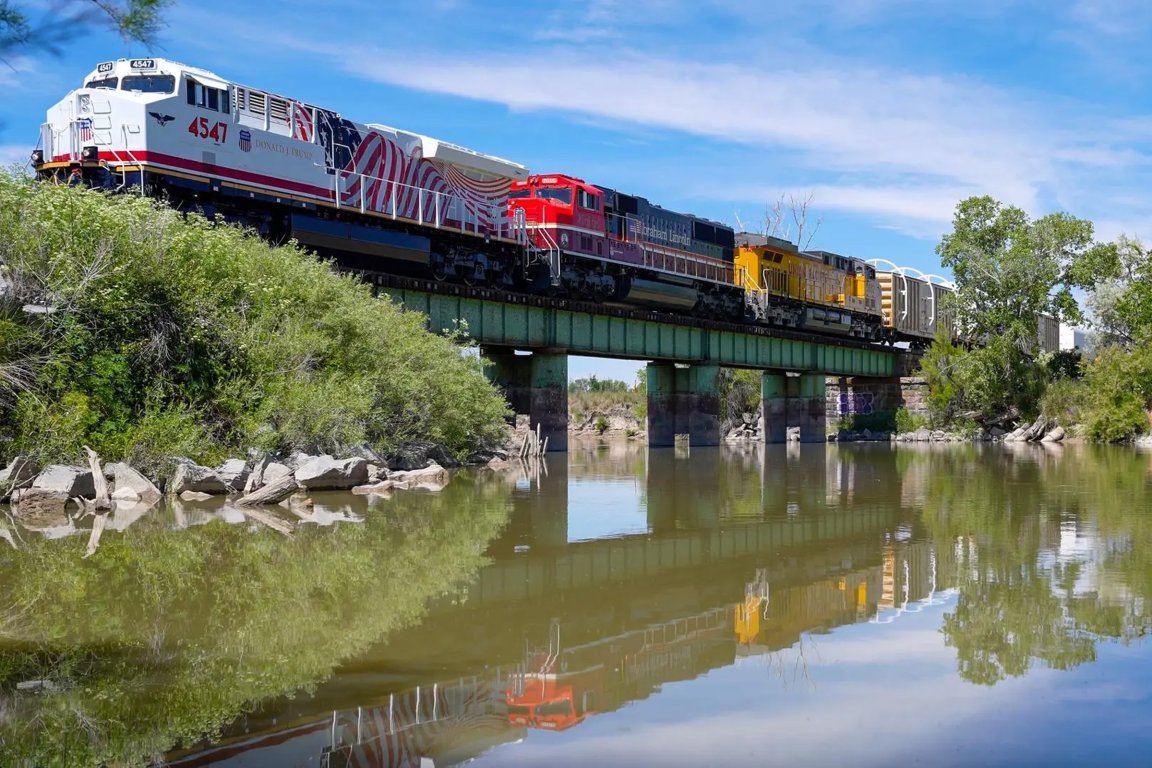
A train transports eight booster motor segments for the SLS (Space Launch System rocket) that will power NASA’s Artemis III mission from Northrop Grumman’s Railyard Shipping Facility in Corinne, Utah, June 2, to NASA’s Kennedy Space Center in Florida.

NASA/Brandon Hancock

Sign up to see the future, today

Can’t-miss innovations from the bleeding edge of science and tech

NASA is gearing up for its extremely ambitious next Moon mission, which will see a crew of astronauts taking two separate Human Landing Systems spacecraft being developed by Blue Origin and SpaceX for a joyride in Earth’s orbit to test their docking capabilities.

The mission, dubbed Artemis 3, will set the stage for the first crewed Moon landing attempt in 2028. To prepare, though, the agency fell back on some distinctly terrestrial transportation: by loading parts of its enormous Space Launch System rocket onto a massive train.

The train was spotted rolling through Wyoming earlier this week, as local publication Cowboy State Daily reports.

The train, which featured a commemorative, star-spangled Union Pacific locomotive celebrating President Donald Trump, departed from its point of origin at Northrop Grumman’s Railyard Shipping Facility in Corinne, Utah, on June 2, arriving at Florida’s Space Coast six days later.

“Later this year, teams will begin stacking the boosters that create 75 percent of the thrust needed at launch,” NASA’s Artemis X account wrote.

The train was carrying the last two of eight solid rocket-booster motor segments. All together, the rocket’s iconic twin solid rocket boosters will generate 7.2 million pounds of thrust during liftoff.

The core stage of the rocket arrived at NASA’s Vehicle Assembly Building (VAB) at NASA Kennedy in late April and is awaiting integration with its two 17-story-tall boosters. The core stage’s four RS-25 rocket engines produce 8.8 million pounds of thrust alone.

It’s an already proven design. NASA successfully used its Space Launch System rocket to send a crew of four astronauts around the Moon and back as part of its Artemis 2 mission earlier this year, as well as an uncrewed mission in late 2022.

Artemis 3 is currently still scheduled to launch sometime next year. However, delays — and massive explosions — plaguing its key contractors, SpaceX and Blue Origin, could force NASA to once again push back the date.

The first crewed landing attempt, Artemis 4, is tentatively scheduled for 2028. Interestingly, instead of using the SLS to get to the Moon to rendezvous with SpaceX’s Starship, NASA has seemingly changed its mind. According to an official Artemis announcement earlier this week, NASA revealed that it will be using Starship, not the SLS, to execute the trans-lunar injection burn for Artemis 4, a critical maneuver that pushes the spacecraft away from the Earth and towards the Moon.

The Trump branding on the train could be as close as the president gets to the lunar surface. The further the timeline slips, the more unlikely it feels that a crewed landing will actually take place before his second term is up at the beginning of 2029.

The news comes after years of criticism of the SLS design, which has seen massive budget overruns and formidable delays. NASA’s administrator, Jared Isaacman, also has a long history of working with Musk’s SpaceX — even becoming the first private astronaut to perform an extravehicular spacewalk when he clambered outside of a SpaceX Crew Dragon in September 2024.

More on Artemis: NASA’s Next Moon Mission Is a Rube Goldberg Machine of Corporate Failure Points