



惯性聚合 高效追踪和阅读你感兴趣的博客、新闻、科技资讯
阅读原文 在惯性聚合中打开

推荐订阅源

Cyberwarzone
Cyberwarzone
F
Full Disclosure
V
Visual Studio Blog
freeCodeCamp Programming Tutorials: Python, JavaScript, Git & More
有赞技术团队
有赞技术团队
J
Java Code Geeks
博客园 - 【当耐特】
OSCHINA 社区最新新闻
OSCHINA 社区最新新闻
博客园 - 叶小钗
L
LINUX DO - 最新话题
T
Threatpost
S
SegmentFault 最新的问题
Vercel News
Vercel News
云风的 BLOG
云风的 BLOG
C
Cyber Attacks, Cyber Crime and Cyber Security
Google DeepMind News
Know Your Adversary
Know Your Adversary
S
Schneier on Security
V
Vulnerabilities – Threatpost
D
DataBreaches.Net
G
GRAHAM CLULEY
Latest news
Latest news
P
Privacy International News Feed
D
Darknet – Hacking Tools, Hacker News & Cyber Security
C
CXSECURITY Database RSS Feed - CXSecurity.com
Scott Helme
Scott Helme
L
Lohrmann on Cybersecurity
T
The Exploit Database - CXSecurity.com
Security Latest
Security Latest
G
Google Developers Blog
L
LangChain Blog
MyScale Blog
MyScale Blog
Project Zero
Project Zero
N
News and Events Feed by Topic
Hacker News - Newest:
Hacker News - Newest: "LLM"
大猫的无限游戏
大猫的无限游戏
P
Proofpoint News Feed
Blog — PlanetScale
Blog — PlanetScale
阮一峰的网络日志
阮一峰的网络日志
N
News | PayPal Newsroom
www.infosecurity-magazine.com
cs.AI updates on arXiv.org
SecWiki News
SecWiki News
T
Tor Project blog
C
Check Point Blog
Google Online Security Blog
GbyAI
GbyAI
The Last Watchdog
The Last Watchdog
cs.CL updates on arXiv.org
WordPress大学
WordPress大学

Futurism

SpaceX Plunges to All-Time Low After Competitor Makes Major Leap China Is Catching Up With SpaceX Fast, Landing First Reusable Rocket Booster on Offshore Platform Scientists Test New Spacecraft Thruster That Uses No Fuel, Just Earth's Magnetic Field, in Orbit Experts Say Mysterious Metallic Orbs Appear to Have Fallen From the Sky Anybody Who Thinks Orbital Data Centers are a Good Idea Is Suffering from AI Psychosis, Experts Argue NASA Prepping to Launch Extremely Risky Rescue Mission Boeing's Starliner Is Such a Disaster That We Don't Even Have Words NASA Has a Major Problem Threatening Its Entire Moon Plans NASA Rover Finds "Complex Organic Matter" on Mars SpaceX Launches Secretive New Spacecraft Shaped Like Flying Saucer Saturn's Icy Moon Is the Perfect Place to Settle, NASA Scientist Argues Scientists Building World's Most Powerful Radio Telescope Deep in the Nevada Desert NASA Loads Moon Rocket onto Giant Trump-Branded Train NASA’s Next Moon Mission Is a Rube Goldberg Machine of Corporate Failure Points Scientists Release Results After Scanning 3I/ATLAS for Alien Signals NASA’s James Webb Discovers That 3I/ATLAS Let One Rip as It Passed Through Solar System Scientists Find Chunk of Lost Planet in Desert ISS Astronauts Ordered to Enter Evacuation Mode Paper Claims the “Asteroid” Japan’s Probe Is Approaching Is Actually a Derelict Spacecraft Scientists Say They’ve Found Fungi That Turn Dead Martian Soil Into Fertile Cropland Jeff Bezos’ Rocket Explodes Into Mushroom Cloud, Dealing Massive Blow to NASA’s Moon Plans NASA Releases Sweeping Plans for Moon Base Scientist Suggests That 3I/ATLAS May Have Seeded Life as It Careened Through Our Solar System SpaceX Announces Plans to Put Billionaire on First Rocket to Mars Elon Musk’s Ex Says He Bragged About 10,000 Lasers in Orbit That Are “Not a Piece They’ll See on the Chess Board” Government Releases UFO Files Containing Photos of “Anomalies” During Apollo 12 and 17 Scientists Detect Atmosphere on Planet-Like Object Beyond Pluto NASA’s Moon Landing Schedule Slipping Horrendously Under Trump NASA Fires Up Futuristic Plasma Thruster Designed to Take Us to Mars There’s a Hidden Shortcut to Mars, Scientific Paper Finds Another Military UFO Guy Just Died Scientists Scan Gigantic Structure Hiding Behind Our Galaxy Video Shows NASA Astronaut Struggling to Walk After Journey Around the Moon Scientists Say They’ve Tested a Way to Get to Alpha Centauri in Just 20 Years FBI Investigating Series of Deaths Among Top Scientists With Very Specific Specialties SpaceX Admits AI Data Centers in Space May Be a Really Terrible Idea Jeff Bezos’ Botched Space Launch Was So Bad It Could Threaten NASA’s Entire Moon Program Guess What This Creepy Underwater Thing Is That Was Photographed by US Navy Divers for NASA Jeff Bezos’ Space Company Just Screwed Up Very, Very Badly NASA’s Mars Rover Comes Across Formation That Looks Like the Scales of a Massive Cosmic Reptile Physicists Have a Major Problem With the Universe There’s Something Extremely Shady About Trump’s Disastrous New NASA Budget Moon Denialists Are So Pathetic That They’re Using AI to Fake Artemis Footage Trump Hires Orbital Towing Company to Build Space Interceptors Space Scientists Wince as Astronauts’ Lives Depend on Artemis 2’s Controversial Heat Shield During Plunge Back to Earth The Moon Astronauts Have Been Working Out With a NASA Rowing Machine in Space As Astronauts Visit the Moon, NASA Insider Says Agency Is in Shambles Behind the Scenes NASA Scientists Screamed With Delight When They Saw Something Smashing Into the Moon Moon Astronaut Captures Shot of Earth That Lets You See Its Razor-Thin Atmosphere Perfectly The Moon Spacecraft’s $30 Million Toilet Has Been a Bit of a Disaster We’re In Utter Disbelief About the Photos the Moon Astronauts Just Sent Back Lone Jar of Nutella Drifts Around Cabin of Moon Spacecraft The Moon Astronauts Just Broke the Record for the Farthest Any Human Has Ever Traveled From Earth Moon Astronauts Forced to Do It in Bags as “Burning Odor” Emanates From Toilet The White House Is Still Desperately Trying to Slash NASA’s Budget Trump Fans Furious That NASA Is Allowing a Canadian on the Moon Mission NASA Spacecraft’s Toilet Fails Hours Into Ten-Day Journey to Moon Conspiracy Theorists Are Going to Have a Field Day as NASA Gears Up to Launch Historic Moon Mission on April Fools’ Day
Visitor Approaches From the Edge of the Solar System
Victor Tangermann · 2026-05-10 · via Futurism

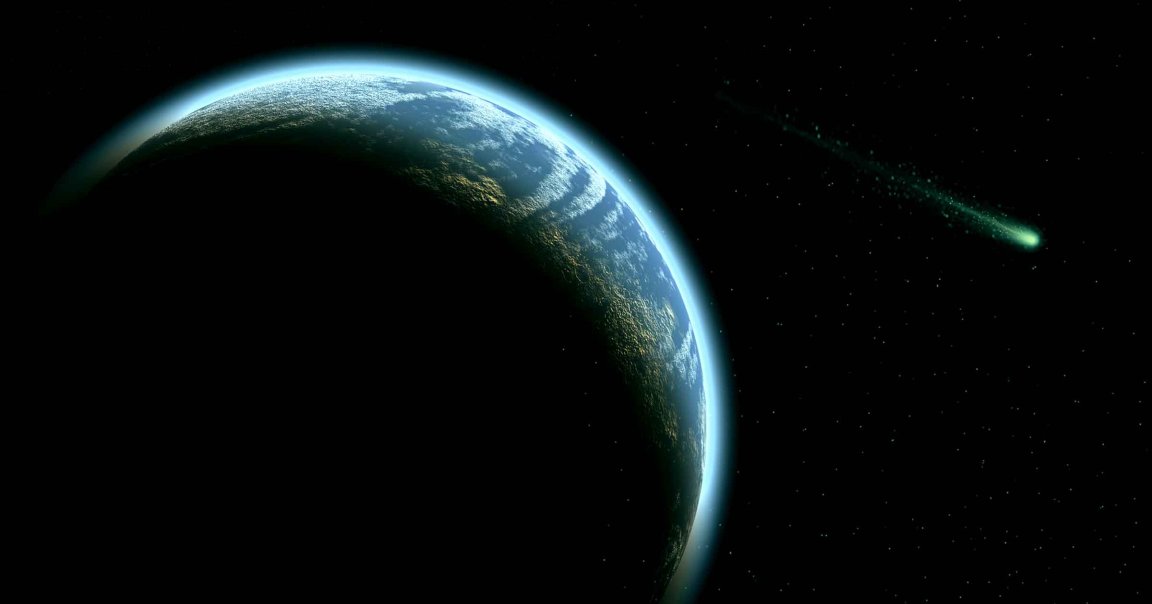
Comet C/2025 R3 PANSTARRS, which was only discovered last year, has been visible to stargazers in the northern hemisphere for weeks now.

Getty Images

Sign up to see the future, today

Can’t-miss innovations from the bleeding edge of science and tech

For thousands of years, astronomers have watched Halley’s Comet come and go, becoming visible to the naked eye every 72 to 80 years. That makes it a short-period comet, whose highly elliptical orbit takes it beyond Neptune before making its decades-long return. (The last time we caught a glimpse of the comet was in 1986, while its next appearance is slated for mid-2061.)

Other comets take far longer to orbit the Sun. As the New York Times reports, comet C/2025 R3 PANSTARRS, which was only discovered last year, has been visible to stargazers in the northern hemisphere for weeks now. However, once it’s on its way out, it’s not expected to return for another 170,000 years.

It’s origin is of particular interest to astronomers, who believe it came from the Oort Cloud, a giant spherical shell that blankets the solar system, representing the outermost edge of our star’s gravitational influence. Researchers believe it’s chock full of icy and rocky objects like C/2025 R3 PANSTARRS.

Long-period comets are an exceedingly rare sight — and an exciting opportunity to get a precious glimpse of the furthest reaches of the solar system.

“Whenever we spot them, it’s the first time we’ve seen them, and it’s also the only time that we will see them in our lifetimes,” Te Whatu Stardome in New Zealand resident astronomer Josh Aoraki told the NYT.

Whether future civilizations will be able to see the visitor again isn’t guaranteed. As the Perth Observatory’s Matt Woods points out in a recent guide, gravitational interactions with the solar system’s planets can eject comets form our star system altogether.

Given its suspected origins, studying a “dirty snowball” comet like C/2025 R3 PANSTARRS could provide us with tantalizing clues about the earliest days of the solar system. Current theories suggest that tiny chunks of leftover planet-making material dating back billions of years, called planetesimals, were driven away from the Sun when the planets formed. While some left the system entirely, others were trapped between a region where galactic influences balanced out with the Sun’s gravity, a region that’s now known as the Oort cloud.

The movement of these objects may have even played a role in delivering the necessary building blocks that allowed life on Earth to form, according to Woods.

In other words, there are plenty of reasons to get out the telescope before C/2025 R3 PANSTARRS is too distant to be visible to amateur astronomers.

“So while C/2025 R3 PANSTARRS might appear as little more than a faint, fuzzy patch through binoculars, it represents something far more significant,” Woods wrote. “It is a relic from the birth of the Solar System, a frozen archive of cosmic history, and for a brief moment, it’s visible from right here on Earth.”

“Not bad for something you can spot just after sunset,” he added.

More on comets: Please Resist the Urge to Drink the Melted Sludge From 3I/ATLAS