




惯性聚合 高效追踪和阅读你感兴趣的博客、新闻、科技资讯
阅读原文 在惯性聚合中打开

推荐订阅源

S
SegmentFault 最新的问题
Jina AI
Jina AI
罗磊的独立博客
V
Visual Studio Blog
freeCodeCamp Programming Tutorials: Python, JavaScript, Git & More
J
Java Code Geeks
U
Unit 42
Microsoft Azure Blog
B
Blog RSS Feed
爱范儿
爱范儿
酷 壳 – CoolShell
酷 壳 – CoolShell
Last Week in AI
Last Week in AI
T
The Blog of Author Tim Ferriss
腾讯CDC
Hugging Face - Blog
Hugging Face - Blog
T
Tailwind CSS Blog
让小产品的独立变现更简单 - ezindie.com
I
InfoQ
月光博客
月光博客
博客园_首页
Vercel News
Vercel News
P
Proofpoint News Feed
GbyAI
GbyAI
Y
Y Combinator Blog

Futurism

Earth May Have Had a Larger Cousin that the Sun Devoured Scientists Baffled by Bizarre "Anomaly" Deep Beneath the Surface of Mars NASA's Powerful New Space Telescope, Just Cleared for Launch, Was Developed by an Intelligence Agency to "Spy on America's Adversaries" Scientists Warn That New Satellites Could Cause Eye Damage for People on the Ground SpaceX Achieves Its First Moon Landing by Accidentally Crashing Into It at 5,400 Miles Per Hour, Causing Huge Explosion and 60-Foot Crater NASA Mars Rover Discovers Field of Mesmerizing Polygons Scientists Discover Massive Alien "Exosatellite" Astronomers Thrilled After Discovering Best Spot Yet to Look for Alien Life You'll Never Guess What Tasty Molecule Astronomers Just Detected In Space Astronomers Horrified by Enormous Mirror Satellite That Reflects Sunlight Back Down to Earth at Night Scientists Say They've Identified an Earth-Like Planet Right Next Door NASA Prepping to Launch Extremely Risky Rescue Mission NASA Has a Major Problem Threatening Its Entire Moon Plans NASA Rover Finds "Complex Organic Matter" on Mars Saturn's Icy Moon Is the Perfect Place to Settle, NASA Scientist Argues Scientists Building World's Most Powerful Radio Telescope Deep in the Nevada Desert NASA Loads Moon Rocket onto Giant Trump-Branded Train NASA’s Next Moon Mission Is a Rube Goldberg Machine of Corporate Failure Points Scientists Release Results After Scanning 3I/ATLAS for Alien Signals Catholic Church Boots Exorcist After He Said UFOs Are Demons NASA’s James Webb Discovers That 3I/ATLAS Let One Rip as It Passed Through Solar System Scientists Find Chunk of Lost Planet in Desert Paper Claims the “Asteroid” Japan’s Probe Is Approaching Is Actually a Derelict Spacecraft Scientists Say They’ve Cracked Mystery Behind a Dozen Strange Signals From Deep Space Scientists Say They’ve Found Fungi That Turn Dead Martian Soil Into Fertile Cropland The Blue Moon Is Fake. You Are Being Deceived Jeff Bezos’ Rocket Explodes Into Mushroom Cloud, Dealing Massive Blow to NASA’s Moon Plans NASA Releases Sweeping Plans for Moon Base SpaceX Announces Plans to Put Billionaire on First Rocket to Mars James Webb Spots Strange Structure at Core of Distant Galaxy
The Moon Spacecraft’s $30 Million Toilet Has Been a Bit o...
2026-04-08 · via Futurism

On Monday, roughly five days into NASA's Artemis 2 mission around the Moon, the toilet became off-limits for at least the third time.

NASA

Sign up to see the future, today

Can’t-miss innovations from the bleeding edge of science and tech

As we continue to feast on breathtaking images of the Moon’s far side taken by the crew of NASA’s Artemis 2 mission, it bears repeating that it took plenty of hardship to get to this point.

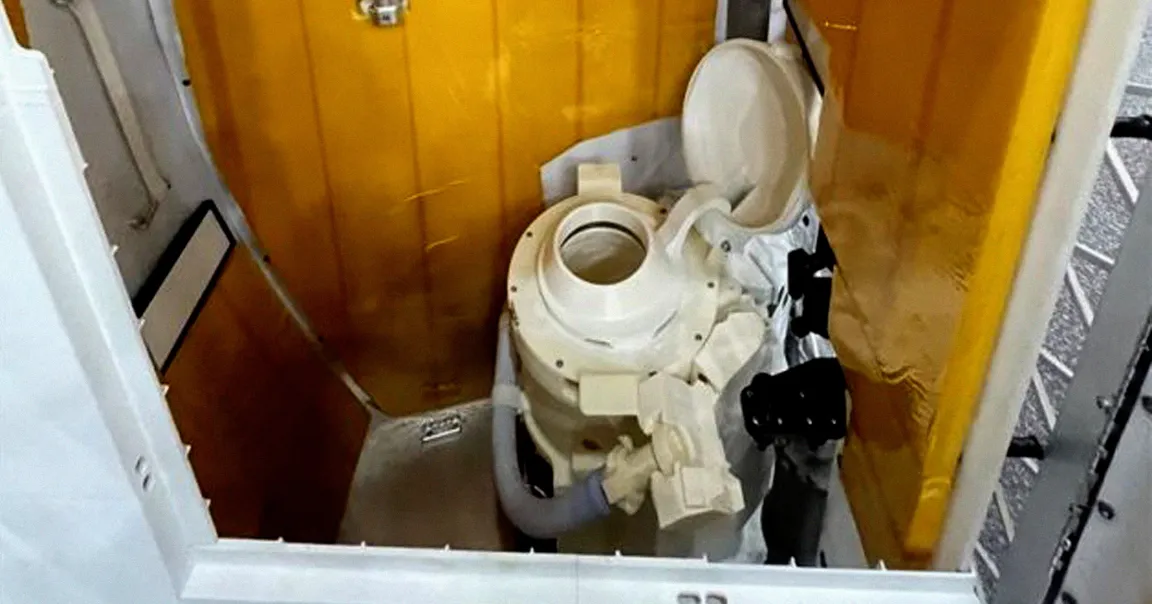
Managing human waste, in particular, has seemingly proven as difficult as ever. The culprit: a newfangled $30 million space toilet, dubbed the Universal Waste Management System (UWMS) and installed on board NASA’s Orion spacecraft.

It all started within hours of launch last week, when the crew reported that the toilet’s fan had jammed. It turned out that they hadn’t added enough water to prime the pump. After NASA astronaut Christina Koch topped off the water level, the system sprang into action.

“I’m proud to call myself the space plumber,” she later told mission control. “We were all breathing a sigh of relief when it turned out to be just fine.”

Days later, the toilet broke down for a second time. This time, the tube meant to vent pee to the outside of the spacecraft had clogged due to “frozen urine.” Rotating the Orion capsule to expose the line to the Sun and using vent heaters to melt away the ice once again made the commode usable.

On Monday, roughly five days into their mission, the toilet became off-limits for at least the third time.

“We just wanted to let you know that toilet right now is no go for use as we stick with the predetermined limit for now,” Jenni Gibbons, capsule communicator (CAPCOM) at Mission Control, told the astronauts around 4 pm Eastern time. “All crew members, please use CCUs.”

Gibbons was likely referring to the wastewater tank, which may have filled up to the point where the toilet became no longer usable due to ice buildup significantly slowing down the amount of urine it could vent to the outside.

The Collapsible Contingency Urinal is an emergency device designed to allow astronauts to relieve themselves in case their space toilet were to malfunction. The device, a tube measuring roughly two feet in length, is “essentially an open container (reusable, sealable, and drainable) that controls the urine-air interface using capillary forces,” as NASA astronaut Donald Pettit explained in a recent Instagram post.

“When you are in cislunar space with a broken toilet, you need contingencies and the CCU replaces the need for about 25 pounds of diapers,” Pettit wrote.

The crew of four will be taking their solid waste back to Earth sealed inside plastic bags that line the toilet’s seat.

Despite being several hundred thousand miles away, the crew’s toilet problems hit close to home.

“I think the fixation on the toilet is kind of human nature,” mission management team chair John Honeycutt told reporters Saturday evening after the toilet broke down for a sceond time. “Everybody knows how important that is to us here on Earth. And it’s harder to manage in space.”

More on toilet troubles: Moon Astronauts Forced to Do It in Bags as “Burning Odor” Emanates From Toilet