






We want to measure and understand how much AI agents can accelerate AI R&D and how this is changing over time. There are various sources of evidence we can look to here, including anecdotes about autonomous contributions (AlphaEvolve and TTT-Discover speeding up a GPU kernels, autoresearch yielding speedups in nanochat), progress on benchmarks, and uplift measurement (see our recent post for a longer discussion).
One interesting source of evidence is cumulative progress on publicly tracked challenges like the NanoGPT speedrun, where we can compare agent contributions to human progress over time. Such challenges and leaderboards of cumulative progress on a task are especially useful when:
Let’s look at one such leaderboard: the nanogpt speedrun. The goal is to train a language model to a target validation loss on FineWeb using 8×H100 GPUs as fast as possible. It’s a small-scale version of LLM pretraining with a public history of contributions, with four recent ones credited to AI agents as of April 2026. The optimization activities map to pretraining research such as architecture changes, writing kernels, and improving optimizers. Contributions, such as the Muon optimizer, have made it to frontier-scale models like GLM-4.5 and Kimi K2.
However, there are some challenges to interpreting this evidence:
The speedrun has two tracks: a small track (target loss 3.28, starting from GPT-2-small 124M params) and a medium track (target loss 2.92, starting from GPT-2-med 350M params). This post focuses on the small track.
From May 2024 to March 2026, 36 contributors have submitted 77 records — each one a new version of the training code that beats the previous best time — cutting the training time from 45 minutes to 1.43 minutes, a 31x speedup.3 Every record has a PR/commit with diffs, descriptions, and often cited papers or tweets describing the idea.
With the help of Claude Code, I went through each merged PR and classified them along the following dimensions. The full dataset is here.
| Dimension | Level | Description | Examples |
|---|---|---|---|
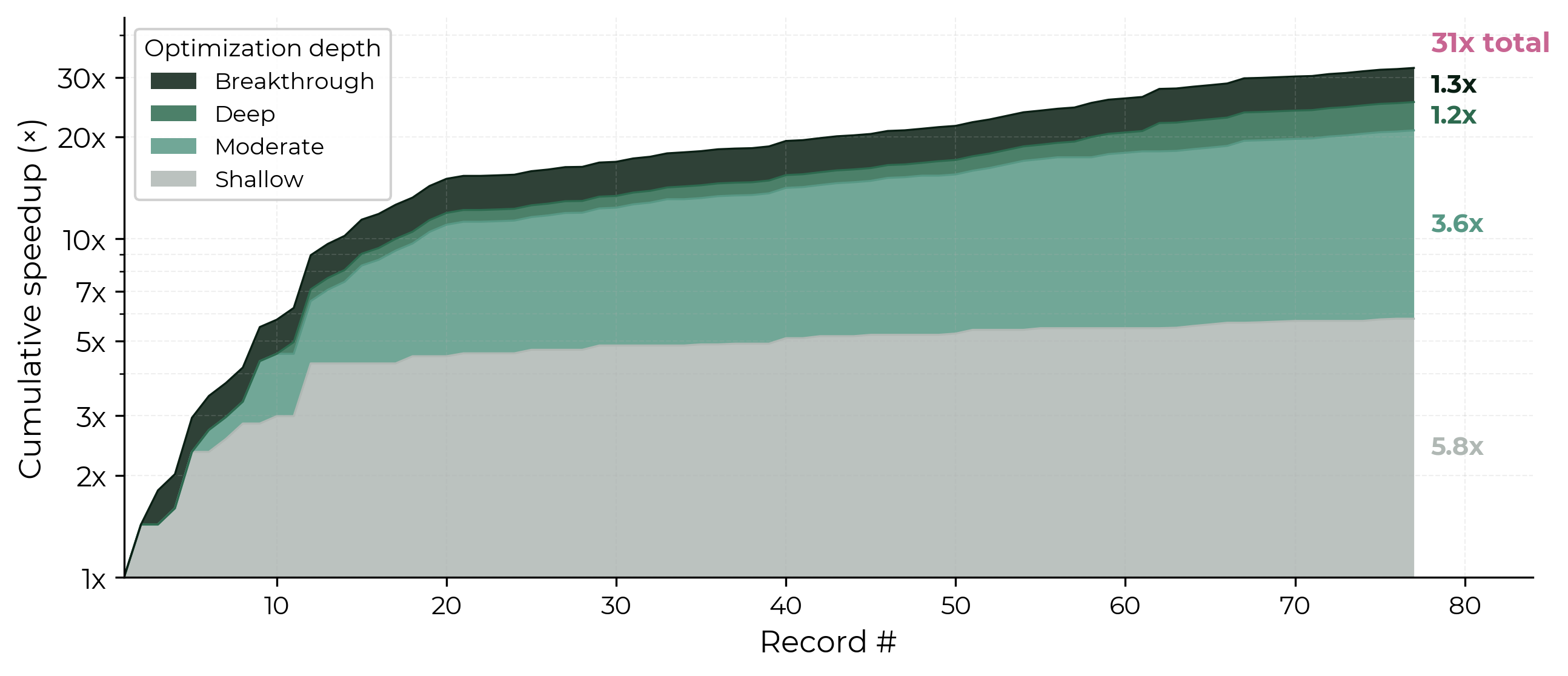
| Optimization depth: how non-obvious is the idea? | Breakthrough | New research contribution adopted widely. | Muon optimizer (#3), later used in Kimi K2 and GLM-4.5. |
| Deep | Novel idea or non-obvious cross-domain application. | Bigram Hash Embedding, hashing token pairs into per-layer residual additions (#62). | |
| Moderate | Non-trivial adaptation requiring domain expertise. | Batch-size schedule as a 3-phase linear ramp (#46); YaRN made dynamic during training (#31). | |
| Shallow | Trivially using a library, tuning hyperparameters, etc. | Upgrading PyTorch to 2.5.0 (#7); lowering logit softcap from 30 to 15 (#18). | |
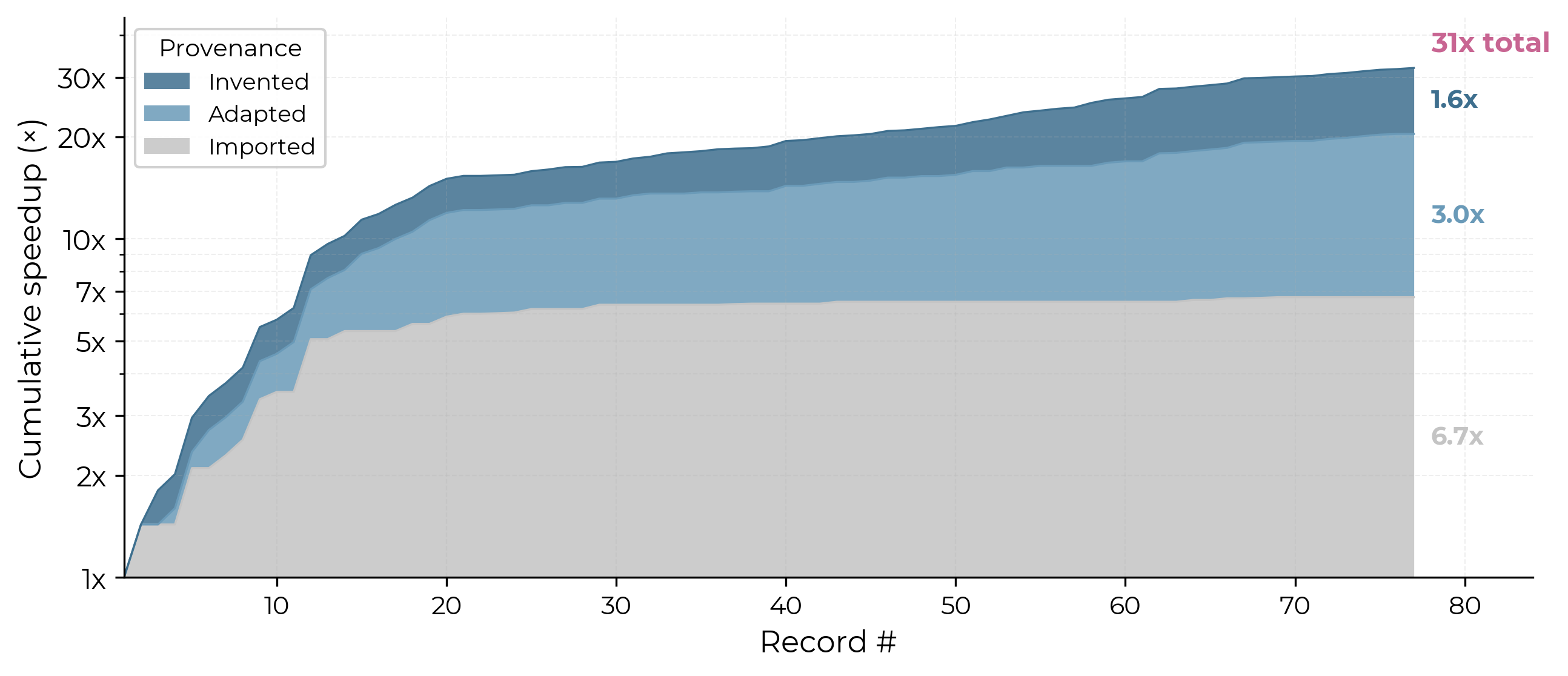
| Provenance: where did the idea come from? | Invented | The core idea originated in the speedrun. | Muon optimizer (#3); Paired Head Attention (#58). |
| Adapted | Building on existing work with significant modification. | U-net skip-connection pattern applied to transformers (#11). | |
| Imported | Directly applying a technique from a paper or library. | Flash Attention 3 library (#29). |
Here’s a graph I created showing the full timeline of records. AI-contributed records are those where the official record history attributes the submission to an AI agent rather than a human contributor.
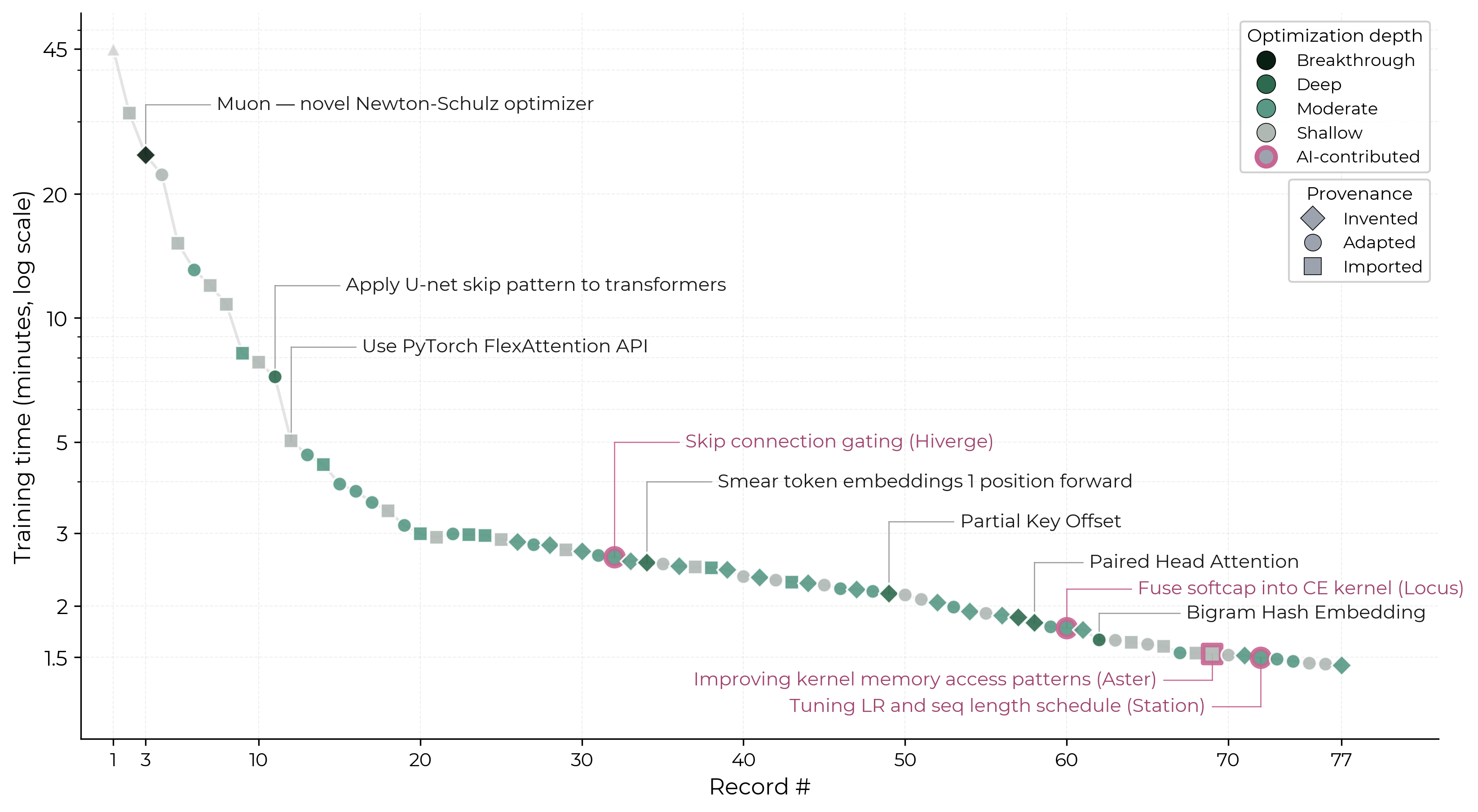
Here are some observations I made from this data:
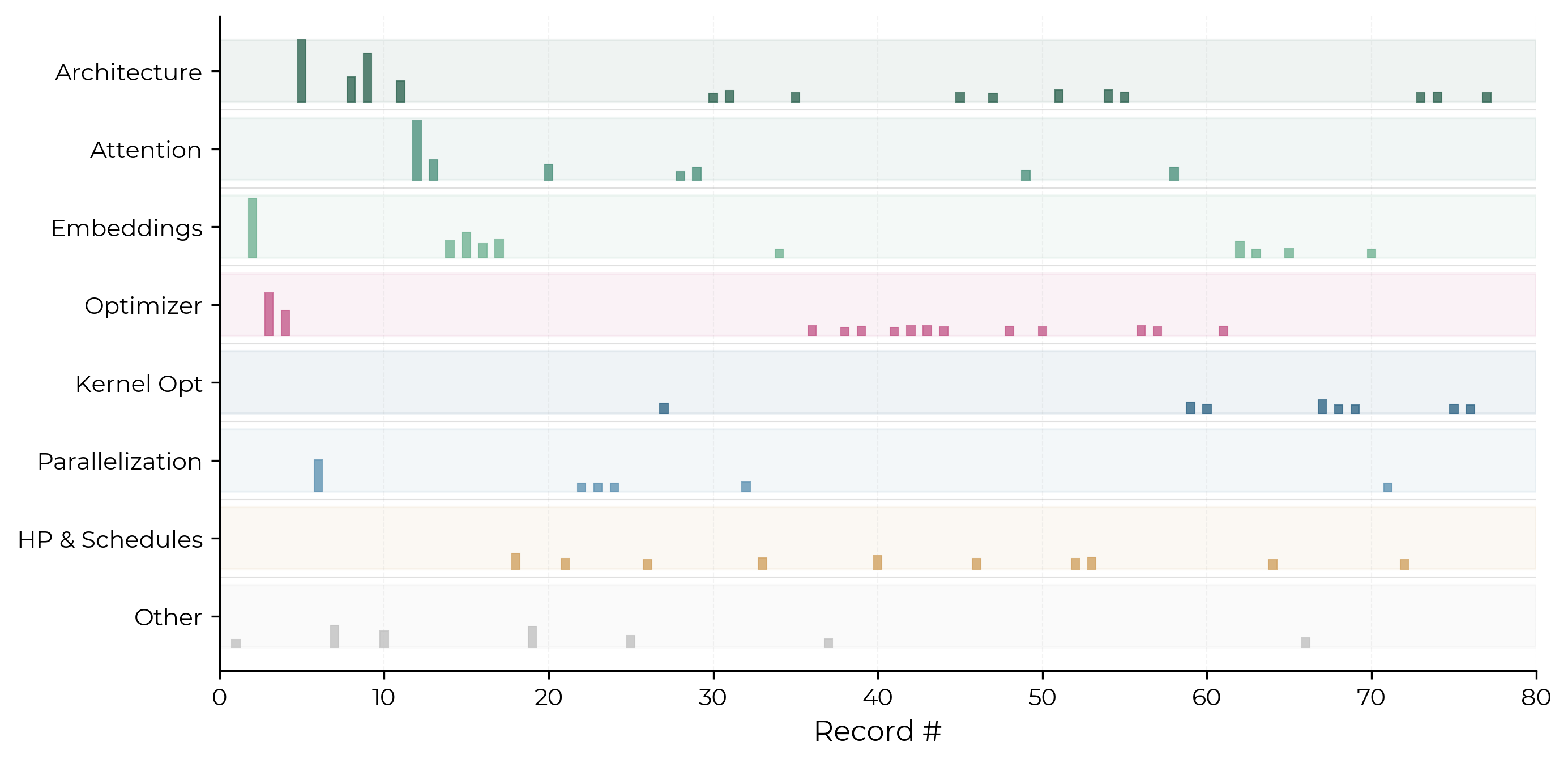
Above, each row shows a different layer of the model stack, with bar height indicating the relative speedup of each record. Despite NanoGPT being a single chunk of AI R&D (pretraining), records span many layers.
Early records were dominated by model architecture changes. The middle phases shifted toward attention mechanisms and parallelization. In later records, optimizer and kernel-level improvements have picked up.
Between late 2025 and early 2026, four records in the official record history credit an AI agent alongside a human co-contributor. All four are bespoke AI agent systems built by specific teams for ML research and optimization, not general-purpose coding assistants like Claude Code:
All four are real improvements, but based on my analysis none reached the deep or breakthrough end of the scale. However, this isn’t strong evidence that agents produce fewer deep ideas than humans. With four records with no disclosure of inference compute spends, these appear similar to more recent human contributions.
A notable contribution was by Station, which discovered that a config parameter (window_size) had been silently ignored by compiled code, a bug humans had missed for months.
Because each record is co-credited to a human, we also don’t know how human-directed these agent runs were or how many failed attempts preceded the successfully recorded ones. Nor do we know how much compute these agent runs consumed. So these contributions are hard to interpret on their own.
Publicly tracked challenges with a lot of accumulated human effort give us a few useful things:
Qualitative observations about human vs agent contributions. We can compare the kinds of ideas humans and agents produce and their substitutability; e.g., whether agents produce shallower optimizations than humans (a hypothesis motivated by the apple-picking model). In NanoGPT, the four AI-contributed records, as of April 2026, are all shallow-to-moderate and imported or adapted. But this isn’t particularly different from randomly sampled recent human contributions, so the four data points can’t yet distinguish agent shallowness from a low base rate.
A source of high-effort human baselines. Maintaining realistic, difficulty-calibrated benchmarks (e.g. METR’s time-horizon) requires tasks where we know how impressive a given score is. These challenges give us this: performance has been pushed for months or years, with a rough sense of how much human effort each step took. To use this, you’d start agents from a chosen point in the history and compare their progress to the human effort made from the same starting point.
A task to run agents on, including at high compute budgets. We can create tasks from these challenges and run agents at much larger compute budgets than anyone has publicly tried. There isn’t public evidence of agents being run at scale on this kind of task, so the shape of the cost curve at high budgets is essentially unknown. Further, public agent-contributions are also useful to cross-check our internal elicitation — if our agents fall short, that could point to scaffolding, prompting, or tooling gaps.
The full dataset for this post is here.
此内容由惯性聚合(RSS阅读器)自动聚合整理,仅供阅读参考。 原文来自 — 版权归原作者所有。