


惯性聚合 高效追踪和阅读你感兴趣的博客、新闻、科技资讯
阅读原文 在惯性聚合中打开

推荐订阅源

博客园_首页
T
Threat Research - Cisco Blogs
GbyAI
GbyAI
Y
Y Combinator Blog
美团技术团队
Cyber Security Advisories - MS-ISAC
博客园 - 【当耐特】
S
SegmentFault 最新的问题
IT之家
IT之家
Recent Announcements
钛媒体:引领未来商业与生活新知
钛媒体:引领未来商业与生活新知
阮一峰的网络日志
阮一峰的网络日志
T
The Blog of Author Tim Ferriss
Martin Fowler
Martin Fowler
Microsoft Azure Blog
V
Visual Studio Blog
freeCodeCamp Programming Tutorials: Python, JavaScript, Git & More
U
Unit 42
WordPress大学
WordPress大学
博客园 - Franky
L
LangChain Blog
人人都是产品经理
人人都是产品经理
小众软件
小众软件
博客园 - 叶小钗
罗磊的独立博客
酷 壳 – CoolShell
酷 壳 – CoolShell
大猫的无限游戏
大猫的无限游戏
云风的 BLOG
云风的 BLOG
Vercel News
Vercel News
雷峰网
雷峰网
腾讯CDC
Google DeepMind News
博客园 - 三生石上(FineUI控件)
CTFtime.org: upcoming CTF events
Help Net Security
Help Net Security
C
Check Point Blog
Hacker News - Newest:
Hacker News - Newest: "LLM"
N
News and Events Feed by Topic
V2EX - 技术
V2EX - 技术
Application and Cybersecurity Blog
Schneier on Security
博客园 - 聂微东
A
Arctic Wolf
H
Heimdal Security Blog
K
KPMG report finds enterprise disconnect between AI and its ROI | CIO
Recent Commits to openclaw:main
T
The Exploit Database - CXSecurity.com
C
Cyber Attacks, Cyber Crime and Cyber Security
让小产品的独立变现更简单 - ezindie.com
Google DeepMind News

METR

Because 8 ≈ e², Anthropic's researcher uplift is plausibly >2x Summary of METR's predeployment evaluation of GPT-5.6 Sol Frontier AI Safety Policies Frontier Risk Report (February to March 2026) 前沿 AI 风险报告(2026 年 2–3 月) Informe de riesgos de la IA de frontera (febrero–marzo de 2026) Measuring the Self-Reported Impact of Early-2026 AI on Technical Worker Productivity Task Substitution and Uplift Review of the "Risks from automated R&D" section in the Anthropic Risk Report (February 2026) Evidence on AI R&D Progress from NanoGPT MirrorCode: Evidence that AI can already do some weeks-long coding tasks Fine-tuning experiments on CoT controllability Red-Teaming Anthropic's Internal Agent Monitoring Systems Impact of modelling assumptions on time horizon results We spent 2 hours working in the future Review of the Anthropic Sabotage Risk Report: Claude Opus 4.6 Many SWE-bench-Passing PRs Would Not Be Merged into Main We are Changing our Developer Productivity Experiment Design Five lessons from having helped run an AI-Biology RCT How We Protect Confidential Information Analyzing coding agent transcripts to upper bound productivity gains from AI agents Measuring Time Horizon using Claude Code and Codex A simpler AI timelines model predicts 99% AI R&D automation in ~2032 Frontier AI safety regulations: A reference for lab staff 前沿 AI 安全法规:AI 公司员工参考指南 Regulación de seguridad de IA de frontera: una referencia para el personal de laboratorios Time Horizon 1.1 Clarifying limitations of time horizon Early work on monitorability evaluations Common Elements of Frontier AI Safety Policies (December 2025 Update) Details about METR's evaluation of OpenAI GPT-5.1-Codex-Max Review of the Anthropic Summer 2025 Pilot Sabotage Risk Report Summary of our gpt-oss methodology review MALT: A Dataset of Natural and Prompted Behaviors That Threaten Eval Integrity Early Results on Monitorability in QA Settings Claude, GPT, and Gemini All Struggle to Evade Monitors Forecasting the Impacts of AI R&D Acceleration: Results of a Pilot Study Research Update: Algorithmic vs. Holistic Evaluation Notes on Scientific Communication at METR CoT May Be Highly Informative Despite “Unfaithfulness” Details about METR's evaluation of OpenAI GPT-5 How Does Time Horizon Vary Across Domains? Measuring the Impact of Early-2025 AI on Experienced Open-Source Developer Productivity What should companies share about risks from frontier AI models? Details about METR's preliminary evaluation of DeepSeek and Qwen models Recent Frontier Models Are Reward Hacking Details about METR's preliminary evaluation of OpenAI's o3 and o4-mini Details about METR's preliminary evaluation of Claude 3.7 HCAST: Human-Calibrated Autonomy Software Tasks Measuring AI Ability to Complete Long Tasks Response to OSTP on AI Action Plan Why it’s good for AI reasoning to be legible and faithful 为什么 AI 推理应当可读,并如实反映模型的实际决策过程 Por qué conviene que el razonamiento de la IA sea comprensible y fiel Details about METR's preliminary evaluation of DeepSeek-R1 METR’s GPT-4.5 pre-deployment evaluations Measuring Automated Kernel Engineering Details about METR's preliminary evaluation of DeepSeek-V3 An update on our preliminary evaluations of Claude 3.5 Sonnet and o1 AI models can be dangerous before public deployment Evaluating frontier AI R&D capabilities of language model agents against human experts The Rogue Replication Threat Model Response to Bureau of Industry and Security’s proposed AI reporting requirements New Support Through The Audacious Project Details about METR's preliminary evaluation of OpenAI o1-preview Response to U.S. AISI Draft “Managing Misuse Risk for Dual-Use Foundation Models” Vivaria Details about METR's preliminary evaluation of GPT-4o An update on our general capability evaluations Response to NIST Draft Generative AI Profile ML Engineers Needed for New AI R&D Evals Project Emma Abele is METR’s new Executive Director Autonomy Evaluation Resources Example autonomy evaluation protocol Guidelines for capability elicitation Measuring the impact of post-training enhancements GitHub - METR/public-tasks Portable Evaluation Tasks via the METR Task Standard 2023 Year In Review Bounty: Diverse hard tasks for LLM agents ARC Evals is now METR Responsible Scaling Policies (RSPs) 负责任扩展政策(RSP) Políticas de escalamiento responsable (RSP) ARC Evals is spinning out from ARC New report: Evaluating Language-Model Agents on Realistic Autonomous Tasks Response to RfC on AI Accountability Policy Update on ARC's recent eval efforts
Observations from two CLI game reimplementation runs with Opus 4.6
Nikola Jurkovic · 2026-03-03 · via METR

Summary: Opus 4.6 can, with a simple agent scaffold, create mostly-playable but somewhat broken CLI versions of Slay the Spire and Balatro1.

Intro

Last weekend I was trying to think of really difficult tasks we could give to AI agents to upper-bound their capabilities. I thought of two examples:

  • Recreating a basic version of the video game Slay the Spire in the CLI
  • Recreating a basic version of the video game Balatro in the CLI

Both of these video games have a few properties that make it especially easy for AI systems to implement them:

  • They already exist, so the AI doesn’t have to come up with new game ideas and do the enormous amount of work necessary to make it a fun game to play.
  • Most player-relevant information is conveyed through text.
  • They have well-defined rules and interactions between game mechanics.
  • They are turn-based and don’t rely on reaction times or on-screen movement at all.
  • They have well-documented wikis and appear on the internet a lot.

Nevertheless, I expected that AI systems are currently far from being able to pull these tasks off. My best guess is that it would take an experienced software engineer a few months to do these tasks.

To test my hypothesis, I created simple versions of these tasks where only the core game mechanics need to be present. Also, instead of creating a full video game with graphics and animations, I only requested that the game be playable in a terminal. This significantly lowers the difficulty of the task.

I tasked Opus 4.6 with implementing these two games. To my surprise, it succeeded at coding mostly playable, although very rough-around-the-edges, versions of the games. I played through each implementation for around two hours, and while I noticed many missing or broken features, I was still able to play them mostly like I would play the actual games.

Methodology

I ran Opus 4.6 with a very simple scaffold that takes actions in a loop (ReAct).2 I gave it 60 million tokens total, ran it with a context window of 64,000 tokens, reasoning effort “max”, internet access, and Inspect’s default summary compaction which I set to kick in when the context window is 75% full.

The game specs were simplified from their real-life versions by a lot.

  • Slay the Spire:
    • implementing only the starting character (out of the 4 usual playable characters),
    • ignoring all game progression mechanics (including card and character unlocks and an unlockable boss), and
    • ignoring various quality of life features (game saving, profiles, settings, etc.)
  • Balatro:
    • implementing only the starting deck (out of the usual 15 playable decks),
    • ignoring all game progression mechanics (including endless mode and many specific requirements to unlock new cards), and
    • ignoring various quality of life features (game saving, profiles, settings, etc.).

I wrote the specs for the games with the help of Claude Code and ChatGPT.

This is a manually-scored task, which means a human (in this case myself) has to manually look at the task outputs and play around with them to determine whether the agent succeeded. I didn’t define a strict scoring rubric for these tasks.

Results

I will describe the result of the agent’s first attempt to implement Slay the Spire, and its second attempt to implement Balatro. I didn’t deeply look into the first Balatro attempt because the UI was difficult to navigate, so I opted to re-run with a clearer UI spec than spend time playing a game with a very clunky UI.
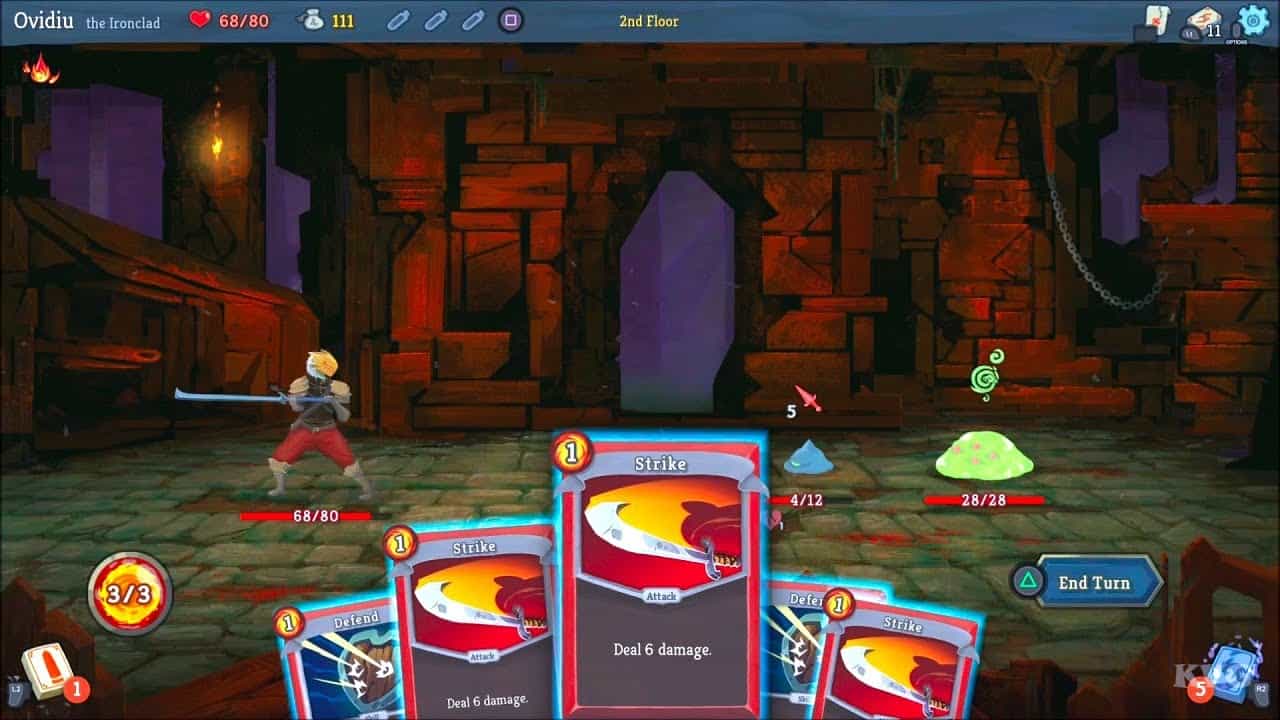
Slay the Spire

Slay the Spire gameplay
Figure 1: A screenshot of actual gameplay footage from the real Slay the Spire.
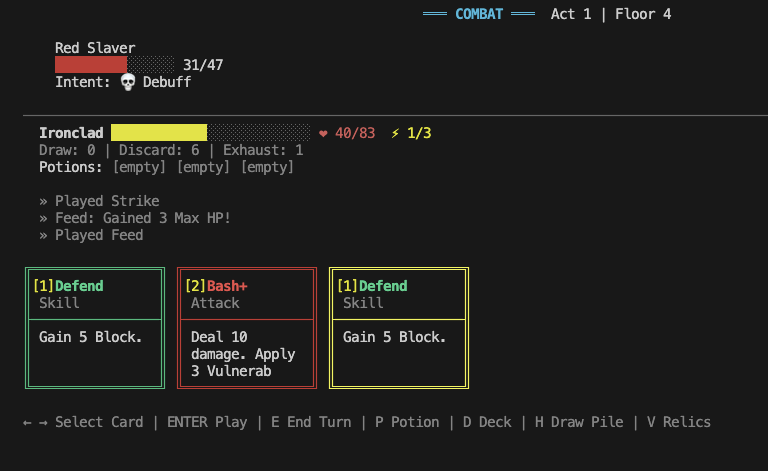
CLI Slay the Spire fight interface
Figure 2: The fight interface in the CLI reimplementation.

The combat feels very recognizable. I noticed a few mistakes and missing features in my two playthroughs:
  • Some card effects are slightly wrong (Headbutt, Flame Barrier).
  • Some UI elements are missing – damage numbers on the cards themselves don’t update in response to buffs/debuffs (but enemies are damaged the right amount).
  • Some enemies behave differently (Slimes split at the wrong time, Time Eater does not eat time).
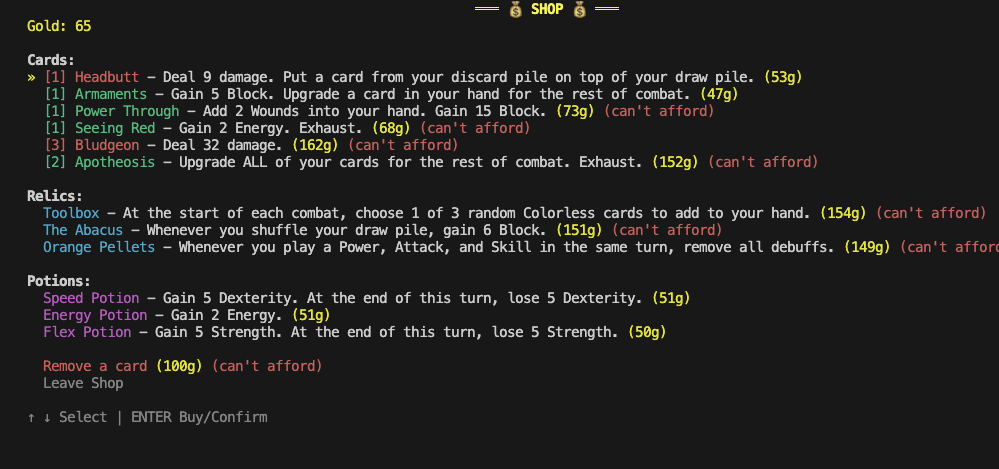
CLI Slay the Spire shop interface
Figure 3: The shop interface.

I didn’t notice any glaring issues in the Shop, aside from the fact that it let me remove a card twice in the same shop which shouldn’t be possible. The number of cards on sale is 6 instead of 7 and the card categories on sale seem subtly wrong (too many skills, no power card, no uncommon colorless card).
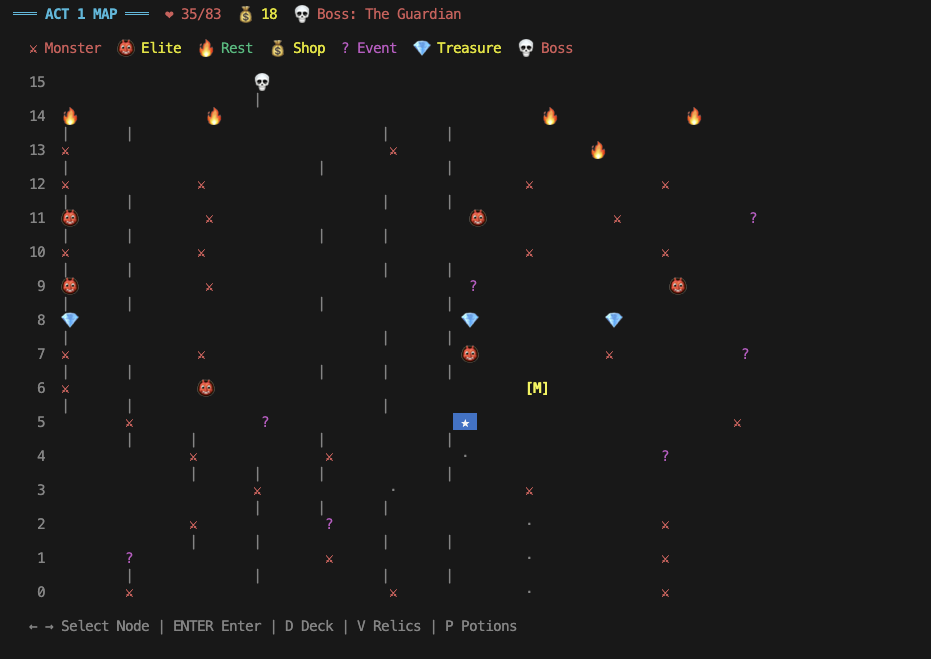
CLI Slay the Spire map interface
Figure 4: The map interface.

The map is the most obviously broken core game mechanic – it is extremely clunky to navigate and it’s unclear which nodes connect to others. The floor numbering is slightly wrong (starts at 0 instead of 1).

Other major mistakes that stood out to me (some found with the help of Claude Code) include:

  • Some potions are missing.
  • Many events are missing.
  • Some relics and status effects don’t work at all (Astrolabe does not prompt the player to pick three cards to transform and upgrade).
  • Neow’s bonuses are wrong – some are missing, others don’t exist in the real game but are available.

Aside from that, I was able to reach and defeat the final boss (using some cheats to get there faster), and most of the way there, the gameplay was pretty similar to that of the actual game.
Balatro

Balatro gameplay
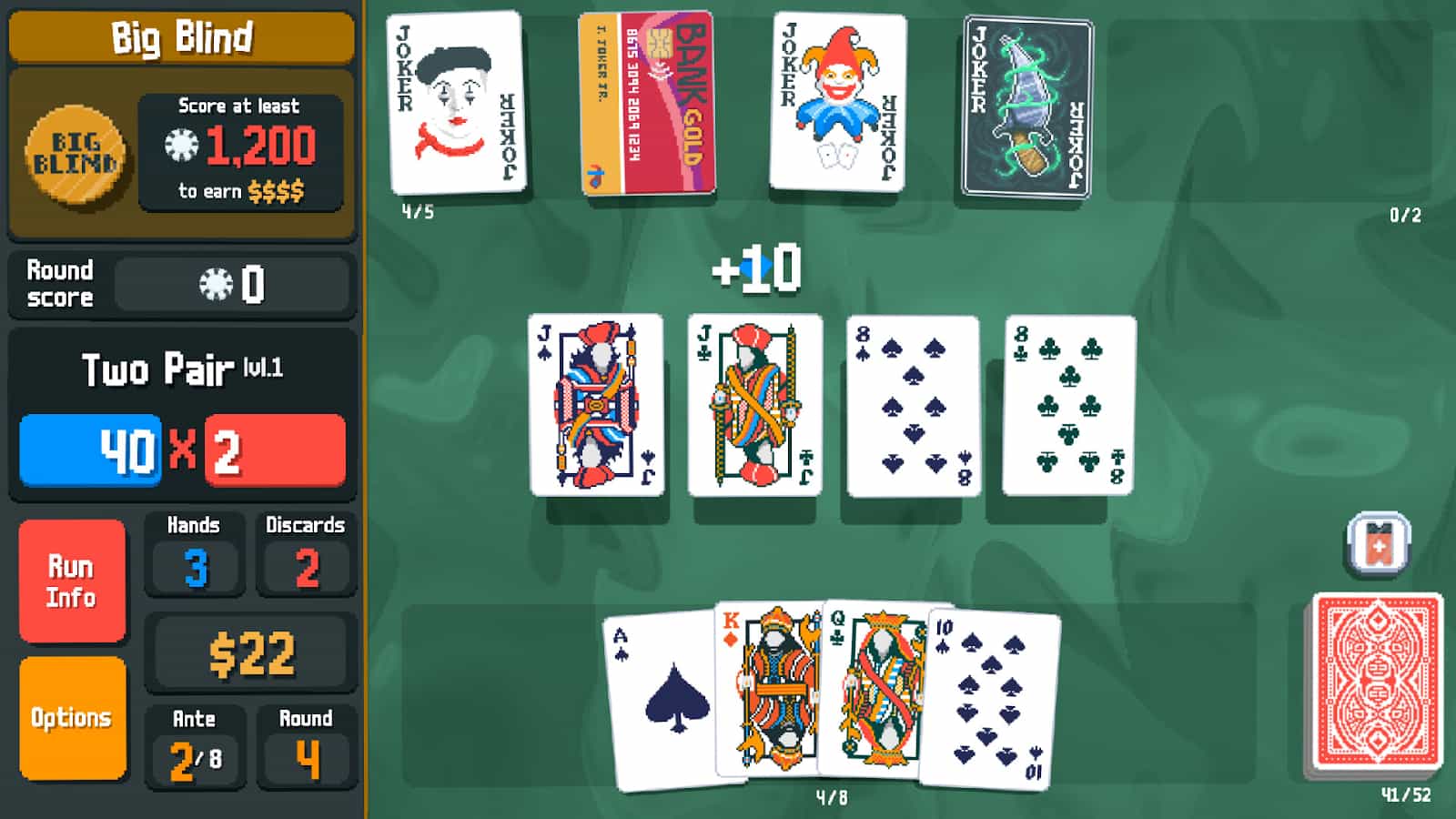
Figure 5: A screenshot of actual gameplay footage from the real Balatro.
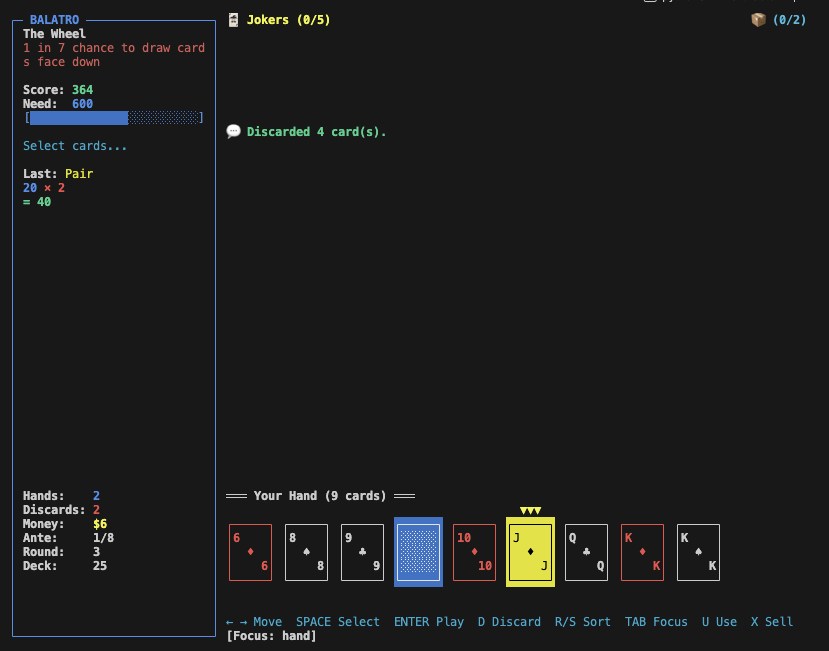
CLI Balatro interface during a Blind
Figure 6: The CLI interface during a Blind.

Overall, the core gameplay during a Blind is very recognizable. The main thing that’s missing is the game mechanic where you can see how much each card and joker contributes to your score. Without it, you just see a total score number for each hand, which provides much less feedback. Also, the player isn’t able to view their full deck, or their run info, or the blinds, or their vouchers, while inside a Blind. I see this mostly as a shortcoming of the spec I wrote rather than the agent messing up. Using consumables on cards during a Blind seems to work too.
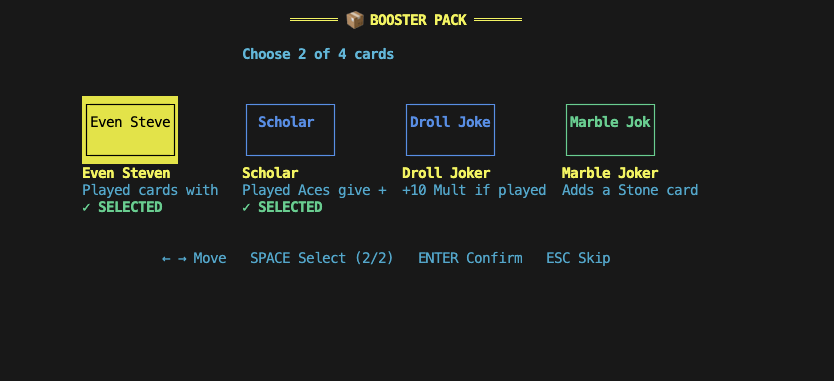
CLI Balatro Mega Buffoon Pack interface
Figure 7: Mega Buffoon Pack interface.

At points, the interface is a bit clunky. For instance, when opening a Mega Buffoon Pack, the description of each joker is impossible to fully read. This makes the game much less playable.
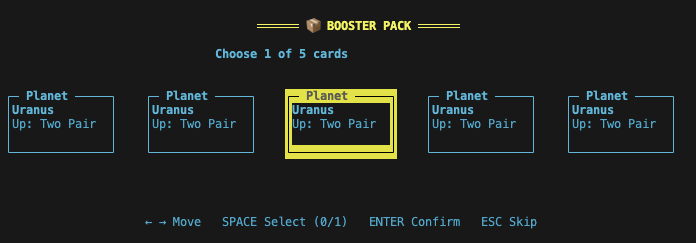
CLI Balatro Jumbo Celestial Pack interface
Figure 8: Jumbo Celestial Pack interface.

Also, some vouchers are completely broken. Buying a Jumbo Celestial Pack while possessing the Telescope Voucher leads to every Celestial card being the most-played one, instead of just guaranteeing that one of them is.
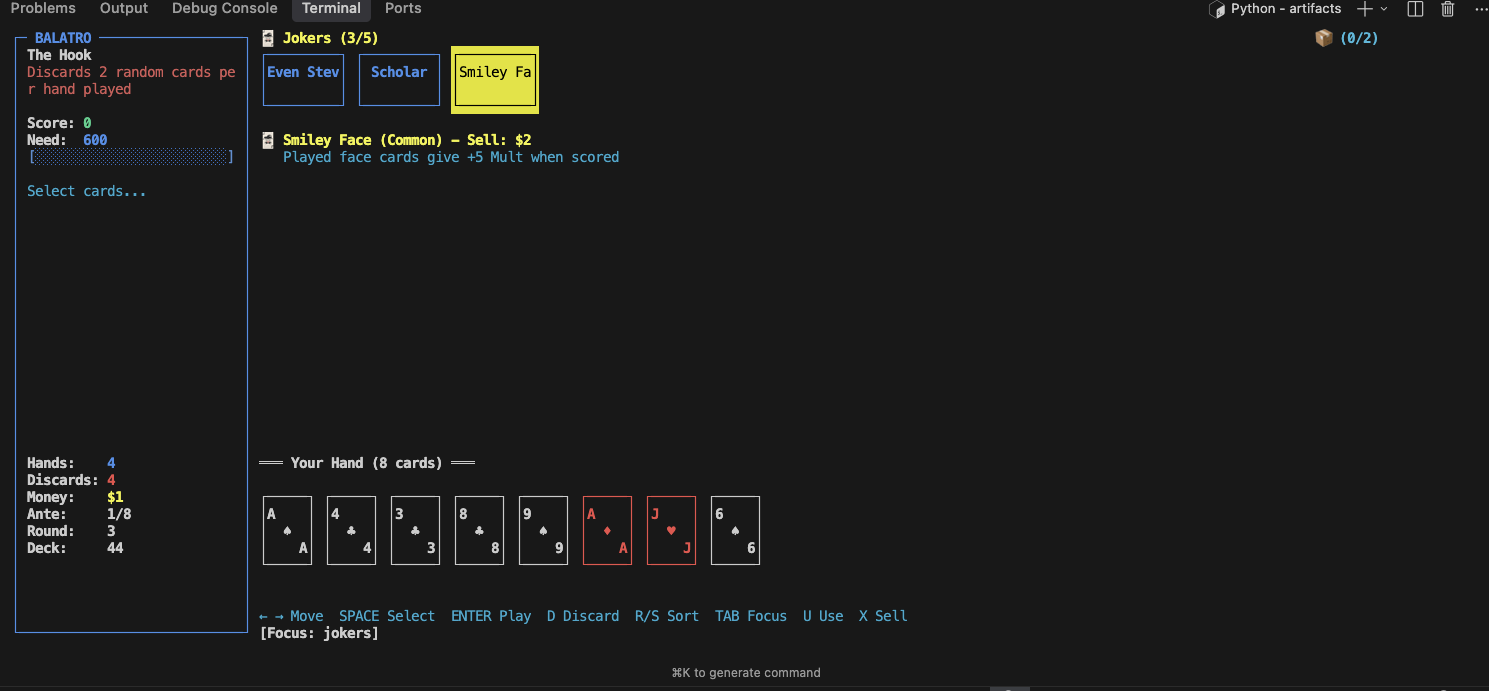
CLI Balatro hovering over a Joker
Figure 9: Hovering over a Joker during a Blind.

While in an actual Blind, you can hover over a joker to see its effect. I played around a bit to verify whether the card scoring is properly affected by jokers and I didn’t notice any major mistakes.
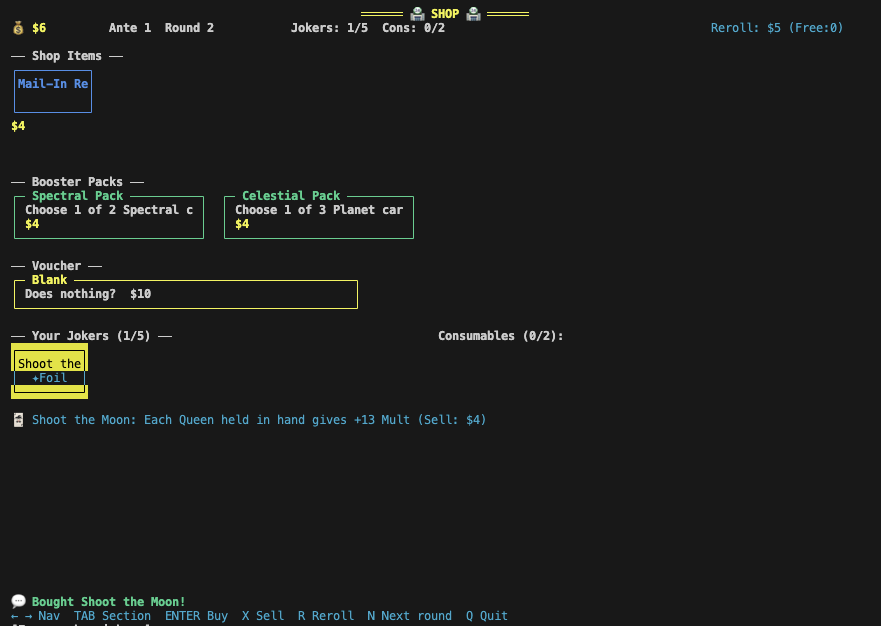
CLI Balatro shop interface
Figure 10: Shop interface.

The shop had some issues. Sometimes, I’d see the same Joker two shops in a row, and I could buy two Vouchers per Ante instead of just one.
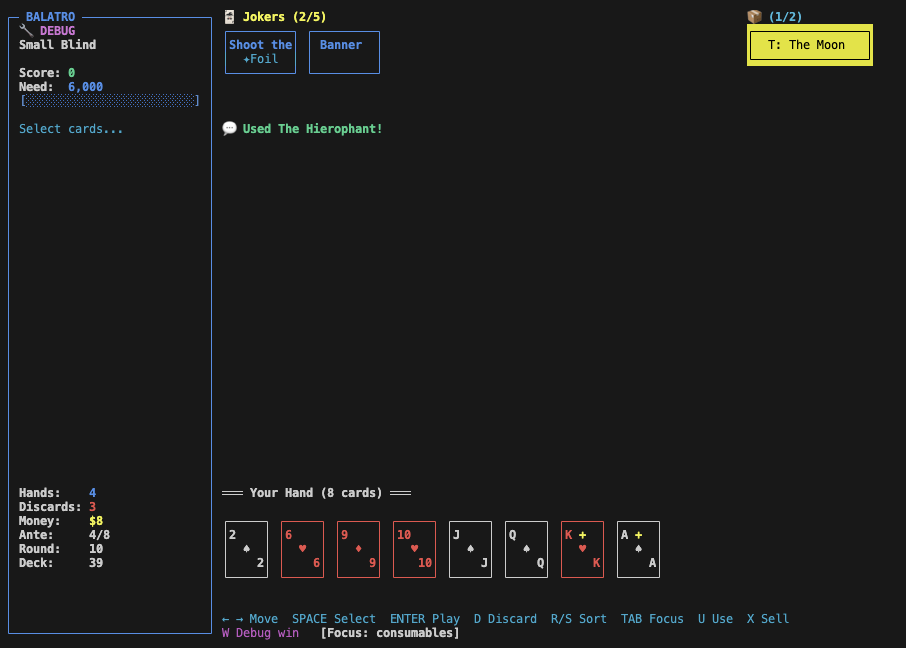
CLI Balatro using Tarot cards
Figure 11: Using Tarot cards during a Blind.

Using tarot cards during a Blind seems to work - in the above case, the King and Ace were turned into bonus cards by The Hierophant. Using the Moon also successfully turns cards into Clubs (after screenshot was taken). Using Death only copies the card rank, and doesn’t copy other card properties. The Fool does not work.

I played one entire run up to the end of Ante 8 (where the game usually ends), but I didn’t test the game super deeply, and most things didn’t seem obviously broken. But there are many things that I was surprised to see actually work – e.g. Lucky Cat correctly increasing its Mult after a successful Lucky card trigger, Spare Trousers increasing its Mult after playing a Two Pair.

The major thing that’s missing, that I didn’t include in my prompt, is Tags. Skipping a blind currently does nothing. I attribute this mostly to me having failed to prompt the agent correctly.

Discussion

Overall, I was pretty surprised by these results. I estimate that it would take me 2 to 8 weeks to implement one of these games to the quality level that the agent achieved3.

Again, this task is not exactly “game development.” The agent was reimplementing an already existing game, which is probably much more heavy on engineering skills than on conceptual skills, taste, game design, or balancing. I have no reason to expect that the actual source code of these games is in the training data, given that they aren’t open source projects, but they are well-documented to the point that reading text on the internet about them can probably reveal basically everything about how they work.

I don’t think I can conclude much about game dev skills or time horizons from this experiment alone, but it’s a scary experience thinking of a task that I don’t expect AI agents to be able to do, and then seeing them do it.

After I saw that Opus 4.6 succeeded at these simple variants of the reimplementation tasks, I decided to give it the much harder tasks of actually reimplementing all of the features of Slay the Spire and Balatro. The first run for both agents didn’t yield an impressive result – the Slay the Spire implementation had obvious flaws around game progression, and the Balatro implementation had a broken user interface that made it unplayable.

Appendix: Token Usage

type count
input 173,485
cache_read 25,357,081
cache_write 277,138
output 191,676
Total 25,999,380

Table 1: Token usage for the Slay the Spire run.

type count
input 4,444
cache_read 4,148,073
cache_write 128,291
output 117,163
Total 4,397,971

Table 2: Token usage for the Balatro run.

The token usage adds up to around $20 for the Slay the Spire run, and around $6 for the Balatro run.