
惯性聚合 高效追踪和阅读你感兴趣的博客、新闻、科技资讯
阅读原文 在惯性聚合中打开

推荐订阅源

S
Securelist
有赞技术团队
有赞技术团队
WordPress大学
WordPress大学
V
V2EX
Google DeepMind News
B
Blog RSS Feed
The Register - Security
Recorded Future
Recorded Future
Y
Y Combinator Blog
小众软件
小众软件
Jina AI
Jina AI
V2EX - 技术
V2EX - 技术
钛媒体:引领未来商业与生活新知
钛媒体:引领未来商业与生活新知
P
Proofpoint News Feed
Engineering at Meta
Engineering at Meta
宝玉的分享
宝玉的分享
The Hacker News
The Hacker News
C
Cybersecurity and Infrastructure Security Agency CISA
K
Kaspersky official blog
博客园 - 三生石上(FineUI控件)
T
Threatpost
博客园 - 聂微东
Scott Helme
Scott Helme
IT之家
IT之家
N
Netflix TechBlog - Medium
T
The Exploit Database - CXSecurity.com
S
Schneier on Security
MongoDB | Blog
MongoDB | Blog
T
Tor Project blog
C
CXSECURITY Database RSS Feed - CXSecurity.com
A
About on SuperTechFans
酷 壳 – CoolShell
酷 壳 – CoolShell
C
CERT Recently Published Vulnerability Notes
P
Palo Alto Networks Blog
Spread Privacy
Spread Privacy
C
Check Point Blog
L
LINUX DO - 最新话题
D
Darknet – Hacking Tools, Hacker News & Cyber Security
Last Week in AI
Last Week in AI
Attack and Defense Labs
T
Tailwind CSS Blog
罗磊的独立博客
让小产品的独立变现更简单 - ezindie.com
Webroot Blog
Webroot Blog
Help Net Security
Help Net Security
cs.AI updates on arXiv.org
OSCHINA 社区最新新闻
OSCHINA 社区最新新闻
爱范儿
爱范儿
PCI Perspectives
PCI Perspectives
Security Latest
Security Latest

JPost.com - Archaeology Around the World

Second century CE Roman military fort found north of Hadrian's Wall in Scotland | The Jerusalem Post Ancient mosaic with Greek inscription discovered in Turkey | The Jerusalem Post Collection of pre-revolution coins found under house in Russia | The Jerusalem Post Handgun fragments found in Germany may be oldest in Europe | The Jerusalem Post Archaeologists find evidence to legendary African king in Sudan | The Jerusalem Post Archaeologists find gold, ceramic in pre-Hispanic tomb in Panama | The Jerusalem Post Ancient Egyptians used 'Wite-Out' to fix mistakes in sacred texts | The Jerusalem Post Cambridge students find 9th century burial pit on dig | The Jerusalem Post Mexico discovers Zapotec tomb from 600 CE | The Jerusalem Post Medieval tunnel system discovered in Germany | The Jerusalem Post Roman carriage ornament found in Essex deemed 'Treasure' | The Jerusalem Post Humans, not glaciers, brought stones to Stonehenge | The Jerusalem Post Indonesia human hand outline may be world's oldest rock art | The Jerusalem Post New human species found, challenges story of 'Lucy' fossil | The Jerusalem Post Ancient Scottish burial site reveals Bronze Age devastation | The Jerusalem Post Louvre shuts fragile wing with Greek masterpieces | The Jerusalem Post Israeli team finds 12,000-year myths in clay figurine | The Jerusalem Post 800-year-old gilded Christ found near lost church | The Jerusalem Post Archaeologists uncover long-lost Temple of Zeus at Limyra | The Jerusalem Post Study shows dogs diversified before modern breeding | The Jerusalem Post Medieval Muslim sunken city discovered in Kyrgyzstan | The Jerusalem Post Ancient tools uncovered in China shed new light on early human diet | The Jerusalem Post ‘This is from Moses’: Newly imaged Sinai inscriptions revive Exodus-era | The Jerusalem Post Ancient inscriptions reveal identity of Great Pyramid builders | The Jerusalem Post Atlantis ruins near Cadiz found, archaeologist blames giant tsunami | The Jerusalem Post 5,000-year-old manuscript with eerie message found in Saqqara tomb | The Jerusalem Post Study: Leprosy existed in the Americas long before Europeans arrived | The Jerusalem Post Original architecture of ancient Roman fountain revealed in Perre Ancien | The Jerusalem Post Museum: Artifact shows playful, serious sides of 19th-century sexuality | The Jerusalem Post
Archaeologists uncover finds at birthplace of Menander | The Jerusalem Post
JERUSALEM POST STAFF · 2025-09-06 · via JPost.com - Archaeology Around the World

Excavation at Khirbat Kafr Hatta reveals mosaics, ritual oil production, and a Greek blessing to a Samaritan owner.
Follow us on Google
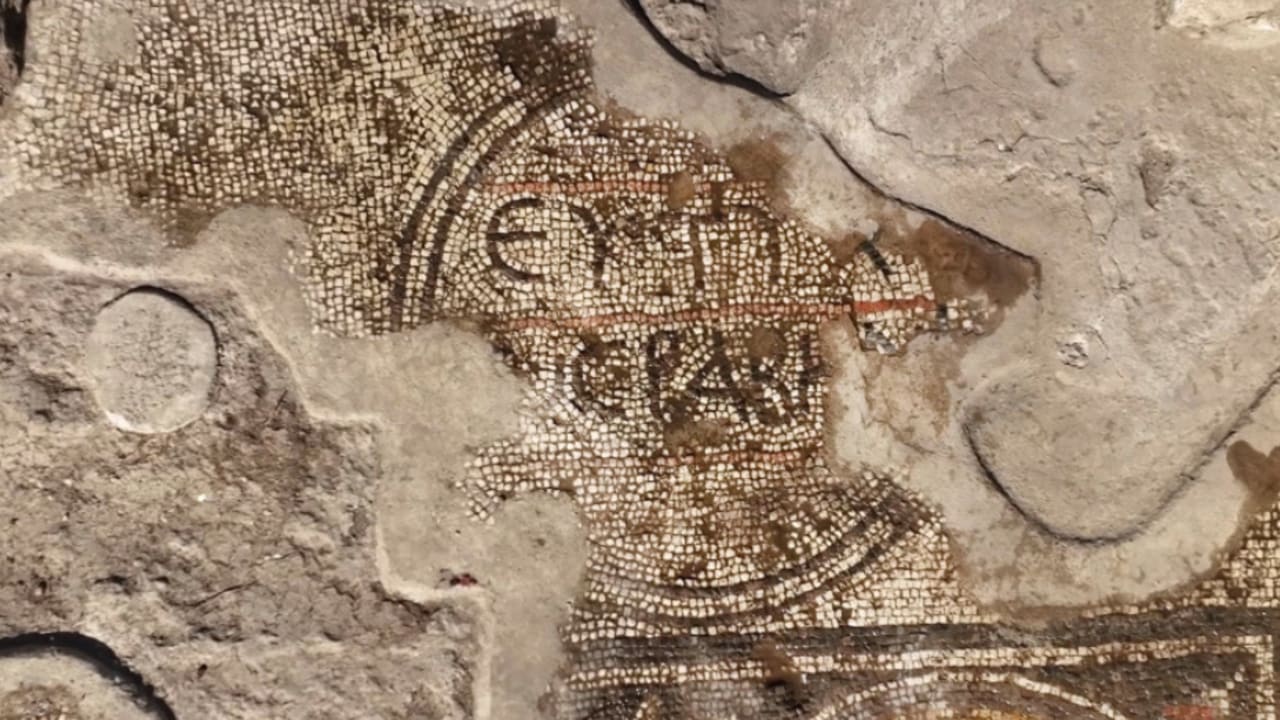
The inscription on one of the mosaics
(photo credit: EMIL ALADJEM/ISRAEL ANTIQUITIES AUTHORITY)
ByJERUSALEM POST STAFF

Archaeologists of the Israel Antiquities Authority (IAA) have uncovered a 1,600-year-old Samaritan agricultural estate at Khirbat Kafr Hatta near Kafr Qasim, central Israel, during a salvage dig supported by the Ministry of Construction and Housing.

Historical sources identify the site as Capparetaea, the birthplace of Menander the Samaritan, who succeeded Simon Magus — the magician often described as the father of Gnostic sects. Menander became a prominent figure in Samaritan tradition and early Christian polemics, linking the estate to one of the most controversial religious currents of Late Antiquity.

At the entrance to one of the estate’s rooms, archaeologists discovered a partially preserved Greek inscription reading “Good Luck!” The dedication was addressed to the building’s owner, whose name survives only in fragments but is recognizable as a name common in Samaritan communities of the time.

The estate included lavish mosaic floors decorated with geometric patterns and an unusually diverse array of vegetal motifs — acanthus leaves, grapes, dates, watermelon, artichoke, and asparagus. The artistry and realism of the imagery underscored the wealth of the community.

Excavators also uncovered a sophisticated olive oil production complex, remarkable for its integration of religious practice. Two screw presses, a crushing basin known as the “stone of the sea,” and a network of auxiliary rooms were paired with a public mikveh where workers immersed themselves before pressing olives to ensure the oil’s ritual purity. Such an arrangement is rare in Samaria and more characteristic of installations in Jerusalem and the Judean Plain.

Over the centuries, luxury gave way to utility. Walls cut through mosaics, capitals and columns were recycled, and the estate shifted toward pure agricultural production. Archaeologists connect this transformation to the Samaritan revolts of the fifth and sixth centuries, when Byzantine rulers imposed restrictive laws on minority religions. Yet the estate survived and retained its Samaritan identity, as evidenced by distinctive ceramic oil lamps.

“This is a fascinating site, which displays the historical gamut between the days of prosperity and the decline of the Samaritan community,” said excavation directors Alla Nagorsky and Dr. Daniel Leahy Griswold. Israeli Heritage Minister Amichai Eliyahu added that the discovery “illuminates another chapter in the shared story of the ancient peoples of this land,” noting that both Jews and Samaritans lived by the Torah and endured similar hardships under antagonistic rule.

The Khirbat Kafr Hatta estate not only enriches knowledge of Samaritan ritual and economy but also situates the community in the intellectual and spiritual debates shaped by Simon Magus and Menander — a reminder of how local lives intersected with larger religious currents in the ancient world.

Assisted by a news-analysis system.

Follow us on Google


