
惯性聚合 高效追踪和阅读你感兴趣的博客、新闻、科技资讯
阅读原文 在惯性聚合中打开

推荐订阅源

Last Week in AI
Last Week in AI
阮一峰的网络日志
阮一峰的网络日志
P
Proofpoint News Feed
让小产品的独立变现更简单 - ezindie.com
MongoDB | Blog
MongoDB | Blog
云风的 BLOG
云风的 BLOG
OSCHINA 社区最新新闻
OSCHINA 社区最新新闻
J
Java Code Geeks
WordPress大学
WordPress大学
T
The Blog of Author Tim Ferriss
V
Visual Studio Blog
小众软件
小众软件
Microsoft Azure Blog
博客园_首页
IT之家
IT之家
Vercel News
Vercel News
C
Check Point Blog
Google DeepMind News
月光博客
月光博客
D
DataBreaches.Net
酷 壳 – CoolShell
酷 壳 – CoolShell
美团技术团队
Y
Y Combinator Blog
Hugging Face - Blog
Hugging Face - Blog

JPost.com - Archaeology Around the World

Second century CE Roman military fort found north of Hadrian's Wall in Scotland | The Jerusalem Post Collection of pre-revolution coins found under house in Russia | The Jerusalem Post Handgun fragments found in Germany may be oldest in Europe | The Jerusalem Post Archaeologists find evidence to legendary African king in Sudan | The Jerusalem Post Archaeologists find gold, ceramic in pre-Hispanic tomb in Panama | The Jerusalem Post Ancient Egyptians used 'Wite-Out' to fix mistakes in sacred texts | The Jerusalem Post Cambridge students find 9th century burial pit on dig | The Jerusalem Post Mexico discovers Zapotec tomb from 600 CE | The Jerusalem Post Medieval tunnel system discovered in Germany | The Jerusalem Post Roman carriage ornament found in Essex deemed 'Treasure' | The Jerusalem Post Humans, not glaciers, brought stones to Stonehenge | The Jerusalem Post Indonesia human hand outline may be world's oldest rock art | The Jerusalem Post New human species found, challenges story of 'Lucy' fossil | The Jerusalem Post Ancient Scottish burial site reveals Bronze Age devastation | The Jerusalem Post Louvre shuts fragile wing with Greek masterpieces | The Jerusalem Post Israeli team finds 12,000-year myths in clay figurine | The Jerusalem Post 800-year-old gilded Christ found near lost church | The Jerusalem Post Archaeologists uncover long-lost Temple of Zeus at Limyra | The Jerusalem Post Study shows dogs diversified before modern breeding | The Jerusalem Post Medieval Muslim sunken city discovered in Kyrgyzstan | The Jerusalem Post Archaeologists uncover finds at birthplace of Menander | The Jerusalem Post Ancient tools uncovered in China shed new light on early human diet | The Jerusalem Post ‘This is from Moses’: Newly imaged Sinai inscriptions revive Exodus-era | The Jerusalem Post Ancient inscriptions reveal identity of Great Pyramid builders | The Jerusalem Post Atlantis ruins near Cadiz found, archaeologist blames giant tsunami | The Jerusalem Post 5,000-year-old manuscript with eerie message found in Saqqara tomb | The Jerusalem Post Study: Leprosy existed in the Americas long before Europeans arrived | The Jerusalem Post Original architecture of ancient Roman fountain revealed in Perre Ancien | The Jerusalem Post Museum: Artifact shows playful, serious sides of 19th-century sexuality | The Jerusalem Post
Ancient mosaic with Greek inscription discovered in Turke...
MIRIAM SELA-EITAM · 2026-03-27 · via JPost.com - Archaeology Around the World

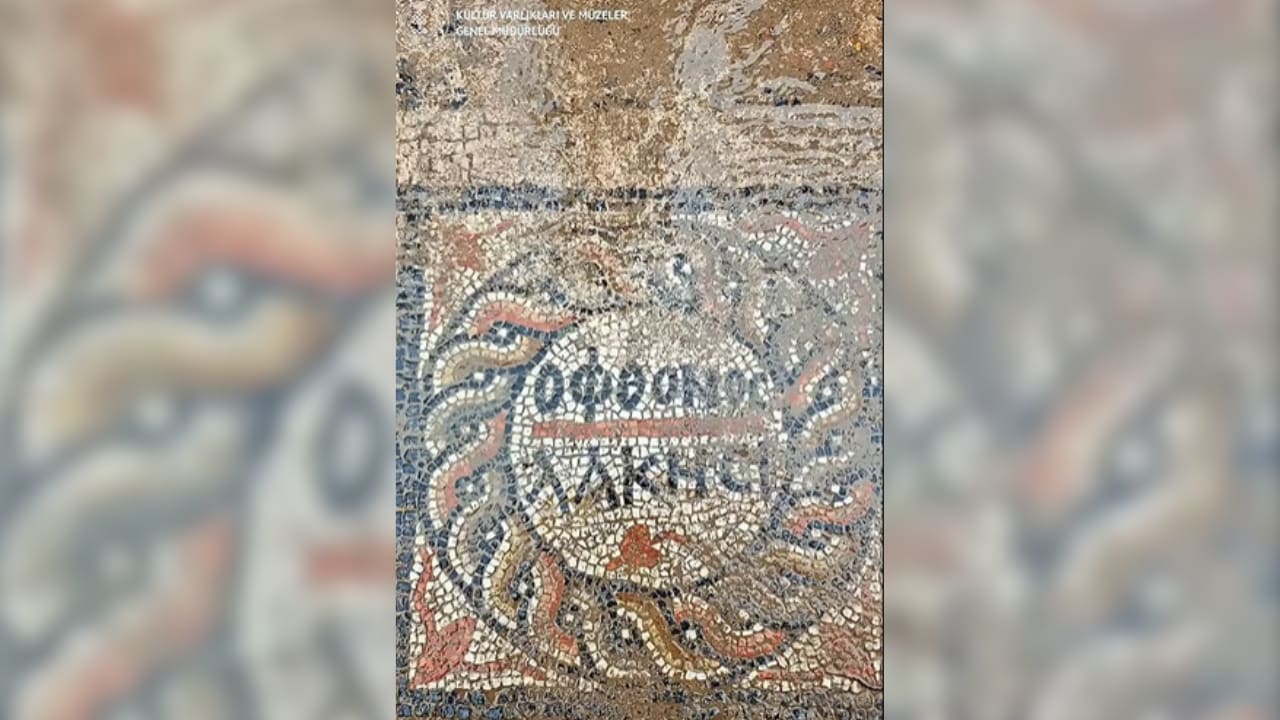
In addition to the two inscriptions, the mosaic consists of geometric patterns and several floral motifs.
Follow us on Google
Screengrab of 1,500-year-old mosaic with a Greek inscription found in Turkey, March 25, 2026.
(photo credit: Screenshot/Facebook/Kültür Varlıkları ve Müzeler Genel Müdürlüğü)
ByMIRIAM SELA-EITAM

A 1,500-year-old mosaic bearing two ancient Greek inscriptions was discovered during excavations in the ancient port city of Syedra in southern Turkey, the Turkish General Directorate of Cultural Heritage and Museums announced in a mid-March social media post. 

The first inscription, found at the top of the mosaic, roughly translates to “may the jealous burst with envy,” a phrase similar in meaning to “haters gonna hate.”

“It has a figurative meaning: the first word refers to ‘the jealous,’ while the second conveys ‘bursting’ or ‘splitting’,” Ergurer explained to Andalou Agency (AA). “Finding such a phrase at the entrance of a 1,500-year-old building was a great surprise for us.”

The second inscription is featured in the center of the mosaic translates to “use with luck” or “farewell with good wishes,” according to Ergurer.

In addition to the two inscriptions, the mosaic consists of geometric patterns and several floral motifs.

Restoring mosaic to former glory

Ergurer shared with AA that the well preserved mosaic was found in one of Syedra’s largest, and believed to have been important, buildings.

“The building contains numerous rooms and a central courtyard. It was in use from the 2nd to the 7th centuries CE,” Ergurer was quoted by AA as saying, further noting that during that period, rooms were added, floors built, and some areas closed off.

 “In later periods,” he added, “the entrance and the mosaic section were covered, which helped preserve the mosaic in such excellent condition until today.”

According to AA, both the building and the mosaic have been placed under protection as restoration efforts continue. 

Follow us on Google

