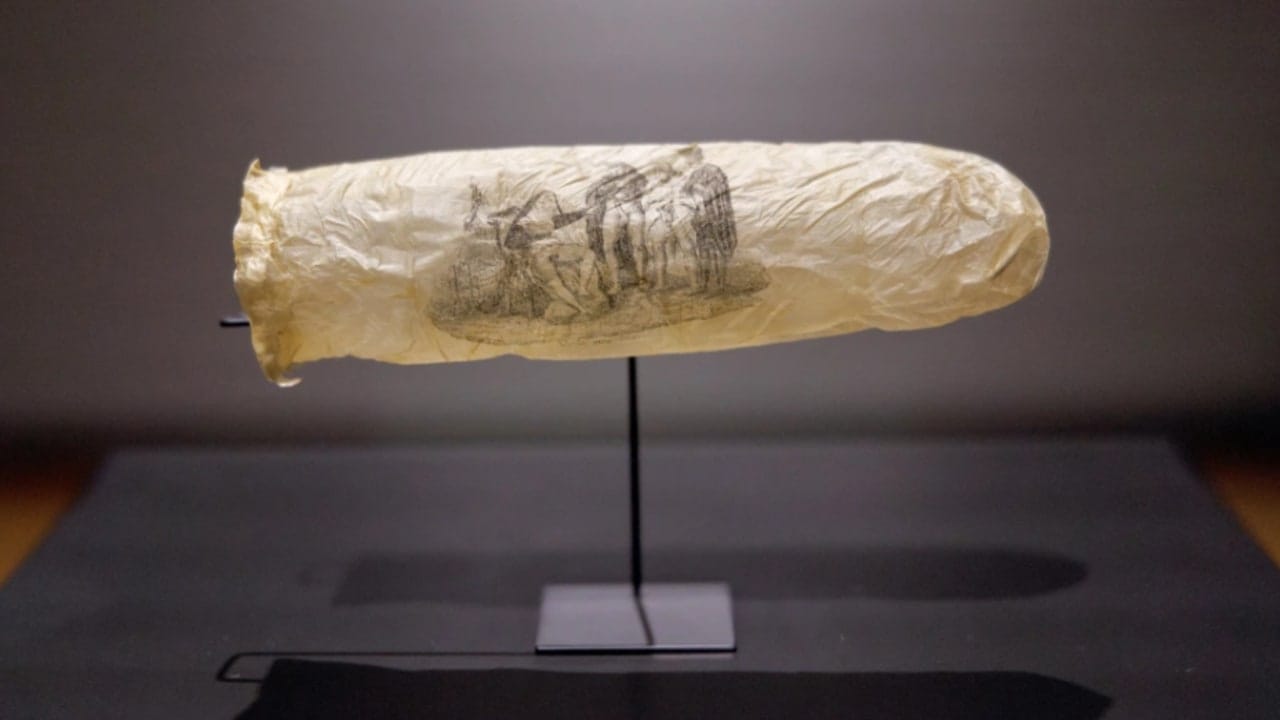







The Rijksmuseum in Amsterdam unveiled a rare 200-year-old condom adorned with a provocative engraving as the centerpiece of its new exhibition "Safe Sex?" The exhibition, which opened on Tuesday, explores underexposed themes of erotica, medicine, and prostitution from the 19th century.
Dating from around 1830, the condom features an erotic illustration depicting a semi-nude nun pointing to the aroused genitals of three clergymen. Beneath the image is the inscription "Voilà mon choix" ("This is my choice"), emphasizing its playful and provocative nature. The engraving is a parody of the Greek myth of the Judgment of Paris, where the Trojan prince Paris must choose the most beautiful among the goddesses Hera, Athena, and Aphrodite.
"The composition of the engraving is an allusion to the Greek myth of The Judgment of Paris, in which the Trojan prince is invited to choose the most beautiful of the three goddesses," said Joyce Zelen, the Rijksmuseum's curator of prints and drawings, according to BFMTV. Zelen added, "We believe therefore that whoever bought the condom must have been quite sophisticated and educated."
Made from sheep's intestine, a common material for contraceptives before the invention of vulcanized rubber in 1839, these early condoms offered little protection against sexually transmitted diseases like syphilis and were not effective in preventing pregnancy. "During the 1830s, condoms were mainly sold under the counter in brothels or barbershops, with some reports of luxury shops offering custom sewing," noted BFMTV.
Believed to have originated from an aristocratic brothel in Paris, the artifact was likely intended as a luxurious souvenir rather than for actual use. "The condom was likely a luxurious souvenir from a brothel in France, intended for a wealthy and educated public rather than one that was actually used," stated ARTnews. The museum confirmed this by extensively examining the 20-centimeter-long contraceptive with UV light and finding no traces of sexual activity. "To preempt the question from the general public, we can now say with certainty that this specimen has never been used. This underscores our theory that it is a brothel souvenir," Zelen told Het Nieuwsblad.
The acquisition adds a unique piece to the museum's vast collection of prints, drawings, and photographs, which numbers around 750,000 items. The Rijksmuseum stated in a press release that the condom "depicts both the playful and the serious side of sexual health," representing the coexistence of pleasure and the fear of sexually transmitted diseases and unwanted pregnancy, reported Le Figaro.
Safe Sex? runs until the end of November and includes historical objects related to sex work and sexual health. The exhibition features Dutch and French engravings and drawings on themes of prostitution and sexual health, presenting the search for pleasure alongside the fear of sexually transmitted infections (STIs), especially syphilis, and unwanted pregnancies. "The exhibition includes prints that depict both the pleasure and the fear associated with sex and visiting brothels, illustrating the coexistence of pleasure and fear of sexually transmitted diseases during the 19th century," noted De Standaard.
Zelen highlighted the societal attitudes towards contraceptives during the era. "In the 1830s, when the condom was made, its use was still frowned upon, especially by the Church," she explained to BFMTV. Despite moral objections, the fear of unwanted pregnancy and incurable STIs like syphilis drove some to use these early forms of protection. "Syphilis was not only a painful and deadly disease, but it also left visible marks, which often came with a lot of shame," Zelen told Het Nieuwsblad.
The condom was purchased at a Bubb Kuyper auction in Haarlem last November for 1,000 euros. "The Rijksmuseum's Print Room purchased the condom at auction six months ago for 1,000 euros," reported El Universal. The museum chose to announce the acquisition in conjunction with the opening of the exhibition to highlight the rarely treated theme of sexuality and prostitution in the 19th century within its collection.
Visitors to the Rijksmuseum will have the opportunity to view this unique artifact, which provides a fascinating insight into the sexual culture of the 19th century. "It testifies to the multiple applications of the art of engraving and offers an insight into sexuality and prostitution in the 19th century," Zelen remarked, according to Le Figaro. The condom, with its daring illustration and historical significance, is expected to become a favorite among the public.
The preparation of this article relied on a news-analysis system.
此内容由惯性聚合(RSS阅读器)自动聚合整理,仅供阅读参考。 原文来自 — 版权归原作者所有。