
惯性聚合 高效追踪和阅读你感兴趣的博客、新闻、科技资讯
阅读原文 在惯性聚合中打开

推荐订阅源

L
LINUX DO - 最新话题
C
Cyber Attacks, Cyber Crime and Cyber Security
G
GRAHAM CLULEY
T
Tenable Blog
T
Threatpost
C
CXSECURITY Database RSS Feed - CXSecurity.com
I
Intezer
cs.CL updates on arXiv.org
D
Darknet – Hacking Tools, Hacker News & Cyber Security
K
Kaspersky official blog
Security Latest
Security Latest
P
Privacy & Cybersecurity Law Blog
Google Online Security Blog
SecWiki News
SecWiki News
P
Palo Alto Networks Blog
TaoSecurity Blog
TaoSecurity Blog
Webroot Blog
Webroot Blog
Spread Privacy
Spread Privacy
O
OpenAI News
The Last Watchdog
The Last Watchdog
P
Proofpoint News Feed
C
Check Point Blog
cs.CV updates on arXiv.org
人人都是产品经理
人人都是产品经理
S
Security @ Cisco Blogs
Scott Helme
Scott Helme
OSCHINA 社区最新新闻
OSCHINA 社区最新新闻
cs.AI updates on arXiv.org
月光博客
月光博客
S
Securelist
酷 壳 – CoolShell
酷 壳 – CoolShell
V
V2EX
T
Troy Hunt's Blog
W
WeLiveSecurity
GbyAI
GbyAI
N
News | PayPal Newsroom
Y
Y Combinator Blog
C
Cisco Blogs
H
Help Net Security
The GitHub Blog
The GitHub Blog
Threat Intelligence Blog | Flashpoint
博客园 - 【当耐特】
Jina AI
Jina AI
MongoDB | Blog
MongoDB | Blog
P
Proofpoint News Feed
让小产品的独立变现更简单 - ezindie.com
CTFtime.org: upcoming CTF events
云风的 BLOG
云风的 BLOG
小众软件
小众软件
N
News and Events Feed by Topic

JPost.com - Archaeology Around the World

Second century CE Roman military fort found north of Hadrian's Wall in Scotland | The Jerusalem Post Ancient mosaic with Greek inscription discovered in Turkey | The Jerusalem Post Collection of pre-revolution coins found under house in Russia | The Jerusalem Post Handgun fragments found in Germany may be oldest in Europe | The Jerusalem Post Archaeologists find evidence to legendary African king in Sudan | The Jerusalem Post Archaeologists find gold, ceramic in pre-Hispanic tomb in Panama | The Jerusalem Post Ancient Egyptians used 'Wite-Out' to fix mistakes in sacred texts | The Jerusalem Post Mexico discovers Zapotec tomb from 600 CE | The Jerusalem Post Medieval tunnel system discovered in Germany | The Jerusalem Post Roman carriage ornament found in Essex deemed 'Treasure' | The Jerusalem Post Humans, not glaciers, brought stones to Stonehenge | The Jerusalem Post Indonesia human hand outline may be world's oldest rock art | The Jerusalem Post New human species found, challenges story of 'Lucy' fossil | The Jerusalem Post Ancient Scottish burial site reveals Bronze Age devastation | The Jerusalem Post Louvre shuts fragile wing with Greek masterpieces | The Jerusalem Post Israeli team finds 12,000-year myths in clay figurine | The Jerusalem Post 800-year-old gilded Christ found near lost church | The Jerusalem Post Archaeologists uncover long-lost Temple of Zeus at Limyra | The Jerusalem Post Study shows dogs diversified before modern breeding | The Jerusalem Post Medieval Muslim sunken city discovered in Kyrgyzstan | The Jerusalem Post Archaeologists uncover finds at birthplace of Menander | The Jerusalem Post Ancient tools uncovered in China shed new light on early human diet | The Jerusalem Post ‘This is from Moses’: Newly imaged Sinai inscriptions revive Exodus-era | The Jerusalem Post Ancient inscriptions reveal identity of Great Pyramid builders | The Jerusalem Post Atlantis ruins near Cadiz found, archaeologist blames giant tsunami | The Jerusalem Post 5,000-year-old manuscript with eerie message found in Saqqara tomb | The Jerusalem Post Study: Leprosy existed in the Americas long before Europeans arrived | The Jerusalem Post Original architecture of ancient Roman fountain revealed in Perre Ancien | The Jerusalem Post Museum: Artifact shows playful, serious sides of 19th-century sexuality | The Jerusalem Post
Cambridge students find 9th century burial pit on dig | The Jerusalem Post
MIRIAM SELA-EITAM · 2026-02-15 · via JPost.com - Archaeology Around the World

The pit is believed to have been from a time of conflict “between the Saxon-run kingdom of Mercia and the kingdom of East Anglia, which was conquered by the Vikings in around 870 [CE]."
Follow us on Google
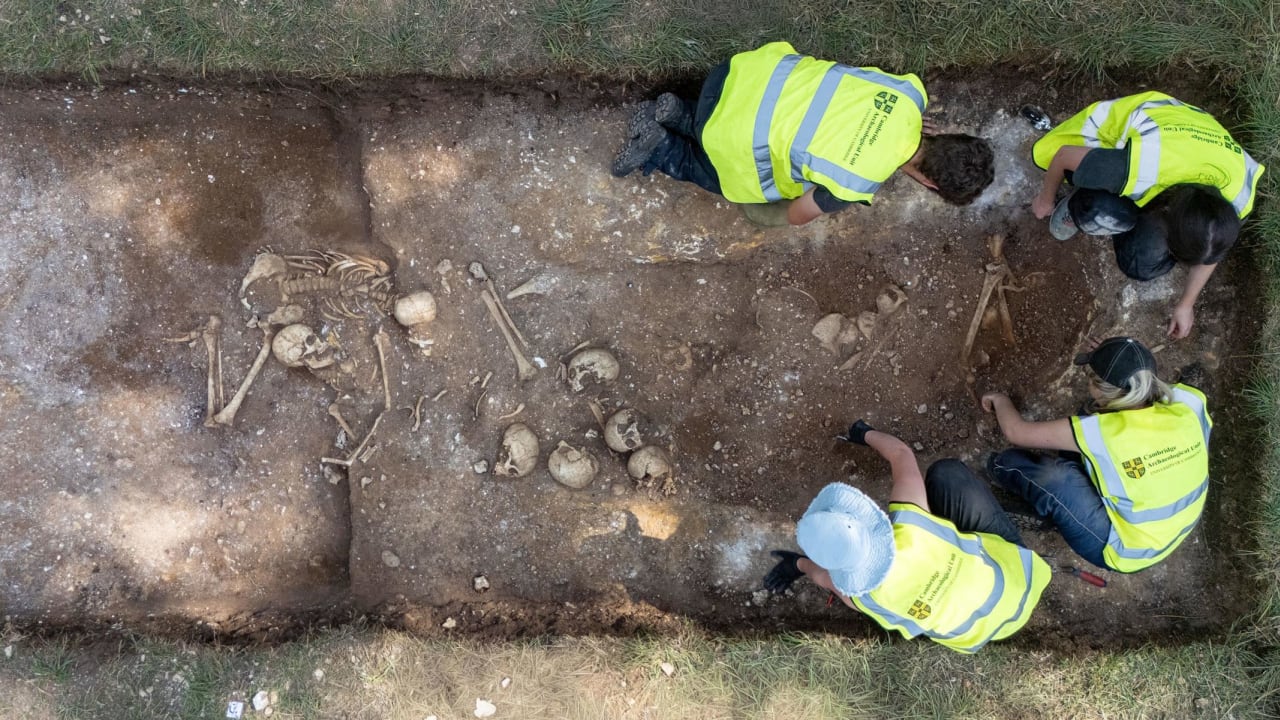
Cambridge University archaeologists and students discover 9th century CE mass burial pit during a training dig at Wandlebury Country Park on the outskirts of Cambridge, UK, February 4, 2026.
(photo credit: Cambridge Archaeological Unit/David Matzliach)
ByMIRIAM SELA-EITAM

A burial pit from the 9th century CE was discovered by Cambridge University archaeologists and students during a training dig, the university announced in an early February statement. 

The dig took place at Wandlebury Country Park on the outskirts of Cambridge, and was led by Dr. Oscar Aldred from the Cambridge Archaeological Unit (CAU).

The pit is believed to have been from a time of conflict “between the Saxon-run kingdom of Mercia and the kingdom of East Anglia, which was conquered by the Vikings in around 870 [CE],” the statement explained.

Archaeologists surmised that the pit contained the remains of at least 10 people, but only four complete skeletons “in positions suggesting they were tied up.”

In addition, the remains also included a decapitation, and “a man well over six foot in stature – extremely tall for the time – with a trepanned head.”

Trepanned skull, found during a training dig by Cambridge University archaeologists and students at Wandlebury Country Park on the outskirts of Cambridge, UK, February 4, 2026.
Trepanned skull, found during a training dig by Cambridge University archaeologists and students at Wandlebury Country Park on the outskirts of Cambridge, UK, February 4, 2026. (credit: Cambridge Archaeological Unit/David Matzliach)

Trepanning is an ancient surgical procedure, where medical practitioners would drill a hole through a living human’s skull, to treat intracranial diseases or release pressure.

Curator of the Duckworth Collections at Cambridge University Dr. Trish Biers theorized that the man’s height could have been due to a tumor affecting his “pituitary gland and caused an excess of growth hormones.” 

Biers further noted that if that were the case, the individual would have been plagued with headaches “that the trepanning may have been an attempt to alleviate.”

Other remains belonged to young men aged 17-24

The remaining bones included “a cluster of skulls without clear accompanying bodies and a ‘stack of legs,’ which researchers will attempt to “refit” in order to confirm the number of remains. 

Archaeologists ruled the remains as belonging to young men between the ages of 17-24, who were thrown into the pit “without care,” but noted that there isn’t enough evidence to suggest that the remains were victims of battle.

“Those buried could have been recipients of corporal punishment, and that may be connected to Wandlebury as a sacred or well-known meeting place,” Aldred explained, noting that the assorted body parts may have been “displayed as trophies” before being gathered up into the pit.

“We don’t see much evidence for the deliberate chopping up of some of these body parts, so they may have been in a state of decomposition and literally falling apart when they went into the pit.”

“I would never have expected to find something like this on a student training dig. It was a shocking contrast to the peaceful site of Wandlebury,” Grace Grandfield, a Cambridge undergraduate who took part in the dig, said.

“Several of the individuals we uncovered were a similar age to me, and it was a sobering experience to identify ever more disarticulated bones and realize the extent of the suffering that had taken place.”

“I had never encountered human remains on a dig, and I was struck by how close yet distant these people felt,” third-year archaeology undergraduate Olivia Courtney echoed. “We were separated by only a few years in age, but over a thousand years in time.”

Follow us on Google


